
Introduction to History and Sources

Introduction to History and Sources

Before jumping straight into dates, kings, and wars, it is important to understand what history actually is and how we know what happened thousands of years ago. We cannot just guess past events—everything we study comes from hard evidence left behind in rocks, buried cities, old coins, and handwritten texts.
This post covers the basics: where the word history comes from, geological time scale & epochs, historic dating systems, how historians divide past ages, and the exact sources we use to piece the past together.
WhatsApp Group
Join Now
Telegram Channel
Join Now

1. Meaning and Origin of History

  • Where the word comes from: The word History comes from the ancient Greek word “Historia”, which simply means “learning or finding out by asking questions and investigating.” It is not just about memorizing stories; it is about looking for facts and proof.

What does the word History originate from - Greek Historia
  • Herodotus (The Father of History): The ancient Greek historian Herodotus (c. 484 – 425 BC) was the very first historian to write down past events by traveling, interviewing eye-witnesses, and checking facts instead of blaming everything on myths and gods. Because of his book The Histories, we call him the “Father of History.”
  • How Famous Thinkers Defined History:
    • E.H. Carr: Described history as an “unending conversation between the present and the past.” What we ask today decides what we look for in the past.
    • Leopold von Ranke: Insisted that historians must show the past “strictly as it actually happened,” without making up stories or guessing.

2. Historic System of Dating (Timeline, Geological Eras & Calendars)

  • Understanding the Basic Dating Terms (BC, BCE, AD, CE):
    • BC (Before Christ) or BCE (Before Common Era): This covers all the time before the birth of Jesus Christ. The key thing to remember is that BC dates count backwards towards zero. For example, 500 BC happened earlier in time than 200 BC.
    • AD (Anno Domini) or CE (Common Era): Anno Domini is a Latin phrase meaning “in the year of our Lord.” These dates count forward normally, starting from year 1 up to today.
    • BP (Before Present): Archaeologists use this when testing old bones or charcoal in labs. To keep things uniform worldwide, “Present” is fixed to the year 1950 AD.
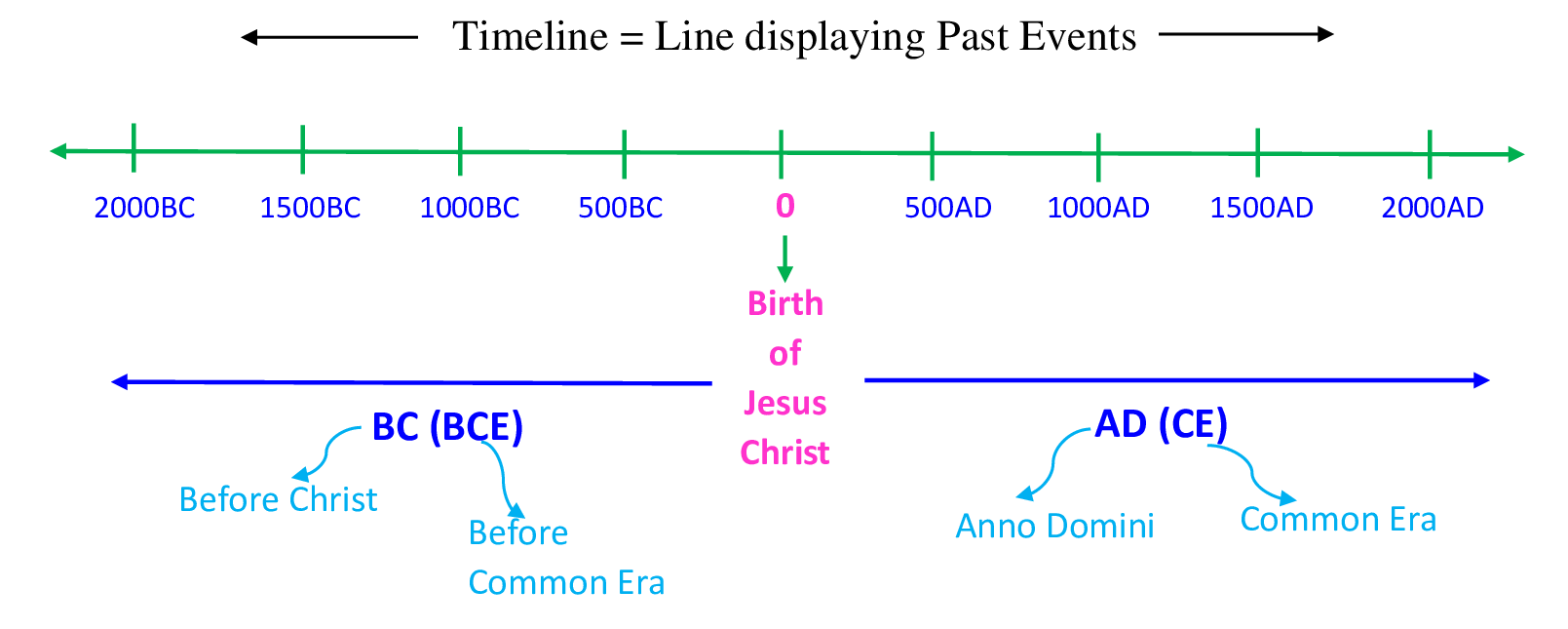
Timeline of Past Events - BC, BCE, AD, CE Breakdown
  • Geological Eras & Epochs of Earth and Human Evolution:
    • Precambrian Era (4.6 Billion – 541 Million Years Ago): Formation of Earth and earliest primitive microscopic life.
    • Palaeozoic Era (541 – 252 Million Years Ago): Ancient life period; explosion of marine life, early plants, fish, and amphibians.
    • Mesozoic Era (252 – 66 Million Years Ago): The Age of Reptiles (Dinosaurs) and early birds.
    • Cenozoic Era (66 Million Years Ago – Present): The Age of Mammals. Humans evolved in the latest period (Quaternary Period) of this era, which is divided into two vital epochs:
      • Pleistocene Epoch (Ice Age | c. 2.6 Million – 10,000 BCE): Extreme cold and global glaciers. Earliest humans evolved and lived as nomadic Palaeolithic hunter-gatherers using crude stone tools.
      • Holocene Epoch (Warm Post-Ice Age | c. 10,000 BCE – Present): Melting ice sheets and stable warm climate triggered the Mesolithic and Neolithic revolutions (domestication of animals, agriculture, and permanent human civilisations).
  • Important Historical Eras and Calendars Used in India:
    • Vikram Samvat (57 BC): Started by King Vikramaditya of Ujjain after defeating the Shaka invaders. It is still widely used in traditional Indian cultural calendars.
    • Shaka Samvat (78 AD): Started by Kushan King Kanishka I upon ascending the throne. The Government of India adopted it as the official National Civil Calendar in 1957.
    • Gupta Era (319–320 AD): Commenced by Chandragupta I to mark the rise of the imperial Gupta Empire.
    • Harsha Era (606 AD): Founded by King Harshavardhana of Kannauj upon his accession.
    • Hijri Era (622 AD): The lunar Islamic calendar, commencing from the year of Prophet Muhammad’s migration (Hijrah) from Mecca to Medina.

3. Scientific Methods of Dating in History
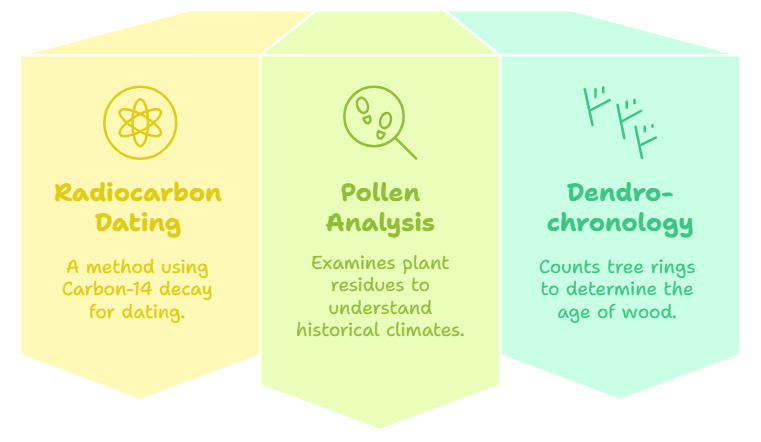
Scientific Dating Methods in History - C14, Pollen, Dendrochronology
  • Radiocarbon Dating (C-14 / 14C): All living things absorb Carbon-14 while alive. Once a plant or animal dies, this carbon starts breaking down at a steady speed (its half-life is 5,730 years). By measuring how much Carbon-14 is left in an old piece of wood, bone, or charcoal, scientists can tell its age up to roughly 50,000 years.
  • Pollen Analysis (Palynology): Tiny pollen grains from ancient plants get trapped in lake mud and soil for thousands of years without rotting. Studying them under a microscope tells us what the climate was like, how much it rained, and when early humans started farming.
  • Dendrochronology (Tree-Ring Dating): Trees grow a new ring inside their trunk every year. Thick rings mean good rainy seasons, while thin rings show droughts. By matching ring patterns from old wooden beams, experts can pinpoint the exact year a tree was cut down.
  • Thermoluminescence (TL Dating): When clay is baked into pottery or bricks in a kiln, the heat clears out all trapped radiation. Over centuries, it slowly traps radiation again. Reheating a piece in a lab releases this energy as light, revealing exactly when that pot was made.
  • Stratigraphy: In any archaeological dig, the deepest layers of soil are naturally the oldest, and the top layers are the newest. This gives a clear step-by-step timeline of who lived there first.

4. Detailed Classification of Sources of History

We cannot talk to people from thousands of years ago, so historians rely on two main types of evidence: Archaeological Sources and Literary Sources.
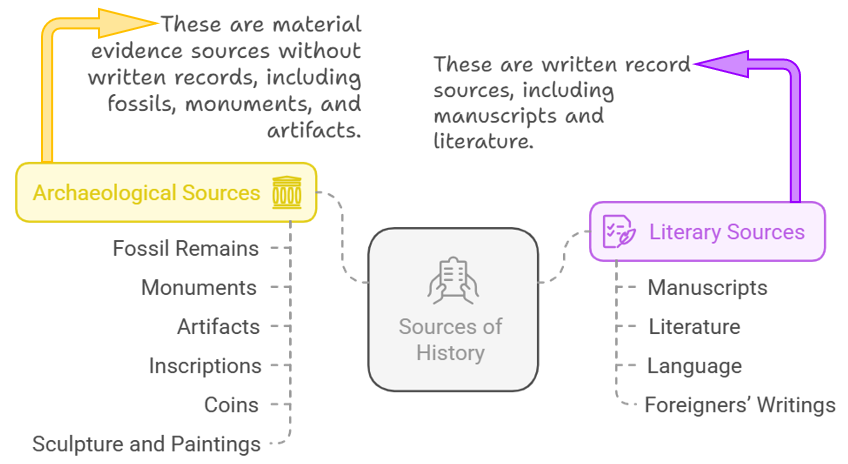
Sources of History Mind Map - Archaeological vs Literary

A. Archaeological Sources (Physical Clues)

  • Fossil Remains: Ancient human and animal bones that show physical evolution, diet, diseases, and how early humans adapted to their surroundings.
  • Monuments and Buildings: Old caves (Ajanta, Ellora), stupas (Sanchi), and stone temples. They show which kings had the money and power to build them, what tools they used, and which religions they supported.
  • Artifacts and Pottery: Everyday items like stone axes, beads, toys, and clay pots. Different periods used different styles of pottery—like Painted Grey Ware (PGW) in the Vedic age and shiny Northern Black Polished Ware (NBPW) in the Mauryan age. Finding these helps date an entire site.
  • Inscriptions (Epigraphy): Writings carved into rocks, pillars, and temple walls. Inscriptions are very reliable because once carved in stone, they cannot be edited easily later on:
    • Ashoka’s Edicts: Emperor Ashoka carved his royal orders and teachings of Dhamma across India. James Prinsep first decoded this script in 1837.
    • Prashastis (Court Tributes): Inscriptions written by court poets praising their kings, like Harishena’s Prayag Prashasti for Samudragupta.
    • Copper Plates (Tamrapatra): Metal sheets given as legal ownership proof when kings gifted tax-free land to priests or temples.
  • Coins (Numismatics): Coins tell us who was ruling, what gods they worshipped, and how rich their kingdom was:
    • Punch-Marked Coins: India’s oldest silver and copper coins, stamped with tree and animal symbols without any king’s name.
    • Indo-Greek Coins: The first coins in India that showed the actual face and name of the ruling king.
    • Gold Coins of Kushans and Guptas: Pure gold coins that prove brisk international trade along the Silk Route.

B. Literary Sources (Written Records)

  • Religious Books: The Vedas, Upanishads, Buddhist Tripitakas, Jataka stories, and Jain Agamas. Even though they are religious, they tell us a lot about social customs, village life, and caste rules of their time.
  • Secular Books: Books on politics and laws like Kautilya’s Arthashastra, grammar books like Panini’s Ashtadhyayi, and plays written by Kalidasa.
  • Historical Biographies & Chronicles: Books written about specific kings, like Banabhatta’s Harshacharita. The most genuine historical chronicle is Kalhana’s Rajatarangini (12th Century AD), which recorded the history of Kashmiri kings after cross-checking older documents.
  • Foreign Travel Accounts: Foreigners visiting India wrote down what they saw with fresh eyes:
    • Greek Accounts: Megasthenes wrote Indica while visiting the Mauryan court of Chandragupta.
    • Chinese Pilgrims: Faxian (Fa-Hien) visited during the Gupta rule, and Xuanzang (Hiuen Tsang) studied at Nalanda during King Harsha’s time.
    • Arab Travelers: Al-Biruni wrote Kitab-ul-Hind, giving deep details about Indian science, religion, and society in the 11th century.

5. Periods of History (Based on Available Evidence)

Historians divide human history into three main stages based purely on what kind of evidence we have:
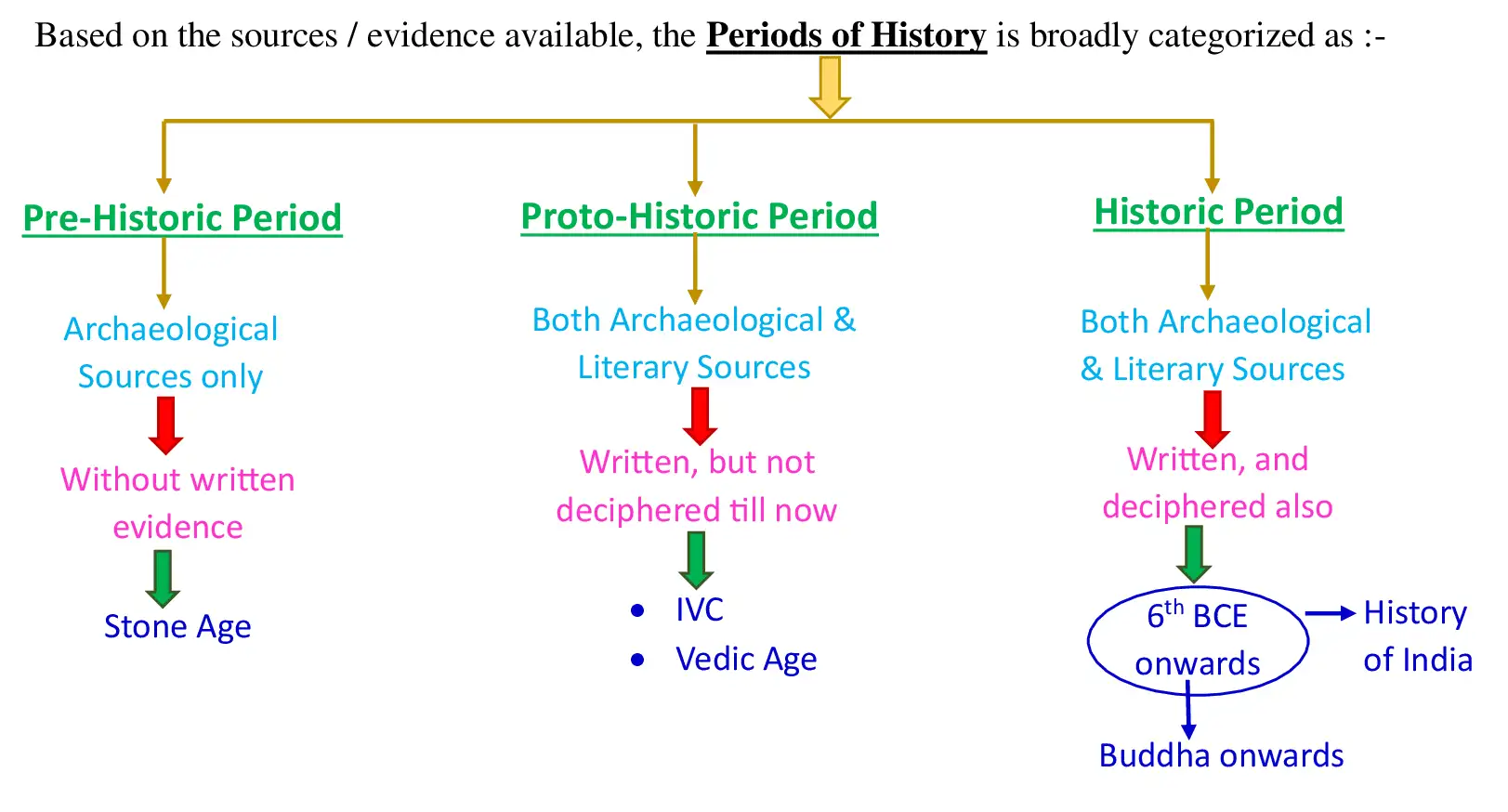
Periods of History Categorization Chart
  • 1. Pre-Historic Period (No Writing):
    • What it means: Humans did not know how to write at all. We have only archaeological evidence (stone tools, bones, cave paintings).
    • Examples: The entire Stone Age—Palaeolithic, Mesolithic, and Neolithic periods (like Bhimbetka caves and Mehrgarh).
  • 2. Proto-Historic Period (Writing Exists, But Cannot Be Read):
    • What it means: People knew how to write, but we have not been able to decipher their script yet. Or, a period with rich oral literature but no contemporary written inscriptions.
    • Examples:
      • Indus Valley Civilization (IVC): Harappans left thousands of written seals, but no one has cracked their script yet.
      • Vedic Period: The Vedas were composed and passed down purely by memory and speech, with no physical inscriptions surviving from that time.
  • 3. Historic Period (Writing Exists and Can Be Read):
    • What it means: We have written records, books, and stone inscriptions that historians can clearly read and understand alongside physical artifacts.
    • Examples: Starts from the 6th Century BCE onwards (the time of Gautam Buddha, Mahavira, the 16 Mahajanapadas, Mauryan Empire, and everything after).
WhatsApp Channel
Follow Now

Topic-Dedicated Practice MCQs for Prelims

Q1. The term “Historia”, from which the word “History” is derived, originates from which language and means what?
  • a) Latin, meaning ‘tales of the ancestors’
  • b) Greek, meaning ‘inquiry or knowledge acquired by investigation’
  • c) Sanskrit, meaning ‘traditional lore’
  • d) French, meaning ‘chronological narration’
Show / Hide Answer
Answer: (b) Greek, meaning ‘inquiry or knowledge acquired by investigation’
Explanation:
  • Historia is an ancient Greek word that means asking questions and investigating facts rather than believing myths.
  • Herodotus used this inquiry method in the 5th Century BC to record real human events.

Thus, the correct answer is (b).

Q2. Which historical era founded in 78 AD was officially adopted by the Government of India as the National Civil Calendar?
  • a) Vikram Samvat
  • b) Shaka Samvat
  • c) Gupta Era
  • d) Harsha Era
Show / Hide Answer
Answer: (b) Shaka Samvat
Explanation:
  • Shaka Samvat (78 AD) was started by the Kushan King Kanishka I when he took the throne.
  • India adopted it as our official National Civil Calendar on 22 March 1957.
  • Vikram Samvat (57 BC) was started earlier by King Vikramaditya.

Thus, the correct answer is (b) Shaka Samvat.

Q3. Which scientific dating technique is specifically used to date ancient wooden structures and calibrate radiocarbon curves by counting annual growth rings?
  • a) Palynology
  • b) Thermoluminescence
  • c) Dendrochronology
  • d) Stratigraphy
Show / Hide Answer
Answer: (c) Dendrochronology
Explanation:
  • Dendrochronology is the science of dating wood by counting and matching tree rings.
  • Palynology studies ancient pollen to understand past weather and plant life.
  • Thermoluminescence is used to date baked clay and pottery.

Thus, the correct answer is (c) Dendrochronology.

Q4. Which isotope’s radioactive decay is measured in Radiocarbon Dating to determine the age of organic archaeological finds up to ~50,000 years?
  • a) Carbon-12
  • b) Carbon-14
  • c) Potassium-40
  • d) Uranium-235
Show / Hide Answer
Answer: (b) Carbon-14
Explanation:
  • Carbon-14 (C-14 / 14C) decays steadily over time with a half-life of 5,730 years.
  • When an organism dies, it stops taking in carbon, allowing scientists to measure the remaining C-14 to calculate its age.

Thus, the correct answer is (b) Carbon-14.

Q5. Thermoluminescence (TL) dating is most reliably applied to determine the age of which archaeological material?
  • a) Unburnt wooden shafts
  • b) Kiln-burnt pottery and terracotta artifacts
  • c) Fossilized animal skeletons
  • d) Gold and silver coins
Show / Hide Answer
Answer: (b) Kiln-burnt pottery and terracotta artifacts
Explanation:
  • Thermoluminescence (TL) measures trapped radiation inside minerals that gets released when heated.
  • Since baking in a kiln resets this clock to zero, it is the best method for dating pottery, bricks, and terracotta.

Thus, the correct answer is (b).

Q6. Under which period of history is the Indus Valley Civilization classified, and why?
  • a) Pre-Historic Period, because no city walls were found
  • b) Proto-Historic Period, because its script exists but is not yet deciphered
  • c) Historic Period, because it had wide trade networks
  • d) Ancient Period, because it was a Bronze Age culture
Show / Hide Answer
Answer: (b) Proto-Historic Period, because its script exists but is not yet deciphered
Explanation:
  • Proto-Historic means people had a writing system, but modern scholars cannot read it yet.
  • The Harappans left writing on thousands of seals, but because it is undeciphered, we rely entirely on archaeological findings.

Thus, the correct answer is (b).

Q7. The Historic Period in Indian history is broadly considered to begin from which century onwards?
  • a) 3rd Century BC (Mauryan period)
  • b) 6th Century BC (Era of Buddha and Mahajanapadas)
  • c) 4th Century AD (Gupta period)
  • d) 1500 BC (Early Vedic period)
Show / Hide Answer
Answer: (b) 6th Century BC (Era of Buddha and Mahajanapadas)
Explanation:
  • India’s Historic Period begins around the 6th Century BCE.
  • This is when the 16 Mahajanapadas formed, Gautam Buddha lived, and we get readable written sources along with archaeological finds.

Thus, the correct answer is (b).

Q8. Which of the following is considered an Epigraphic source of history?
  • a) Kalidasa’s play Abhijnanashakuntalam
  • b) The Junagadh Rock Inscription of Rudradaman
  • c) Punch-Marked Silver Coins
  • d) Megasthenes’ book Indica
Show / Hide Answer
Answer: (b) The Junagadh Rock Inscription of Rudradaman
Explanation:
  • Epigraphy is the study of writings carved on rocks, pillars, or metal plates. The Junagadh Rock Inscription (150 AD) is a classic example.
  • Coins fall under Numismatics, while books and plays belong to Literary sources.

Thus, the correct answer is (b).

Q9. Which dynasty in ancient India was the first to issue coins carrying the portraits, names, and titles of kings?
  • a) Mauryas
  • b) Indo-Greeks
  • c) Guptas
  • d) Satavahanas
Show / Hide Answer
Answer: (b) Indo-Greeks
Explanation:
  • Indo-Greek rulers (2nd Century BC) were the first to mint coins with the king’s face, title, and name in Greek and Kharosthi scripts.
  • Older punch-marked coins carried only stamped geometric or animal symbols.

Thus, the correct answer is (b) Indo-Greeks.

Q10. Kalhana’s 12th-century text “Rajatarangini” is celebrated in Indian historiography primarily because:
  • a) It is the oldest surviving religious epic in Sanskrit
  • b) It is the earliest text to adhere to critical methods of historical inquiry and cross-verify prior records
  • c) It contains the first foreign traveler account of South India
  • d) It describes the administrative statecraft of Chandragupta Maurya
Show / Hide Answer
Answer: (b) It is the earliest text to adhere to critical methods of historical inquiry and cross-verify prior records
Explanation:
  • Rajatarangini (River of Kings) was written by Kalhana in 1148–1150 AD to chronicle Kashmir’s history.
  • Instead of blindly praising kings, Kalhana checked 11 older books, verified stone inscriptions, coins, and land charters, making it India’s first genuine historical text.

Thus, the correct answer is (b).

Mains Practice Questions with Ideal Model Answers

GS Paper-1 | 10 Marks (150 Words)

Q1. Clearly differentiate between Pre-history, Proto-history, and History. Illustrate how material archaeological remains form the primary foundation for reconstructing Proto-historic India.

Introduction:

Historians divide the human past into three distinct phases based on whether ancient people left written records and whether modern scholars can read them today.

1. The Three Periods of History:
  • Pre-History (c. 2 Million BC – 2500 BC): No writing existed. We understand this period solely through physical objects like stone tools, fossils, and cave art (e.g., Palaeolithic, Mesolithic, and Neolithic Stone Ages).
  • Proto-History (c. 2500 BC – 600 BC): Writing existed but is undeciphered (Indus Valley Civilization), or literature was preserved orally without contemporary stone inscriptions (Vedic Period).
  • History (c. 600 BC onwards): Periods backed by readable written texts, stone inscriptions, and coins alongside physical remains (e.g., Mahajanapadas and Mauryan Empire).
2. Why Archaeology is the Backbone of Proto-Historic India:
  • City Planning & Engineering: Because Harappan script cannot be read, excavations at Mohenjo-Daro, Harappa, and Dholavira provide our only direct proof of their grid-planned streets, covered brick drains, and large water reservoirs.
  • Pottery Sequences: Changing pottery styles—like Ochre Coloured Pottery (OCP) and Painted Grey Ware (PGW)—help trace how people shifted from Bronze Age settlements to iron-using Vedic farming communities.
  • Trade and Daily Life: Steatite seals showing animals and chert weights show organized trade, while the dockyard found at Lothal proves maritime sea trade with Mesopotamia.
Conclusion:

Without readable written records, scientific excavations and material artifacts remain our only reliable guide to understanding Proto-historic India.

GS Paper-1 | 15 Marks (250 Words)

Q2. “Archaeological, epigraphic, and numismatic sources provide an objective anchor to historical reconstruction that literature alone cannot provide.” Critically analyze with suitable examples from ancient India.

Introduction:

Ancient books and poems offer deep cultural details, but they often suffer from court flattery, mythological storytelling, and changes made by later copyists. Physical evidence—inscriptions, coins, and excavated ruins—gives us solid, unchangeable facts that anchor the timeline.

1. Inscriptions: Permanent and Reliable Records:
  • Unfiltered Royal Policies: Ashoka’s Rock and Pillar Edicts give direct, firsthand accounts of his governance and Dhamma. Without these physical pillars, Ashoka might have been remembered only through exaggerated religious stories.
  • Verifying Military Conquests: The Prayag Prashasti on the Allahabad Pillar outlines Samudragupta’s exact military campaigns, while the Aihole Inscription records Pulakeshin II stopping King Harsha’s march south—a major defeat that Harsha’s court poet Banabhatta completely skipped in his book.
2. Coins: The True Test of Economy and Dynasties:
  • Rediscovering Forgotten Rulers: Over thirty Indo-Greek kings who ruled northwestern India are known to history almost entirely because their names and faces were stamped on bilingual coins.
  • Tracking Trade and Economic Health: Large finds of pure gold coins from the Kushan and Gupta eras prove strong international trade along the Silk Route. When later Gupta coins started mixing cheaper metals, it directly revealed economic decline and shrinking trade.
3. Archaeology: Showing the Lives of Ordinary People:
  • Ancient literature mostly focused on kings, queens, and court elites. Excavations of mud houses, cooking pots, animal bones, and farming tools show how common farmers, potters, and craftsmen actually lived day to day.
4. Limitations to Keep in Mind:
  • Physical evidence has its own challenges: stone inscriptions written by royal order rarely mention defeats, and coins can travel far from their original mint through trade, which can mislead historians if not cross-checked.
Conclusion:

We cannot rely on written texts alone. The most accurate history comes from testing literary stories against tangible stones, coins, and archaeological excavations.

Introduction to History & Sources PDF

✓ Free Download • Printable Notes
Download PDF
Introduction to History and Sources

IVC Part-2

IVC Part-2

In this post of “IVC Part-2”, we will discuss about the Agriculture & Allied activities of the Harappans, Socio-religious aspects of Harappa, etc.

Topics to be covered in this Article :-

  • Agriculture & Allied activities of the Harappans
  • The Socio-Religious aspects of Harappa
  • Decline of the Harappans


Agriculture & Allied activities of the Harappans

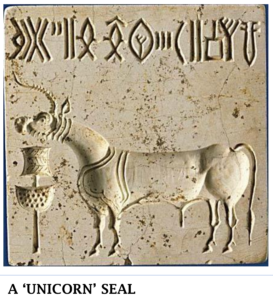
The sources to know about the agriculture and allied activities of the Harappans are mainly – the Seals and the Pottery.

Sources :- Seals and Pottery

Unicorn Seal
Image Credit : https://www.harappa.com/blog/seals-and-sodalities
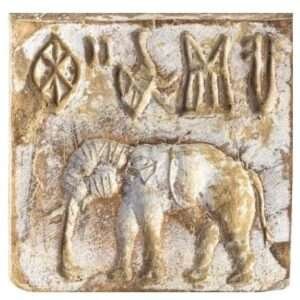
Elephant Seal
Image Credit : https://benedante.blogspot.com/

•(1). The Harappans used to also practice agriculture to support not only villagers, but also urban dwellers.

•(2). The evidences of ploughfield from Kalibangan and the evidences of the Teracotta model of plough from Banawali are sufficient to indicate their agrarian practice. However, there is no evidence of wooden plough of the Harappans.

•(3). Irrigation was practiced but not through Canal System. Unlike the Mesopotamians, the Harappans used to irrigate the land through wells and river waters.

•(4). We have found some evidences of a rudimentary level of irrigation through Canal System at Shortughai and Lothal.

•(5). The knowledge of water management and rain-water harvesting has been found from the site Dholavira (in Runn of Kutch) in Gujarat (Kadir island).

•(6). Dholavira has shown a unique system of water harvesting and water management in the form of small dams construction.

•(7). From Dholavira site, the biggest signboard having a longest script of the Harappans has been found and lastly the stone monuments found from Dholavira are the exception among the all Harappan sites.

•(8). The Harappans had the knowledge of various animals and crops such as elephant, camel, tiger, Rhinos, Bulls and even Unicorn (a mythical animal). However, the Harappans have not shown a considerable evidence of their knowledge and utility of cows and horses.

•(9). From the sites of Surkotada, kuntasi etc., the remnants of Horse like animal has been found off the Late Harappan phase.

•(10). Harappans were perhaps the first to produce cotton and using the cotton textiles in the world. Therefore, in the Greek writing, the word “Sindon” has been used for cotton produced in the Indian Subcontinent for various centuries.

•(11). The Harappans also used to produce the crops like wheat, Barley, Rice, Pulses, Vegetables etc. Meat consumption was also common in their diet.


The Socio-Religious Aspects of Harappa

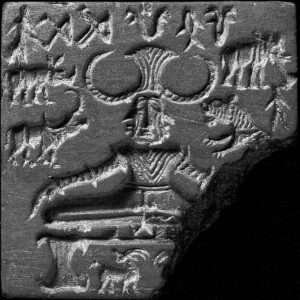
Priest King
Image Credit : https://twitter.com/abdaal/status/1618680968155652096
Pashupati Seal
Image Credit : https://mapacademy.io/article/pashupati-seal/
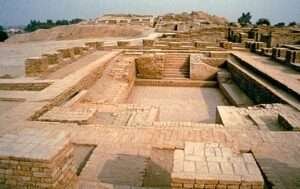
Great Bath
Image Credit : https://www.harappa.com/slide/great-bath-mohenjo-daro-0

•(1). According to some Scholars, the Harappan Society was not egalitarian (not equal). However, the Merchant or Priestly class must have been the dominant players in the Harappan society. For e.g. :— In Mesopotamia, the Priestly Class was the dominant section of the society.

•(2). The evidences from the Harappan sites such as Harappa, Lothal, Mohenjodaro etc. have shown the evidences of Granaries for food stocks and at the same time, small quarters made for the labourers or workers or slaves may have been also used by the Harappans.

•(3). The emergence of Hindu-Religious practices can also be traced from the Harappan times. For e.g. :—
→a). The worshipping of Pashupati Cult is traced from the seal found from Mohenjodaro by John Marshall.
→b). The worshipping of Mother Goddess in the form of Teracotta figurines also began by the Harappans.
→c). The worshipping of plants, trees and animals like Peepal tree, Shami tree and Snakes also began by the Harappans.
→d). The use of Fire-altars found from the sites like Kalibangan, Lothal, Banawali etc. again indicate the differences in their practices within the vast area of Harappan culture because Fire-altar has not been found from any Harappan site.
→e). Unlike the Mesopotamians and Egyptians, no temple has been found from the Harappan site except the Great Bath of Mohenjodaro perhaps used for Religious Ablutions (bathing).


Decline of the Harappans

→1). The Population Growth theory
→2). The Climatic Changes theory
→3). The shifting of river waters – causing frequent floods.
→4). Dryness of rivers due to Geological factors
→5). Aryan Invasion theory

The decline of Harappa has to be understood in the backdrop of the following theories given by various scholars such as :—

•(1). Fairservis has given the theory of Population Growth causing pressure on the resources of the Harappans.

•(2). Similarly, Allchin & Allchin has given the theory of Climatic Changes and causing the decline of the Harappans. The Harappans used the baked bricks on a massive scale indicating they must have used the forest products for burning the mud bricks. Hence, compromising the ecological balance of the area.

•(3). H.T. Lambrick has given the theory of shifting of river-course of river Indus behind the flooding of Mohenjodaro and Chanhudaro cities of Harappa. Since, Mohenjodaro being the capital of Harappa was destroyed multiple times due to floodings. Therefore, a centralised control over the Harappan Cities may have been lost completely.

•(4). The dryness of the river water of Ghaggar and Hakra (ancient Saraswati) caused due to the geological factors adversely affected the majority of the Harappan cities. The natural factors such as earthquake, rock-faulting, lack/ failure of monsoon etc. also contributed in the decline of the Harappans.

•(5). The most controversial theory regarding the decline of Harappans is the Aryan Invasion theory. Ram Prasad Chanda was the first scholar who gave this theory in 1920s and subsequently withdrew his theory as well.

•(6). However the scholars like V. Gorden Childe and Mortimer Wheeler have popularized the Aryan Invasion theory on the basis of following factors :—
→ (i) God Indra in Rigveda has also been called as “Purandara” that means “destroyer of forts”.

→ (ii) Battle of Hariyupia is mentioned in Rigveda fought between the Aryans and non-Aryans who have been identified as the Harappans by these scholars.

→ (iii) The existence of Cemetry-H culture on the southwest of Harappa belong to an alien people who may have destroyed the Harappans. However, this theory is rejected by the modern Historians like P.V. Kane, B.B. Lal, George F. Dales. According to them, there is no evidence of attack of Aryans upon the Harappans. Secondly, there is a difference of more than 200 years between the decline of Harappa and the origin of Aryans in India and Thirdly, there was no any Sudden end of Harappans, rather there are evidences of the overlap of the Harappan and other cultures between 1800 to 1500 BCE as well. For e.g. :— Bargaon & Ambakheri villages of UP have shown the evidences of the existence of the OCP (Ochre-Coloured Pottery) culture with the Harappan culture. Similarly, from Bhagwanpura, Dadheri, Katpaloan sites found in Punjab have shown the evidence of the co-existence of PGW (Painted Grey-Ware) cultures with the Harappan people. Hence, it was the Harappan Civilization which declined but their culture continued with some changes to the present generation such as Pashupati cult wearing of Bangles.


Class Quiz

Q1. Which of the following sites has yielded evidences of double burial?
a) Kuntasi
b) Dholavira
c) Lothal
d) Kalibangan

Q2. Match list-I with list-II and select the correct answer by using the code given below:-
list-I (Harappan Settlement)        list-II (River on which located)
A. Harappa                                  1. Bhogawati
B. Kalibangan                              2. Ghaggar
C. Lothal                                      3. Ravi
D. Ropar                                      4. SutlejMaharashtra

Codes:-
a) A-3, B-2, C-1, D-4
b) A-3, B-4, C-1, D-2
c) A-4, B-2, C-3, D-1
d) A-1, B-3, C-2, D-4

Q3. What was the social organization of the Indus Valley Civilization believed to be?
a) Matriarchal
b) Patriarchal
c) Egalitarian
d) Caste-based

Q4. Which structure in Mohenjodaro is believed to have been used for public gatherings and religious ceremonies?
a) Granary
b) Great Bath
c) Citadel
d) Assembly Hall

Q5. Which of the following is NOT correctly matched?
a) Harappa – Daya Ram Sahni
b) Lothal – S.R.Rao
c) Surkotada – J.P. Joshi
d) Dholavira – B.K. Thapar

Q6. Famous bull-seal of Indus Valley Civilization was found from which site?
a) Harappa
b) Chanhudaro
c) Mohenjodaro
d) Both a and c

Q7. What is the term used to describe the distinctive pottery style of the Harappan Civilization?
a) Black Polished Ware
b) Red Ware
c) Painted Grey-Ware
d) Black-and-Red Ware

Q8. The decline of the Indus Valley Civilization (IVC) is attributed to:-
a) Invasion by foreign tribes
b) Climate change and ecological factors
c) Economic Collapse
d) All of the above

Q9. Which Harappan site is known for its dockyard and maritime trade?
a) Harappa
b) Mohenjodaro
c) Lothal
d) Kalibangan

Q10. What was the main crop cultivated by the Harappans?
a) Pulses
b) Rice
c) Barley
d) Millet


Some Important Links
History Class-4 YouTube Short VideoClick Here
Download History Class-4 PDFClick Here
If you are satisfied with our website iaspcsprep.com, Please like and share with more people.
Follow on InstagramFollow Now
Join WhatsApp Group for PDFJoin Now
For any Query and Feedback, Contact Us at – study@iaspcsprep.com.

History Class-4 IVC Part-2

Indus Valley Civilization (IVC)

Indus Valley Civilization (IVC)

In this post of “Indus Valley Civilization (IVC)”, we will discuss about the Harappan Civilization, Origin of Harappans, etc.

Harappan Civilization Topics
WhatsApp Group Join Now
Telegram Channel Join Now

The Harappan civilization, also known as the Indus Valley civilization, was one of the world’s earliest urban civilizations. Flourishing in the vast floodplains of the Indus River and its tributaries, the civilization emerged around 3300 BCE and thrived for nearly 2,000 years, until around 1300 BCE. Named after the modern-day city of Harappa in Pakistan, where its remains were first discovered, the Harappan civilization encompassed a large area extending from modern-day northeast Afghanistan to Pakistan and northwest India.

• (1). Born out of the womb of Indian Subcontinent in 1922, the sites of Harappa and Mohenjodaro were discovered by the scholars like Dayaram Sahni and Rakhal Das Banerjee respectively. However, John Marshall and Mortimer Wheeler also played a crucial role in the discovery and excavation  of the Harappan cites.

• (2). Since, Harappa was the first site excavated by the scholars, It has been named as the “Harappa Civilization”. In other words, Harappa was a type-site.

• (3). John Marshall had used the name “Indus Valley Civilization” due to the location of the Harappan sites mainly on river bank Indus. But after India’s Independence, various other sites of Harappa were excavated outside the river Indus mainly in the Ghaggar-Hakra river valley. Therefore, Current Government of India named it the Sindhu-Saraswati Civilization.

• (4). According to the Diffusionist theory, the Harappans were the migrants who came from the pockets of West Asia and settle down in the Indian Subcontinent. According to them, on the basis of Racial Study, the Harappans were divided into 4 races:-

  • (i) Mediterranean race
  • (ii) Mangoloids race
  • (iii) Proto – Australoids race
  • (iv) Alpines race

and majority of the Harappan belongs to the Mediterranean Race. However, the Diffusionist theory has been rejected by the Modern Historians regarding the origin of Harappa, it was long drawn process through which the Harappan Civilization emerged between 2600 BCE and 1900 BCE.

• (5). The Neolithic-Chalcolithic Cultures emerged in the Indian Subcontinent from C. 5000 BCE onwards in the form of the sites like Mehargarh, Saraikhola, Rahman-dheri etc. formed the basis for the emergence of pre-harappans and early-harappans in the Indian Subcontinent.

• (6). The pre-harappan and early-harappan cultures shared various cultural practices with continuity and change. Therefore, in the mature-harrapan phase many cultural practices of the early-harappans continued with some modifications.

• (7). Hence, under the above background. the Harappan Civilization emerged due to the strong-will and hard labour of the Harappans from 2600 BCE onwards.

• (8). The equation i.e. R1 + R2   +  R3 = Harappan Civilization well establishes the process of the emergence of Harappan civilization where  R1 stands for the perfect balance between the Harappan Cities and the villages in the surrounding whereas R2 stands for a balance between the city to city interaction within the Harappan territories and  R3 stands for a perfect relationship between the cities of Harappa with the other cities of contemporary civilizations as Mesopotamia (Irag), Sumeria (Gulf Nations), and Egyptian and Mycenean (Greek) civilizations.

♦♦ It is important to note here, as long as the Harappans were able to maintain a perfect balance between R1 , R2   and  R3, they prospered in the Indian Subcontinent, but when they compromised it, the decline of the Harappans was set-in.

Extent of Empire
Image Credit : https://www.quora.com/


The Extent of Empire and Urbanization

According to some scholars, the Harappans may have been an Empire because of the following reasons:-
•1). It was an extensive civilization extended from Sutkagendor in the west on the Makran Coast to Alamgirpur near Meerut of UP as the eastern point of the Harappans. Similarly, Manda in Kashmir and Daimabad in Maharashtra are the Northern and Southern-most point of the Harappans.

•2). Shortughai on the border of Afghanistan and Pakistan acted as the overland post of Harappa for trade and commerce. Hence, Harappans were extended to a vast area of 2.18 million square kilometers which is much bigger than the Egyptian Civilization and even today’s Pakistan.

•3). The level of Uniformity found in the bricks, seals, ceilings, weights and measures across the Harappan cities indicate a centralized control may have been exercised by some authority either it could be Priest or the king.

•4). However, Some Historians are are of the opinion that Harappans may have been controlled by some Mercantile class because of their engagement in the trade and commercial activities. For e.g.:- the Lothal Dockyard.

Lothal Dockyard
Image Credit : https://www.quora.com/


Map
Image Credit : https://www.quora.com/


•5). The most important contribution of Harappa to the modern civilization happens to be their urban characteristics such as:-
→ (A.) Their town planning used to consist of the main features like:-

  • (i) Fortification
  • (ii) laying down the town planning into forms:- (a) Citadel and; (b) lower towns.

     However, there are 2 exceptions:-

  • (a) Chanhudaro lacks Citadel.
  • (b) Dholavira has middle town in between.
  • (iii) Well-planned states designed on the Grid-pattern where normally the roads or states used to interact with each other at 90o.
  • (iv) The emphasis on cleanliness and hygiene by the Harappans were par excellence on the parameters of even the modern days.
  • (v) The construction of houses and buildings was designed upon the “English-bond” style under which the bricks were placed or
    laid down in a typical arrangement i.e. vertical along with horizontal bricks.

→ (B.) The urban pattern of Harappa was supported by their trade and commerce and the agricultural practices performed by the nearby villages. Even some harappan cities used to perform the practice of agriculture. For eg.:- Kalibangan in Rajasthan has shown the evidence of the ploughed field. Similarly, Lothal has shown the evidence of the Bazaar Street of the Harappa. Lothal and Mohenjodaro have been as the “Mound of the Dead” because of discovering the skeletons of the Harappans from these sites.

→ (C.) Because of their long-distance trade, the Harappan towns were able to prosper during 2600 BCE to 1900 BCE. For e.g.:- The inscription of the King Sargaon of Akkad dated 2350 BCE mentions the ships of Dilmun, Magan, and Meluhha used to dock on the parts of Ur, Kish, Nippur, Susa of the Mesopotamian Civilization.


Practice Question

Ques. The ancient civilization in Indian Sub-continent differed from those of Egypt, Mesopotamia and Greece that its culture and traditions have been preserved without a breakdown to the present day. Comment. (200 words) (2015)


Class Quiz

Q1. The Great Bath, found in the excavations of the Harappan city of Mohenjodaro, was likely used for:-
a) Religious rituals
b) Daily bathing
c) Agricultural irrigation
d) Cooking purposes

Q2. Match list-I with list-II and select the correct answer from the code given below:-
list-I (Harappan Site)        list-II (Location)
A. Manda                        1. Rajasthan
B. Daimabad                   2. Haryana
C. Kalibangan                 3. Jammu and Kashmir
D. Rakhigarhi                  4. Maharashtra

Codes:-
a) A-1, B-2, C-3, D-4
b) A-2, B-3, C-4, D-1
c) A-3, B-4, C-1, D-2
d) A-4, B-1, C-2, D-3

Q3. Ploughed field was discovered at which site?
a) Mohenjodaro
b) Kalibangan
c) Harappa
d) Lothal

Q4. What evidence suggests that Harappan society was well-organized?
a) Standardized weights and measures
b) Hierarchical social structure.
c) Strict caste system
d) Heavy taxation

Q5. Which of the following was NOT a feature of Harappan cities?
a) Well-planned streets
b) Advanced drainage system
c) Fortified walls
d) Pyramids

Q6. What was the primary material used for the construction of houses in Harappan cities?
a) Wood
b) Stone
c) Mud bricks
d) Concrete

Some Important Links
History Class-3 YouTube Short VideoClick Here
Download History Class-3 PDFClick Here
If you are satisfied with our website iaspcsprep.com, Please like and share with more people.
Follow on InstagramFollow Now
Join WhatsApp Group for PDFJoin Now
For any Query and Feedback, Contact Us at – study@iaspcsprep.com.
History Class-3 IVC Part-1


Pre-Historic Period

Pre-historic Period (Stone Age)

The Pre-historic Period constitutes over 99% of human existence on Earth, representing the extensive era before the invention of scripts and writing systems. In the Indian subcontinent, early human survival, cognitive evolution, and technology are traced exclusively through stone tool typology, fossil remains, cave paintings, and habitation debris.
This complete guide explores the three major divisions of the Stone Age—Palaeolithic, Mesolithic, and Neolithic—along with their tool traditions, rock art heritage, and crucial archaeological sites for UPSC & State PCS examinations.
WhatsApp Group
Join Now
Telegram Channel
Join Now

1. Introduction & Tripartite Classification of Stone Age

  • Definition of Pre-history: The era characterized by the complete absence of written records. All historical reconstructions rely on archaeological remains such as stone implements, bone tools, rock shelters, and fossil beds.
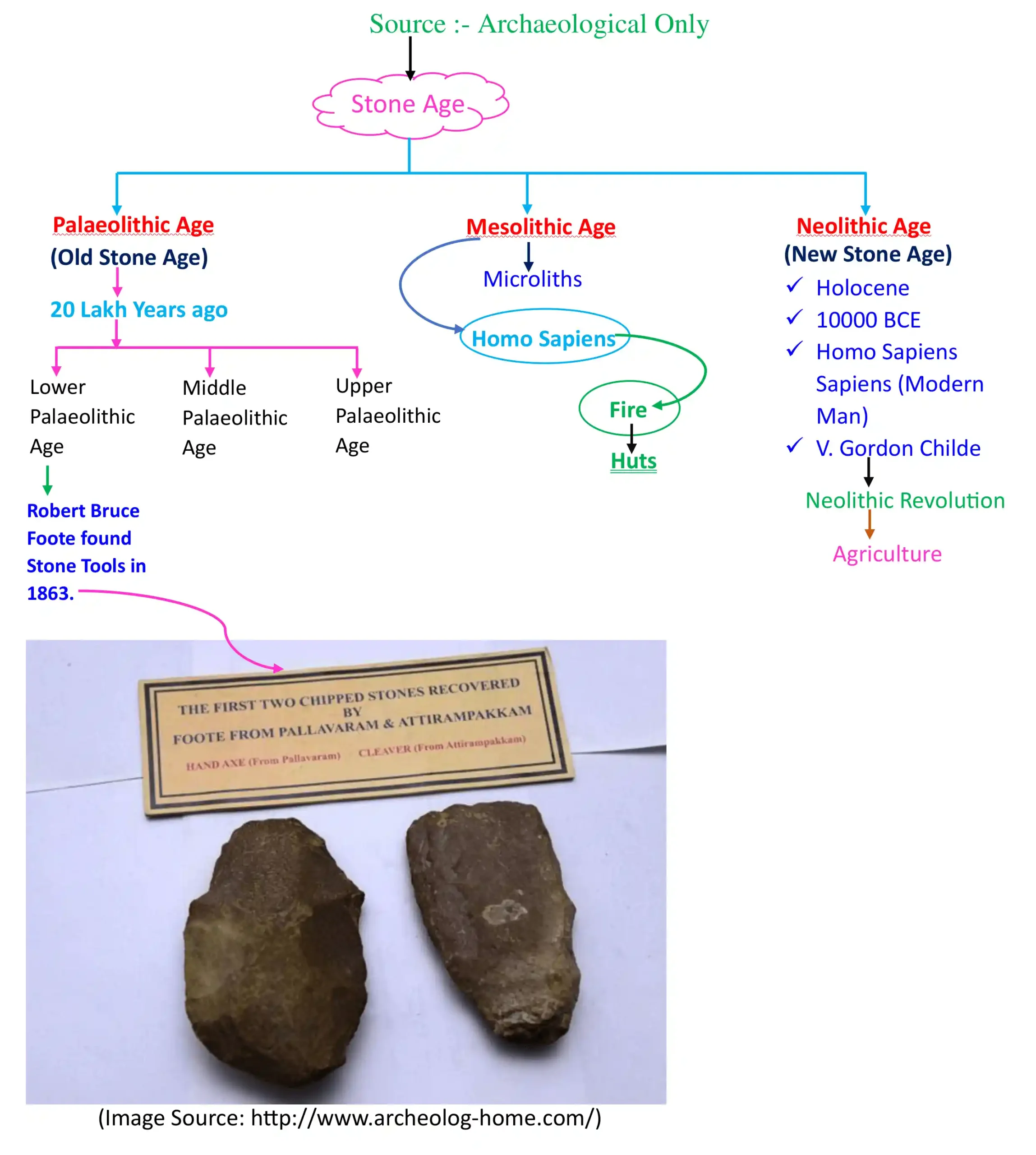
  • Pioneering Discoveries: Prehistoric archaeology in India began when Robert Bruce Foote discovered the first Palaeolithic tool—a quartzite handaxe—at Pallavaram near Madras (Chennai) in 1863. Foote is rightfully regarded as the “Father of Indian Pre-history.”
  • The Three-Age System: Danish scholar Christian Jürgensen Thomsen classified human antiquity into Stone, Bronze, and Iron ages. The Stone Age is further divided into three distinct phases based on geological epoch, climate, and tool technology:
    • Palaeolithic Age (Old Stone Age): c. 2 Million – 10,000 BCE (Pleistocene Epoch / Ice Age)
    • Mesolithic Age (Middle Stone Age / Late Stone Age): c. 10,000 – 6,000 BCE (Holocene Epoch / Warm Climate)
    • Neolithic Age (New Stone Age): c. 6,000 – 1,000 BCE (Food production & settled life)
Classification of Stone Age in India

2. Palaeolithic Age (Old Stone Age | c. 2 Million – 10,000 BCE)

The Palaeolithic Age in India developed during the Pleistocene Epoch (Ice Age). Early humans lived as nomadic hunter-gatherers, possessed no knowledge of agriculture, pottery, or metal, and made heavy tools out of hard rock called Quartzite (earning them the title “Quartzite Men”).

  • A. Lower Palaeolithic (c. 2 Million – 100,000 BCE):
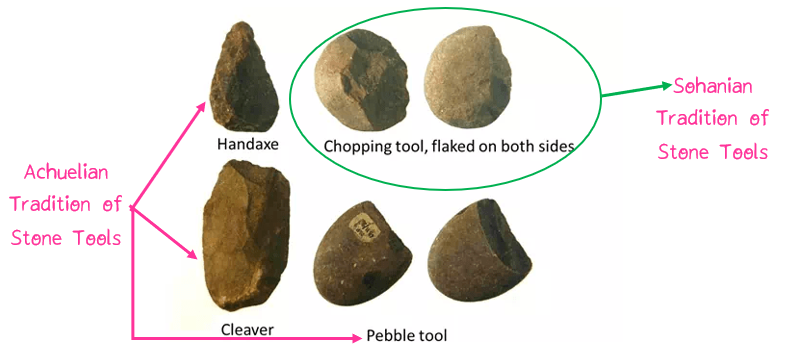
    • Tool Types: Large core tools made by pebble flaking—Handaxes, Cleavers, and Chopper-Chopping tools.
    • Two Distinct Traditions:
      • Soan Culture (Punjab, Pakistan): Dominated by pebble/chopper-chopping implements.
      • Acheulian / Madrasian Culture (South India): Dominated by bifacial handaxes and cleavers (Attirampakkam, Pallavaram).
    • Key Sites: Bori (Maharashtra – earliest dated human tool site ~1.4 mya), Bhimbetka (MP), Hunsgi (Karnataka), Didwana (Rajasthan), and Belan Valley (UP).
  • Tools of Lower Palaeolithic Stone Age
  • B. Middle Palaeolithic (c. 100,000 – 40,000 BCE):
    • Tool Technology: Shift from core tools to Flake tools made of fine-grained siliceous stones like chert, jasper, and agate. Characterized as the Nevasan Culture after the site of Nevasa (Maharashtra).
    • Key Tools: Scrapers, Borers, Points, and Blades.
    • Key Sites: Nevasa (Maharashtra), Bhimbetka rock shelters (MP), Samnapur in Narmada Valley (MP), and Kalpi (UP).
  • C. Upper Palaeolithic (c. 40,000 – 10,000 BCE):
    • Characteristics: Emergence of anatomically modern humans (Homo sapiens), warm transition at the end of the Ice Age, and the dawn of primitive rock art.
    • Tool Technology: Blade and Burin industry with long, parallel-sided flint blades; first widespread use of bone tools (harpoons, needles).
    • Key Sites: Kurnool Caves and Muchchatla Chintamanu Gavi (Andhra Pradesh – bone tools), Renigunta (AP), Belan Valley (UP – bone mother goddess idol at Lohanda Nala), and Patne (Maharashtra – engraved ostrich eggshell beads).

3. Mesolithic Age (Middle Stone Age | c. 10,000 – 6,000 BCE)

  • Climatic Transition: Coincided with the advent of the warm and humid Holocene Epoch. Melting glaciers created thick forests and rich grasslands, expanding fast-moving small fauna (deer, rabbits, birds) and aquatic resources.
  • Microlithic Tool Technology: Characterized by tiny, refined stone tools called Microliths (measuring 1 cm to 5 cm in length), made of chalcedony, chert, and quartz.
    • Geometric and Non-Geometric Tools: Blades, lunates, trapezes, triangles, and arrowheads.
    • Composite Tool Mechanism: Microliths were hafted onto wooden or bone handles to make composite spears, sickles, and bows/arrows.
  • Economic Shift & Domestication: Transition from exclusive big-game hunting to broad-spectrum foraging, fishing, and earliest animal domestication (dogs, cattle, sheep, goats).
  • Key Mesolithic Sites:
    • Adamgarh (Madhya Pradesh) & Bagor (Rajasthan): Earliest archaeological evidence of animal domestication in India (c. 5000 BCE). Bagor on river Kothari is India’s largest Mesolithic settlement.
    • Sarai Nahar Rai, Mahadaha, & Damdama (Ganga Valley, UP): Rich evidence of microliths, bone ornaments, hearths, microlithic burials, and joint graves.
    • Langhnaj (Gujarat): Human skeletons, microliths, and faunal remains.
    • Teri Sites (Tamil Nadu): Fossilized red sand dunes yielding quartz microlith assemblages.

4. Pre-historic Rock Art in India

Prehistoric rock paintings serve as a vital visual window into the social, ritual, and economic world of Stone Age hunter-gatherers and pastoralists.

  • First Discovery: Discovered in India in 1867–68 by archaeologist Archibald Carlleyle at Sohagighat in the Kaimur Hills (UP), twelve years before the famous discovery of Altamira cave paintings in Spain.
  • Bhimbetka Caves (Madhya Pradesh):
    • Located in the foothills of Vindhyan ranges near Bhopal, discovered by V.S. Wakankar in 1957 and designated a UNESCO World Heritage Site in 2003.
    • Contains over 750 rock shelters spanning Upper Palaeolithic, Mesolithic, Neolithic, and historic periods.
    • Mesolithic Dominance: The largest and most vibrant paintings belong to the Mesolithic phase, illustrating hunting scenes, animal chases, collective stick-figure dances, childbirth, and burial rituals.
    • Pigments Used: Natural mineral colors—red from hematite (geru), white from limestone/gypsum, green from chalcedony, mixed with animal fat and tree resin.

5. Neolithic Revolution (New Stone Age | c. 6,000 – 1,000 BCE)

Australian archaeologist V. Gordon Childe coined the phrase “Neolithic Revolution” because the shift from nomadic food-gathering to sedentary food-producing triggered profound transformations in human culture, economy, and society.

  • Pillars of the Neolithic Transition:
    • Polished Stone Celts: Ground, pecked, and polished stone axes and adzes with sharp, durable cutting edges.
    • Agriculture: Systematic cultivation of wheat, barley, rice, and pulses.
    • Invention of Pottery: Hand-made and wheel-turned pottery (cord-impressed, burnished grey/black ware) to store surplus grains and cook pulses.
    • Permanent Sedentary Villages: Mud-brick and wattle-and-daub huts replacing open cave shelters.
  • Major Regional Neolithic Sites in India:
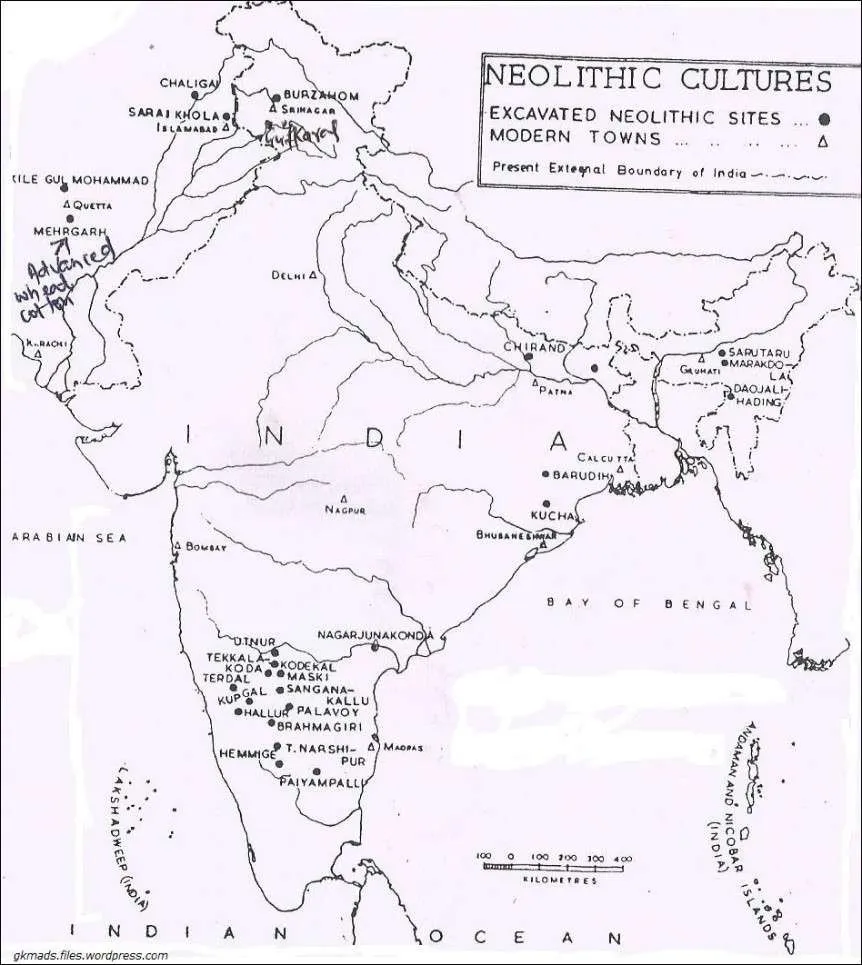
    • Mehrgarh (Balochistan, Pakistan): The oldest Neolithic site in the subcontinent (c. 7000 BCE). Shows continuous evolution from aceramic Neolithic to bronze age; earliest evidence of wheat/barley farming, cattle rearing, and mud-brick houses.
    • Burzahom & Gufkral (Kashmir Valley): Known for unique subterranean pit-dwellings (shelter from freezing winds), bone tools, polished stone axes, and unique graves where master and pet dogs were buried together.
    • Lahuradewa (Sant Kabir Nagar, UP): Yielded earliest carbonized rice husk evidence dating back to c. 9000–7000 BCE, reshaping theories on rice domestication in Asia.
    • Koldihwa & Mahagara (Belan Valley, UP): Early evidence of rice cultivation, circular huts, and cattle pens.
    • Chirand (Saran, Bihar): Famous for an extraordinary abundance of refined antler bone tools alongside polished celts.
    • South Indian Ashmound Sites (Piklihal, Utnur, Kupgal, Brahmagiri, Sanganakallu): Characterized by large pastoral burnt cow-dung ash mounds, millets/pulses cultivation, and stone axe grinding grooves.
    • Daojali Hading & Sarutaru (Assam / Northeast): Cord-marked pottery and shoulder-axes made of fossil wood, reflecting cultural connections with Southeast Asia.
Neolithic Culture Map
WhatsApp Channel
Follow Now

Topic-Dedicated Practice MCQs for Prelims

Q1. Who among the following is recognized as the “Father of Indian Pre-history” for discovering the first Palaeolithic tool in India at Pallavaram in 1863?
  • a) Sir Alexander Cunningham
  • b) Robert Bruce Foote
  • c) Sir John Marshall
  • d) Sir Mortimer Wheeler
Show / Hide Answer
Answer: (b) Robert Bruce Foote
Explanation:
  • British geologist and archaeologist Robert Bruce Foote discovered India’s first prehistoric stone implement (a quartzite handaxe) at Pallavaram (Madras) in May 1863.
  • This seminal discovery laid the foundation of prehistoric studies in India, earning him the title of the Father of Indian Pre-history.

Thus, the correct answer is (b).

Q2. The earliest evidence of animal domestication in the Indian subcontinent during the Mesolithic period has been unearthed at which pair of sites?
  • a) Burzahom (Kashmir) and Gufkral (Kashmir)
  • b) Adamgarh (Madhya Pradesh) and Bagor (Rajasthan)
  • c) Mehargarh (Balochistan) and Chirand (Bihar)
  • d) Attirampakkam (Tamil Nadu) and Nevasa (Maharashtra)
Show / Hide Answer
Answer: (b) Adamgarh (Madhya Pradesh) and Bagor (Rajasthan)
Explanation:
  • Excavations at Adamgarh (Hoshangabad, MP) and Bagor (Bhilwara, Rajasthan) yielded faunal remains proving animal domestication dating back to c. 5000 BCE.
  • Bagor on the river Kothari is also the largest excavated Mesolithic settlement in India.

Thus, the correct answer is (b).

Q3. “Subterranean pit-dwelling” architecture and the practice of burying domestic dogs along with their masters in graves are hallmark features of which Neolithic site?
  • a) Mehrgarh
  • b) Chirand
  • c) Burzahom
  • d) Daojali Hading
Show / Hide Answer
Answer: (c) Burzahom
Explanation:
  • Burzahom (‘place of birch’) in the Kashmir Valley is renowned for deep circular and rectangular pit-dwellings constructed to protect early inhabitants from freezing winds.
  • Burials at Burzahom uniquely feature skeletons of dogs and wolves interred alongside human masters.

Thus, the correct answer is (c).

Q4. With reference to Indian rock art, consider the following statements regarding the Bhimbetka Rock Shelters:
  • 1. They were discovered by archaeologist V.S. Wakankar in 1957.
  • 2. The paintings exclusively depict scenes from the Neolithic and Bronze Age, with no representation of the Mesolithic period.
  • 3. Red pigment was derived from iron oxide (hematite), while green was sourced from chalcedony rock.

Which of the statements given above are correct?

  • a) 1 and 2 only
  • b) 1 and 3 only
  • c) 2 and 3 only
  • d) 1, 2, and 3
Show / Hide Answer
Answer: (b) 1 and 3 only
Explanation:
  • Statement 1 is correct: Dr. V.S. Wakankar discovered the Bhimbetka rock paintings in 1957.
  • Statement 2 is incorrect: The largest and most prominent cluster of paintings at Bhimbetka belongs to the Mesolithic period, featuring dynamic hunting expeditions and stick-figure community dancing.
  • Statement 3 is correct: Natural minerals provided the color palette—hematite for shades of red, limestone for white, and green minerals (chlorite/chalcedony).

Thus, the correct answer is (b) 1 and 3 only.

Q5. Which of the following Upper Palaeolithic sites in India has yielded definitive evidence of decorated and engraved ostrich eggshell beads?
  • a) Patne (Maharashtra)
  • b) Hunsgi (Karnataka)
  • c) Didwana (Rajasthan)
  • d) Attirampakkam (Tamil Nadu)
Show / Hide Answer
Answer: (a) Patne (Maharashtra)
Explanation:
  • Excavations at Patne in the Jalgaon district of Maharashtra yielded engraved ostrich eggshell fragments and disc beads dating to the Upper Palaeolithic period.
  • This proves the existence of ostriches in prehistoric India and demonstrates early personal ornamentation.

Thus, the correct answer is (a) Patne.

Q6. The famous Upper Palaeolithic carved bone figurine interpreted as a ‘Mother Goddess’ was recovered from the gravels of which river valley?
  • a) Soan Valley (Punjab)
  • b) Belan Valley (Uttar Pradesh)
  • c) Narmada Valley (Madhya Pradesh)
  • d) Kortallaiyar Valley (Tamil Nadu)
Show / Hide Answer
Answer: (b) Belan Valley (Uttar Pradesh)
Explanation:
  • A damaged bone artifact identified as a stylized female figurine (Mother Goddess) was discovered at Lohanda Nala in the Belan Valley (Mirzapur, UP).
  • It belongs to the Upper Palaeolithic horizon and is considered one of the earliest pieces of portable sculpture in South Asia.

Thus, the correct answer is (b).

Q7. The archaeological site of “Chirand” located in Bihar is renowned in prehistoric studies for which specific artifact assemblage?
  • a) Extensive copper hoard harpoons
  • b) Exceptionally large quantity of polished antler and bone tools
  • c) Naturalistic cave petroglyphs
  • d) Pre-Harappan gold ornaments
Show / Hide Answer
Answer: (b) Exceptionally large quantity of polished antler and bone tools
Explanation:
  • Chirand (Saran district, Bihar) on the northern bank of the Ganga is unique because its Neolithic stratum yielded a massive collection of bone and deer antler tools (scrapers, needles, points, celts).
  • Bone tools in such high concentrations are found elsewhere only at Burzahom in Kashmir.

Thus, the correct answer is (b).

Q8. Which of the following technological characteristics definitively distinguishes the Mesolithic tool industry from the preceding Palaeolithic cultures?
  • a) Complete reliance on heavy unifacial pebble choppers
  • b) Dominance of composite microlithic tools hafted onto organic shafts
  • c) Discovery and smelting of iron weapons
  • d) Mass production of wheel-made polished black pottery
Show / Hide Answer
Answer: (b) Dominance of composite microlithic tools hafted onto organic shafts
Explanation:
  • The diagnostic marker of the Mesolithic period is the Microlith (diminutive stone tools 1–5 cm in size like lunates, trapezes, and points).
  • These were systematically slotted and glued into wood or bone grooves to make compound tools such as sickles, spearheads, and barbed arrows.

Thus, the correct answer is (b).

Q9. “Ashmounds” (heaps of vitrified and calcined burnt cattle dung) discovered at Piklihal, Utnur, and Kupgal represent the cultural activity of which group?
  • a) Lower Palaeolithic hunters
  • b) Neolithic pastoral communities of South India
  • c) Megalithic iron-smelting guilds
  • d) Harappan trade merchants
Show / Hide Answer
Answer: (b) Neolithic pastoral communities of South India
Explanation:
  • Ashmounds found across the Deccan (Karnataka, Andhra Pradesh, Telangana) at sites like Utnur, Kupgal, Kudatini, and Piklihal were created by periodic seasonal burning of accumulated cow dung in Neolithic cattle pens.
  • They prove an intensive pastoralist economy focused on cattle rearing.

Thus, the correct answer is (b).

Q10. Match List-I (Prehistoric Site) with List-II (State) and select the correct option:
  • A. Hunsgi — 1. Uttar Pradesh
  • B. Didwana — 2. Karnataka
  • C. Damdama — 3. Rajasthan
  • D. Daojali Hading — 4. Assam
  • a) A-2, B-3, C-1, D-4
  • b) A-3, B-2, C-4, D-1
  • c) A-2, B-1, C-3, D-4
  • d) A-4, B-3, C-1, D-2
Show / Hide Answer
Answer: (a) A-2, B-3, C-1, D-4
Explanation:
  • Hunsgi (Karnataka): Famous Lower Palaeolithic Acheulian limestone tool-making site.
  • Didwana (Rajasthan): Lower/Middle Palaeolithic site in the Thar Desert.
  • Damdama (Uttar Pradesh): Mesolithic Ganga Valley site with multiple burials and microliths.
  • Daojali Hading (Assam): Neolithic site yielding cord-impressed pottery and fossil-wood adzes.

Thus, the correct matching is (a) A-2, B-3, C-1, D-4.

Mains Practice Questions with Ideal Model Answers

GS Paper-1 | 10 Marks (150 Words)

Q1. Why is the Neolithic phase termed as a ‘Revolution’? Discuss the major socio-economic shifts that marked the transition from hunting-gathering to food production in ancient India.

Introduction:

V. Gordon Childe coined the phrase “Neolithic Revolution” to denote humanity’s transformative shift from parasitic food-gathering and nomadism to active food production and sedentary village life around the 7th millennium BCE.

1. Key Socio-Economic Shifts:
  • Food Production over Extraction: Systematic cultivation of wheat, barley (Mehrgarh), and rice (Lahuradewa/Koldihwa) guaranteed a dependable food supply, breaking human dependence on seasonal wild game.
  • Sedentism and Built Settlements: Crop cycles required communities to stay in one place, leading to permanent settlements consisting of circular mud huts or sun-dried rectangular bricks (Mehrgarh).
  • Tool Innovation: Ground and polished stone celts, grinding slabs, and saddle querns enabled efficient land clearance, tree felling, and grain processing.
  • Technological Genesis of Pottery: Agricultural surplus necessitated storage vessels, prompting the invention of handmade and wheel-thrown pottery (cord-impressed and grey wares).
  • Social Stratification & Division of Labour: Stable food reserves allowed occupational specialization (potters, toolmakers, farmers) and laid the foundation for lineage and kinship property concepts.
Conclusion:

The Neolithic transition was not merely a technological upgrade but an economic foundation that catalyzed population growth and directly laid the groundwork for the Bronze Age urbanism of the Harappan civilization.

GS Paper-1 | 15 Marks (250 Words)

Q2. “Mesolithic rock art of India is not merely an aesthetic expression, but a socio-ecological archive of early human life.” Elaborate with special reference to the Bhimbetka rock shelters.

Introduction:

Prehistoric rock art in India, pioneered by Archibald Carlleyle’s discoveries in 1867 and epitomized by the UNESCO World Heritage site of Bhimbetka (discovered by V.S. Wakankar), serves as a priceless documentary archive of human cognitive evolution, environmental relationships, and social dynamics during the Mesolithic era.

1. Ecological Archive and Faunal Biodiversity:
  • Faunal Spectrum: Paintings realistically illustrate a wide array of wildlife—tigers, elephants, rhinoceroses, boars, deer, and bison—documenting the rich Pleistocene-Holocene faunal ecology of central India.
  • Human-Nature Coexistence: Visuals depict intimate awareness of animal behaviors, tracking tracks, nesting habits, and seasonal gathering of honey and forest roots.
2. Economic Strategies and Tool Usage:
  • Collective Hunting Techniques: Dynamic compositions depict groups of hunters wielding barbed spears, bows, arrows, and sticks, illustrating coordinated community hunting strategies and traps.
  • Microlithic Hafting: The depiction of barbed arrowheads and spearheads matches the archaeological recovery of geometric microliths hafted onto wooden handles.
3. Socio-Cultural and Ritual Dimensions:
  • Community Cohesion: Vivid stick figures engaged in hand-in-hand group dancing, rhythmic beating of drums, and community feasts reflect collective social identity and shared recreation.
  • Gender Roles & Family Life: Women are depicted nursing infants, foraging roots, and preparing food, while men are mostly portrayed in hunting expeditions, revealing the early emergence of division of labor.
  • Spiritual & Ritual Beliefs: Depictions of mythical horned beasts, fertility motifs, child rearing, and mourning over dead bodies highlight the earliest manifestations of magical beliefs, shamanistic rituals, and funeral ceremonies.
Conclusion:

In the complete absence of written literature, Bhimbetka’s rock art serves as an irreplaceable pictorial chronicle, bridging the gap between material stone tools and the living social fabric of prehistoric Indian communities.

Pre-Historic Period PDF

✓ Free Download • Printable Notes
Download PDF
Pre-Historic Period

History Syllabus

History Syllabus and Some PYQs

History is a massive part of the UPSC exam, both in Prelims and Mains GS Paper-1. But because the syllabus is so vast, it is very easy to get lost reading too much without knowing what actually matters.

To help you stay focused, this post puts everything you need in one place: the exact syllabus, a topic-by-topic timeline from Ancient to World History, past year trends, and actual PYQs with solutions so you know exactly how UPSC asks questions.
WhatsApp Group
Join Now
Telegram Channel
Join Now

Syllabus for UPSC Prelims (History):

  • History of India and Indian National Movement.

Syllabus for UPSC Mains (History):

  • Indian culture will cover the salient aspects of Art Forms, literature, and Architecture from ancient to modern times.
  • Modern Indian history from about the middle of the eighteenth century until the present- significant events, personalities, issues.
  • The Freedom Struggle — its various stages and important contributors/contributions from different parts of the country.
  • Post-independence consolidation and reorganization within the country.
  • History of the world will include events from the 18th century such as the Industrial Revolution, world wars, redrawal of national boundaries, colonization, decolonization, political philosophies like communism, capitalism, socialism, etc.— their forms and effects on society.

UPSC History Trend Analysis (Prelims) (2011-2026)

History Prelims Examination Trend Analysis (2011-2026)
Year2011201220132014201520162017201820192020202120222023202420252026
No. of Questions12201619151613181517191413121316
No. of Questions
12
2011
20
2012
16
2013
19
2014
15
2015
16
2016
13
2017
18
2018
15
2019
17
2020
19
2021
14
2022
13
2023
12
2024
13
2025
16
2026

UPSC History Trend Analysis (Mains) (2013-2025)

History Mains Examination Trend Analysis (2013-2025)
Year2013201420152016201720182019202020212022202320242025
No. of Questions
(Marks)
13
(130)
10
(100)
6
(75)
6
(75)
7
(90)
6
(75)
5
(60)
6
(75)
7
(75)
6
(75)
6
(75)
6
(75)
6
(75)
WhatsApp Channel
Follow Now
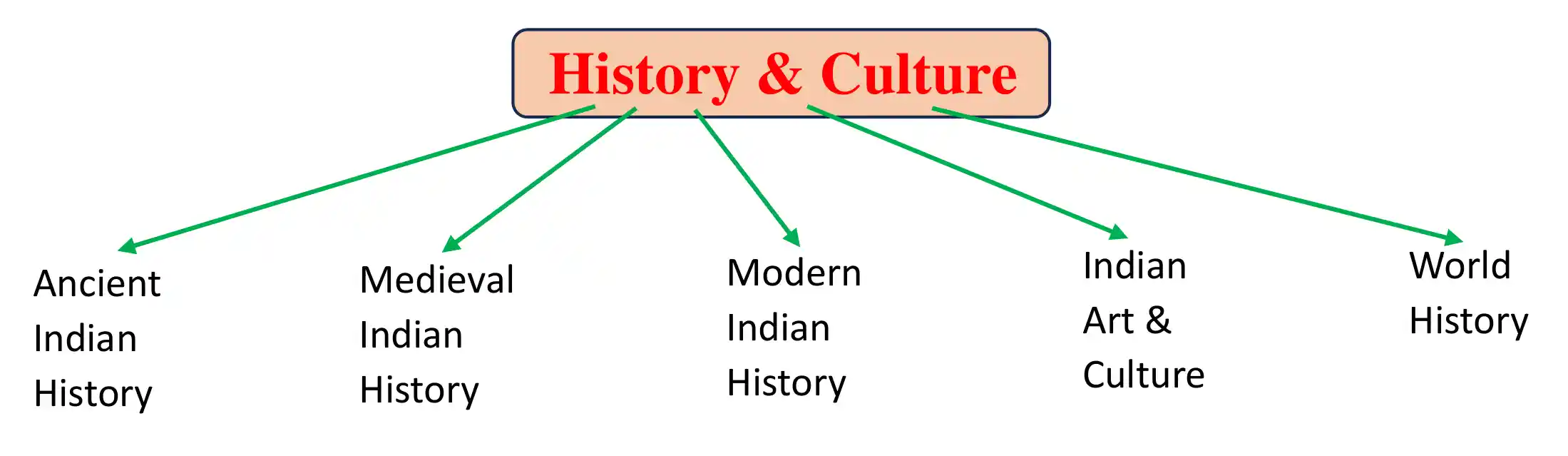
History & Culture Diagram

Ancient Indian History (20 lakh BC – 750 AD)

  • Sources
  • Pre-Historic Period (Stone Age) (2 Million BC – 1000 BC)
  • Palaeolithic Age (Old Stone Age) (2 Million BC – 10,000 BC)
  • Mesolithic Age (Middle Stone Age) (10,000 BC – 6000 BC)
  • Neolithic Age (New Stone Age) (6000 BC – 2000 BC)
  • Chalcolithic Age (Copper-Stone Age) (3500 BC – 1000 BC)
  • Indus Valley Civilization (IVC) (2600 BC – 1900 BC)
  • Vedic Period: Early Vedic Period (Rigvedic Age) (1500 BC – 1000 BC)
  • Vedic Period: Later Vedic Period (1000 BC – 600 BC)
  • Mahajanapadas and Rise of Magadha (600 BC – 321 BC)
  • Rise of Jainism and Buddhism (6th Century BC – 5th Century BC)
  • Persian and Macedonian (Alexander) Invasions (550 BC – 326 BC)
  • Mauryan Empire (322 BC – 185 BC)
  • Post-Mauryan Period: Indigenous Rulers (Sungas, Kanvas, Satavahanas, Chedis) (185 BC – 300 AD)
  • Post-Mauryan Period: Foreign Invasions (Indo-Greeks, Shakas, Parthians, Kushans) (200 BC – 250 AD)
  • Early Sangam Age in South India (Cheras, Cholas, Pandyas) (300 BC – 300 AD)
  • Gupta Empire (Golden Age) (319 AD – 550 AD)
  • Post-Gupta Period and Vardhana Dynasty (Harshavardhana) (550 AD – 647 AD)
  • Early Chalukyas of Badami and Pallavas of Kanchi (550 AD – 750 AD)

Medieval Indian History

  • Early Medieval Period and Tripartite Struggle (Palas, Pratiharas, Rashtrakutas) (750 AD – 1000 AD)
  • Imperial Cholas of Thanjavur (850 AD – 1279 AD)
  • Arab Conquest of Sindh (Muhammad bin Qasim) (712 AD)
  • Ghaznavid and Ghorid Invasions (Battles of Tarain) (1000 AD – 1192 AD)
  • Delhi Sultanate: Slave / Mamluk Dynasty (1206 AD – 1290 AD)
  • Delhi Sultanate: Khalji Dynasty (1290 AD – 1320 AD)
  • Delhi Sultanate: Tughlaq Dynasty (1320 AD – 1414 AD)
  • Delhi Sultanate: Sayyid Dynasty (1414 AD – 1451 AD)
  • Delhi Sultanate: Lodi Dynasty (1451 AD – 1526 AD)
  • Vijayanagara Empire (1336 AD – 1646 AD)
  • Bahmani Kingdom and Deccan Sultanates (1347 AD – 1687 AD)
  • Bhakti and Sufi Movements (8th Century AD – 17th Century AD)
  • Early Mughal Empire (Babur and Humayun) (1526 AD – 1540 AD)
  • Sur Empire (Sher Shah Suri) (1540 AD – 1555 AD)
  • Mughal Empire at its Zenith (Akbar, Jahangir, Shah Jahan, Aurangzeb) (1556 AD – 1707 AD)
  • Rise of the Marathas and Shivaji Maharaj (1627 AD – 1680 AD)
  • Peshwa Rule and Maratha Confederacy (1713 AD – 1818 AD)
  • Later Mughals and 18th Century Regional States (Bengal, Awadh, Hyderabad, Mysore, Punjab) (1707 AD – 1761 AD)

Modern Indian History & Freedom Struggle

  • Advent of European Powers (Portuguese, Dutch, British, French) (1498 AD – 1740 AD)
  • Anglo-French Carnatic Wars (1746 AD – 1763 AD)
  • British Conquest of Bengal (Plassey, Buxar, Dual System) (1757 AD – 1772 AD)
  • British Expansion (Anglo-Mysore, Anglo-Maratha, Anglo-Sikh Wars) (1767 AD – 1849 AD)
  • British Land Revenue Systems (Permanent, Ryotwari, Mahalwari) (1793 AD – 1833 AD)
  • Early Peasant, Civil, and Tribal Uprisings (1763 AD – 1856 AD)
  • Socio-Religious Reform Movements (19th Century) (1815 AD – 1900 AD)
  • Great Revolt of 1857 and End of Company Rule (1857 AD – 1858 AD)
  • Development of Press and Modern Education (1813 AD – 1944 AD)
  • Rise of Early Nationalism and Pre-Congress Bodies (1866 AD – 1884 AD)
  • Foundation of INC and Moderate Phase (1885 AD – 1905 AD)
  • Partition of Bengal, Swadeshi Movement and Rise of Extremism (1905 AD – 1911 AD)
  • Surat Split (1907 AD) and Morley-Minto Reforms (1909 AD)
  • Early Revolutionary Phase (India and Abroad) (1907 AD – 1917 AD)
  • Home Rule League Movement and Lucknow Pact (1916 AD)
  • Arrival of Mahatma Gandhi and Early Satyagrahas (Champaran, Ahmedabad, Kheda) (1915 AD – 1918 AD)
  • Rowlatt Act, Jallianwala Bagh and Montagu-Chelmsford Reforms (1919 AD)
  • Khilafat and Non-Cooperation Movement (1920 AD – 1922 AD)
  • Swarajists Phase and Constructive Work (1922 AD – 1927 AD)
  • Simon Commission, Nehru Report and 14 Points (1927 AD – 1929 AD)
  • Second Revolutionary Phase (HRA, HSRA, Chittagong Raid) (1924 AD – 1934 AD)
  • Lahore Session and Civil Disobedience Movement (1929 AD – 1934 AD)
  • Round Table Conferences and Poona Pact (1930 AD – 1932 AD)
  • Government of India Act 1935 and 1937 Elections (1935 AD – 1939 AD)
  • August Offer (1940 AD) and Cripps Mission (1942 AD)
  • Quit India Movement (1942 AD)
  • Subhash Chandra Bose, INA and INA Trials (1942 AD – 1946 AD)
  • Cabinet Mission, Direct Action Day and Interim Government (1946 AD)
  • Mountbatten Plan, Partition and Indian Independence Act (1947 AD)

Post-Independence India

  • Partition Aftermath and Refugee Rehabilitation (1947 AD – 1950 AD)
  • Integration of Princely States (Sardar Patel and V.P. Menon) (1947 AD – 1949 AD)
  • Enactment of the Indian Constitution (1950 AD)
  • First General Elections (1951 AD – 1952 AD)
  • Linguistic Reorganisation of States (Fazal Ali Commission) (1953 AD – 1956 AD)
  • Tribal Policies (Panchsheel) and Border Settlements (1950s AD – 1960s AD)
  • Land Reforms, Five-Year Plans and Industrial Policy (1951 AD – 1966 AD)
  • Green Revolution and White Revolution (1965 AD – 1975 AD)
  • Evolution of Non-Alignment Movement (NAM) and Foreign Policy (1954 AD – 1961 AD)
  • Major Wars: 1947-48 (Pak), 1962 (China), 1965 (Pak), 1971 (Bangladesh Liberation) (1947 AD – 1971 AD)
  • Pokhran-I (1974 AD) and Pokhran-II Nuclear Tests (1998 AD)
  • JP Movement, Internal Emergency and Restoration of Democracy (1974 AD – 1977 AD)
  • Regional Accords and Insurgencies (Punjab, Assam, Northeast) (1980s AD)
  • LPG Economic Reforms (New Economic Policy) (1991 AD)

Indian Art and Culture

  • Pre-Historic Rock Art and Cave Paintings (Bhimbetka) (10,000 BC – 2000 BC)
  • Harappan Arts, Seals and Bronze Sculptures (2600 BC – 1900 BC)
  • Mauryan Art and Ashokan Pillars (300 BC – 200 BC)
  • Buddhist and Jain Cave Architecture (Karle, Bhaja, Ajanta, Ellora) (200 BC – 800 AD)
  • Sculpture Schools: Gandhara, Mathura, and Amaravati (1st Century BC – 4th Century AD)
  • Stupa Architecture (Sanchi, Bharhut, Amravati) (3rd Century BC – 2nd Century AD)
  • Nagara Temple Architecture (North, Odisha, Khajuraho, Gujarat) (5th Century AD – 13th Century AD)
  • Dravida Temple Architecture (Pallava, Chola, Vijayanagara) (6th Century AD – 16th Century AD)
  • Vesara Temple Architecture (Chalukya, Rashtrakuta, Hoysala) (7th Century AD – 13th Century AD)
  • Delhi Sultanate Architecture (Arcuate Style, Qutb Complex) (1206 AD – 1526 AD)
  • Mughal Architecture and Gardens (Humayun’s Tomb, Fatehpur Sikri, Taj Mahal) (1556 AD – 1707 AD)
  • Colonial and Modern Architecture (Indo-Saracenic, Lutyens’ Delhi) (1858 AD – 1947 AD)
  • Miniature Painting Traditions (Pala, Mughal, Rajasthani, Pahari) (10th Century AD – 19th Century AD)
  • Classical Dances (8 SNA Forms) and Major Folk Dance Traditions (Ancient to Present)
  • Classical Music: Hindustani and Carnatic Traditions (Vedic to Present)
  • Six Schools of Indian Philosophy (Shad-Darshana) (6th Century BC – 4th Century AD)
  • Traditional Theatres, Puppetry and UNESCO Intangible Heritage (Ancient to Present)

World History

  • Scientific Revolution and the Enlightenment (17th Century AD – 18th Century AD)
  • American Revolution and Declaration of Independence (1775 AD – 1783 AD)
  • French Revolution and Rise of Nationalism (1789 AD – 1799 AD)
  • Napoleonic Era, Continental System and Battle of Waterloo (1799 AD – 1815 AD)
  • Industrial Revolution (Britain to Worldwide) (1750 AD – 1850 AD)
  • Rise of Political Ideologies (Capitalism, Socialism, Marxism) (19th Century AD)
  • Unification of Italy (Risorgimento) (1848 AD – 1870 AD)
  • Unification of Germany (Bismarck’s Blood & Iron) (1864 AD – 1871 AD)
  • Imperialism and Scramble for Africa (1884 AD – 1914 AD)
  • Imperialism in Asia (Opium Wars, Spheres of Influence, Meiji Restoration) (1839 AD – 1905 AD)
  • First World War (Causes, Course, Global Impact) (1914 AD – 1918 AD)
  • Treaty of Versailles and League of Nations (1919 AD – 1920 AD)
  • Russian Revolution and Formation of the USSR (1917 AD – 1922 AD)
  • The Great Economic Depression (1929 AD – 1939 AD)
  • Rise of Fascism in Italy and Nazism in Germany (1922 AD – 1939 AD)
  • Second World War and The Holocaust (1939 AD – 1945 AD)
  • Establishment of the United Nations (UN) (1945 AD)
  • Post-WWII Decolonization in Asia and Africa (1945 AD – 1975 AD)
  • Cold War Flashpoints (Berlin, Korea, Cuba, Vietnam, Afghanistan) (1947 AD – 1989 AD)
  • Fall of the Berlin Wall (1989 AD) and Dissolution of the USSR (1991 AD)

Some Previous Years’ UPSC Prelims Questions (History)

Q1. With reference to Indian freedom struggle, Usha Mehta is well-known for (2011)
  • a) Running the Secret Congress Radio in the wake of Quit India Movement.
  • b) Participating in the Second Round Table conference.
  • c) Leading a contingent of Indian National Army.
  • d) Assisting in the formation of Interim Government under Pandit Jawahar Lal Nehru.
Show / Hide Answer
Correct Answer: (a)
Explanation: During the Quit India Movement (1942), Usha Mehta organized the clandestine ‘Secret Congress Radio’ transmitter to broadcast uncensored news and Gandhi’s messages from undisclosed locations across Bombay.
Q2. With reference to Ryotwari Settlement, Consider the following statements: (2012)
  • 1. The rent was paid directly by the peasants to the Govt.
  • 2. The government gave Pattas to the Ryots.
  • 3. The lands were surveyed and assessed before being taxed.

Which of the statements given above is/are correct?

  • a) 1 only
  • b) 1 and 2 only
  • c) 1, 2 and 3
  • d) None
Show / Hide Answer
Correct Answer: (c) 1, 2 and 3
Explanation: In the Ryotwari System introduced by Thomas Munro and Alexander Read, ownership rights (Pattas) were directly handed over to the peasants (Ryots). Revenue was directly collected without middlemen after detailed land surveys.
Q3. Consider the following Bhakti Saints: (2013)
  • 1. Dadu Dayal
  • 2. Guru Nanak
  • 3. Tyagaraja

Who among the above was/were preaching when the Lodi dynasty fell and Babur took over ?

  • a) 1 and 3
  • b) 2 only
  • c) 2 and 3
  • d) 1 and 2
Show / Hide Answer
Correct Answer: (b) 2 only
Explanation: The First Battle of Panipat took place in 1526 AD when Babur defeated Ibrahim Lodi. Guru Nanak lived from 1469 to 1539 AD. Dadu Dayal was born in 1544 AD, and Tyagaraja lived much later (1767–1847 AD).
Q4. The Partition of Bengal made by Lord Curzon in 1905 lasted until (2014)
  • a) the First World War when Indian troops were needed by the British and the Partition was ended.
  • b) King George V abrogated Curzon’s Act at the Royal Durbar in Delhi in 1911.
  • c) Gandhiji launched his Civil Disobedience Movement.
  • d) the Partition of India in 1947 when East Bengal became East Pakistan.
Show / Hide Answer
Correct Answer: (b)
Explanation: Lord Curzon partitioned Bengal in 1905. King George V annulled the partition in December 1911 at the Delhi Durbar, alongside shifting the imperial capital from Calcutta to Delhi.
Q5. Who of the following organized a march on the Tanjore Coast to break the Salt Law in April 1930? (2015)
  • a) V.O. Chidambaram Pillai
  • b) C. Rajagopalachari
  • c) K. Kamaraj
  • d) Annie Besant
Show / Hide Answer
Correct Answer: (b) C. Rajagopalachari
Explanation: In April 1930, C. Rajagopalachari led the Vedaranyam Salt Satyagraha from Tiruchirappalli to Vedaranyam in Tanjore district, Madras Presidency.
Q6. Banjaras during the medieval period of Indian History were generally (2016)
  • a) agriculturists
  • b) warriors
  • c) weavers
  • d) traders
Show / Hide Answer
Correct Answer: (d) traders
Explanation: Banjaras were prominent nomadic trader-transporters. Alauddin Khalji utilized Banjaras extensively to transport food grains from villages to town markets.
Q7. The object of the Butler Committee of 1927 was to (2017)
  • a) Define the jurisdiction of the Central & Provincial Governments.
  • b) Define the powers of the Secretary of State for India.
  • c) Impose censorship on national press.
  • d) Improve the relationship between the Government of India and the Indian States.
Show / Hide Answer
Correct Answer: (d)
Explanation: The Harcourt Butler Committee examined the constitutional relationship between the British Crown (Paramount Power) and the rulers of Indian Princely States.
Q8. Which one of the following foreign travellers elaborately discussed about diamonds and diamond mines of India? (2018)
  • a) Francois Bernier
  • b) Jean-Baptiste Tavernier
  • c) Jean de Thevenot
  • d) Abbe Barthelemy Carre
Show / Hide Answer
Correct Answer: (b) Jean-Baptiste Tavernier
Explanation: Jean-Baptiste Tavernier, a 17th-century French merchant and gem expert, made six voyages to India and documented detailed accounts of diamond mines at Golconda.
Q9. Which one of the following is not a Harappan site? (2019)
  • a) Chanhudaro
  • b) Kot diji
  • c) Sohgaura
  • d) Desalpur
Show / Hide Answer
Correct Answer: (c) Sohgaura
Explanation: Sohgaura (in Gorakhpur, UP) is a Mauryan-period site famous for its copper-plate inscription dealing with famine relief. Chanhudaro, Kot Diji, and Desalpur are Harappan sites.
Q10. With reference to the history of India, “Ulgulan” or the Great Tumult is the description of which of the following events? (2020)
  • a) The Revolt of 1857
  • b) The Mapilla Rebellion of 1921
  • c) The Indigo Revolt of 1859-60
  • d) Birsa Munda’s Revolt of 1899-1900
Show / Hide Answer
Correct Answer: (d) Birsa Munda’s Revolt of 1899-1900
Explanation: Birsa Munda led the historic Munda uprising of 1899–1900 in the Chotanagpur region, known in tribal folk memory as the “Ulgulan” (The Great Tumult).
Q11. Who among the following was associated as secretary with Hindu Female School which later came to be known as Bethune Female School? (2021)
  • a) Annie Besant
  • b) Debendranath Tagore
  • c) Ishwar Chandra Vidyasagar
  • d) Sarojini Naidu
Show / Hide Answer
Correct Answer: (c) Ishwar Chandra Vidyasagar
Explanation: Founded in 1849 by J.E.D. Bethune in Calcutta, social reformer Ishwar Chandra Vidyasagar served tirelessly as its secretary.
Q12. Consider the following freedom fighters: (2022)
  • 1. Barindra Kumar Ghosh
  • 2. Jogesh Chandra Chatterjee
  • 3. Rash Behari Bose

Who of the above was / were actively associated with the Ghadar Party?

  • a) 1 and 2
  • b) 2 only
  • c) 1 and 3
  • d) 3 only
Show / Hide Answer
Correct Answer: (d) 3 only
Explanation: Rash Behari Bose was the chief coordinator in India for the planned Ghadar Mutiny of 1915 before leaving for Japan. Barindra Ghosh led Anushilan Samiti and Jogesh Chatterjee co-founded HRA.
Q13. Who among the following rulers of medieval Gujarat surrendered Diu to Portuguese? (2023)
  • a) Ahmad Shah
  • b) Mahmud Begarha
  • c) Bahadur Shah
  • d) Muhammad Shah
Show / Hide Answer
Correct Answer: (c) Bahadur Shah
Explanation: Sultan Bahadur Shah of Gujarat signed the Treaty of Bassein in 1534 with the Portuguese, ceding Bassein and Diu for military assistance against Humayun.
Q14. Sanghabhuti, an Indian Buddhist monk, who travelled to China at the end of the fourth century AD, was the author of a commentary on: (2024)
  • a) Prajnaparamita Sutra
  • b) Visuddhimagga
  • c) Sarvastivada Vinaya
  • d) Lalitavistara
Show / Hide Answer
Correct Answer: (c) Sarvastivada Vinaya
Explanation: Sanghabhuti traveled from North India to Chang’an, China around 381 AD and produced an authoritative commentary on the Sarvastivada Vinaya.
Q15. Consider the following statements about Raja Ram Mohan Roy: (2025)
  • I. He possessed great love and respect for the traditional philosophical systems of the East.
  • II. He desired his countrymen to accept the rational and scientific approach and the principle of human dignity and social equality of all men and women.

Which of the statements given above is/are correct?

  • a) I only
  • b) II only
  • c) Both I and II
  • d) Neither I nor II
Show / Hide Answer
Correct Answer: (c) Both I and II
Explanation: Raja Ram Mohan Roy synthesized Vedanta philosophy with Western rationalism and scientific enquiry, advocating for human dignity and women’s rights.
Q16. Consider the following assertion: (2026)

The genesis of political alliances based on community lay in the very nature of the Montague-Chelmsford Reforms, 1919.

Which of the following statements support/supports the above assertion?

  • 1. Reforms retained and extended the principle of separate electorates.
  • 2. Separate electorates were supposed to counter Indian nationalism, which was growing stronger.
  • 3. Deprived classes rallied around the favours inherent in separate electorates.

Select the answer using the code given below:

  • a) 1 only
  • b) 2 and 3 only
  • c) 1 and 2 only
  • d) 1, 2 and 3
Show / Hide Answer
Correct Answer: (d) 1, 2 and 3
Explanation: The 1919 Act extended separate electorates to Sikhs, Indian Christians, Anglo-Indians, and Europeans, institutionalizing communal divisions in the representative machinery.

Some Previous Years’ UPSC Mains Questions (History)

2013 | 10 Marks (200 Words)

Q1. “In many ways, Lord Dalhousie was the founder of modern India.” Elaborate.

2014 | 10 Marks (150 Words)

Q2. The third battle of Panipat was fought in 1761. Why were so many empire-shaking battles fought at Panipat?

2015 | 12.5 Marks (200 Words)

Q3. Mesolithic rock cut architecture of India not only reflects the cultural life of the times but also a fine aesthetic sense comparable to modern painting. Critically evaluate this comment.

2016 | 12.5 Marks (200 Words)

Q4. Highlight the differences in the approach of Subhash Chandra Bose and Mahatma Gandhi in the struggle for freedom?

2017 | 10 Marks (150 Words)

Q5. Why did the ‘Moderates’ fail to carry conviction with the nation about their proclaimed ideology and political goals by the end. of the nineteenth century?

2018 | 10 Marks (150 Words)

Q6. Safeguarding the Indian art heritage is the need of the moment. Discuss.

2019 | 10 Marks (150 Words)

Q7. Examine the linkages between the nineteenth century’s “Indian Renaissance” and the emergence of national identity.

2020 | 10 Marks (150 Words)

Q8. Pala period is the most significant phase in the history of Buddhism in India. Enumerate.

2021 | 15 Marks (250 Words)

Q9. Bring out the constructive programmes of Mahatma Gandhi during Non-Cooperation Movement and Civil Disobedience Movement.

2022 | 15 Marks (250 Words)

Q10. Discuss the main contributions of Gupta Period and Chola Period to Indian heritage and culture.

2023 | 10 Marks (150 Words)

Q11. What was the difference between Mahatma Gandhi and Rabindranath Tagore in their approach towards education and nationalism?

2024 | 10 Marks (150 Words)

Q12. What were the events that led to the Quit India Movement? Point out its results.

2025 | 15 Marks (250 Words)

Q13. The French Revolution has enduring relevance to the contemporary world. Explain.

History Syllabus and Some PYQs PDF

✓ Free Download • Printable Notes
Download PDF
History Syllabus and Some PYQs