


UPSC CSE Mains Trend Analysis (2013-2024): A Data-Driven Strategic Guide
Since the major syllabus revision in 2013, the nature of questions has moved decisively away from factual descriptions. Understanding trends over the 12-year period from 2013 to 2024 is not about guessing questions; it is about decoding the examiner’s expectations, identifying weightage reallocations, and mastering the exact presentation blueprints required to secure top marks across Essay, GS Papers 1 to 4, and Optional subjects.
1. The Four Foundational Pillars of UPSC Mains Evaluation
- 1. Transition from ‘What’ to ‘Why and How’ (Analytical Rigor): Purely descriptive questions are obsolete. Rather than asking “What are the constitutional provisions for Interstate Water Disputes?”, UPSC asks, “Why have statutory tribunals under Article 262 faced chronic delays, and how can institutional mechanisms like the Inter-State Council offer a more collaborative federal solution?”
- 2. Complete Convergence of Static and Dynamic Concepts: The boundary between the static syllabus and dynamic current events has disappeared. For example, questions on temple architecture or ancient trade routes examine their socio-economic impact, while questions on macroeconomics directly reference post-pandemic fiscal policies and Economic Survey recommendations.
- 3. Inter-Disciplinary Synergies: Real-world administrative challenges cut across multiple academic disciplines. An inquiry into urban flooding links geomorphology and drainage patterns (GS-1), municipal governance failures and urban local bodies (GS-2), infrastructure investments and climate-resilient planning (GS-3), and environmental justice (GS-4).
- 4. Structural Excellence & Time Budgeting: Writing 20 high-quality answers (around 4,000 words in 180 minutes) requires structural discipline: crisp introductions, categorized sub-headings, bulleted arguments, labeled micro-diagrams, and forward-looking, actionable conclusions.
2. Paper-I (Essay): Philosophical Dominance & The 140+ Formula
Carrying 250 marks, the Essay paper offers one of the highest returns on investment in the entire examination. Over the past six years, the paper has shifted decisively from factual, governance-based topics toward philosophical and introspective prompts.
- The Trend Shift (2018–2024): Prompts like “A ship in harbour is safe, but that is not what ships are for”, “Forests precede civilizations and deserts follow them”, or “Thinking is like a game, it does not begin unless there is an opposite team” now dominate both Section-A and Section-B. They assess psychological depth, balance, and originality of thought.
- The Multi-Dimensional Exploration Matrix (PESTLE+): Deconstruct abstract philosophical quotes across multiple structured dimensions:
- Philosophical & Ethical: What is the core moral premise? How does it apply to individual self-actualization?
- Historical: Historical turning points that validate or counter the thesis (e.g., the Industrial Revolution, the Indian National Movement, the Renaissance).
- Sociological: Implications for marginalized communities, gender dynamics, and social cohesion.
- Political & Governance: Application to constitutional values, civic responsibility, and democratic governance.
- Economic & Ecological: Sustainable growth, resource equity, and environmental stewardship.
- International: Global diplomacy, multilateralism versus unilateral conflict, and universal human fraternity.
- The 15-Minute Brainstorming Protocol: Resist the urge to start writing immediately. Spend the first 15 to 20 minutes outlining your central thesis, drafting an engaging opening anecdote, listing multi-dimensional arguments, and structuring seamless transitions between paragraphs.
3. Paper-II (GS-1): Heritage, History, Geography, and Indian Society
GS Paper-1 covers Art & Culture, Ancient, Medieval, and Modern History, World History, Physical and Human Geography, and Indian Society. The historical data from 2013 to 2024 confirms a significant realignment in subject weightage:
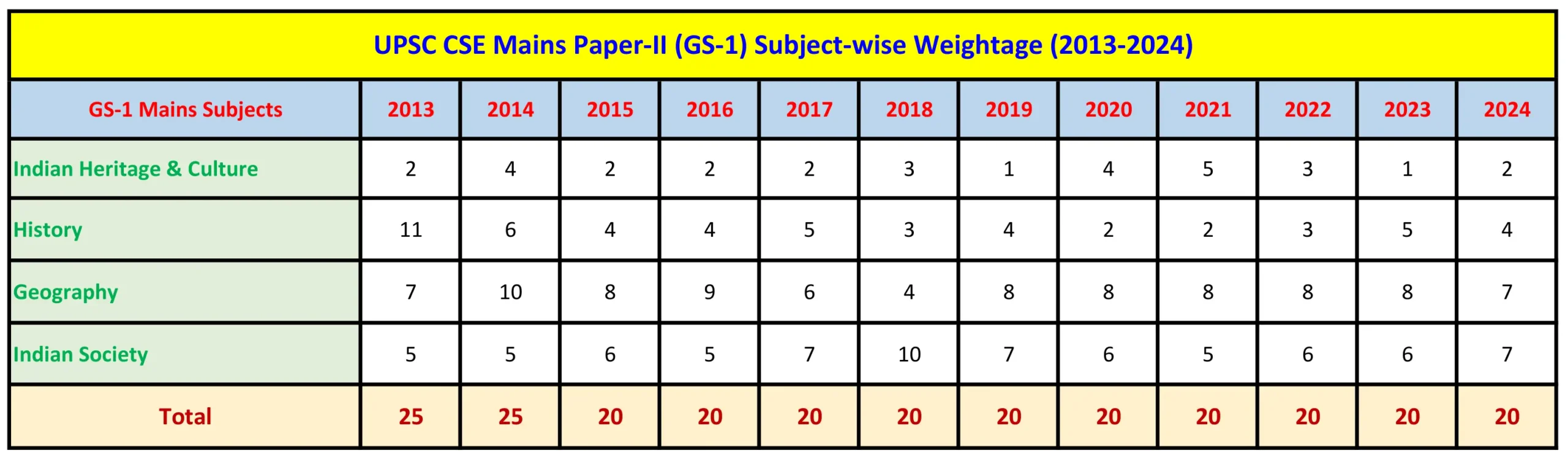
- Geography & Society Emerge as the Core Block: In 2013, History led the paper with 11 questions. However, by 2024, Geography and Indian Society combined to contribute 14 questions (7 questions each) out of 20, representing 70% of the total paper (175 marks).
- History’s Consolidating Footprint: Modern History questions have stabilized at 3 to 5 questions annually, with an emphasis on regional resistance movements, peasant and tribal uprisings, and ideological debates among nationalist leaders. World History has decreased to one question or occasionally zero.
- Art & Culture Focus: Questions have moved away from isolated architectural descriptions toward the socio-philosophical impact of cultural movements (e.g., Bhakti-Sufi literature, Buddhist rock-cut traditions, and temple administrative networks).
-
GS-1 Answer-Writing Framework:
- Integrate Maps and Diagrams in Geography: Hand-drawn schematic maps illustrating plate margins, cyclone paths, ocean currents, and critical mineral belts consistently secure higher marks.
- Data-Driven Arguments in Indian Society: Support societal answers with indicators from Census data, NFHS-5 surveys, the NITI Aayog Multidimensional Poverty Index, and sociological concepts (e.g., secularization, Sanskritization, feminization of agriculture).
4. Paper-III (GS-2): Governance, Constitution, Polity, Social Justice, and IR
GS-2 is analytically intensive and demands a solid foundation in constitutional law, institutional checks and balances, and foreign policy dynamics:
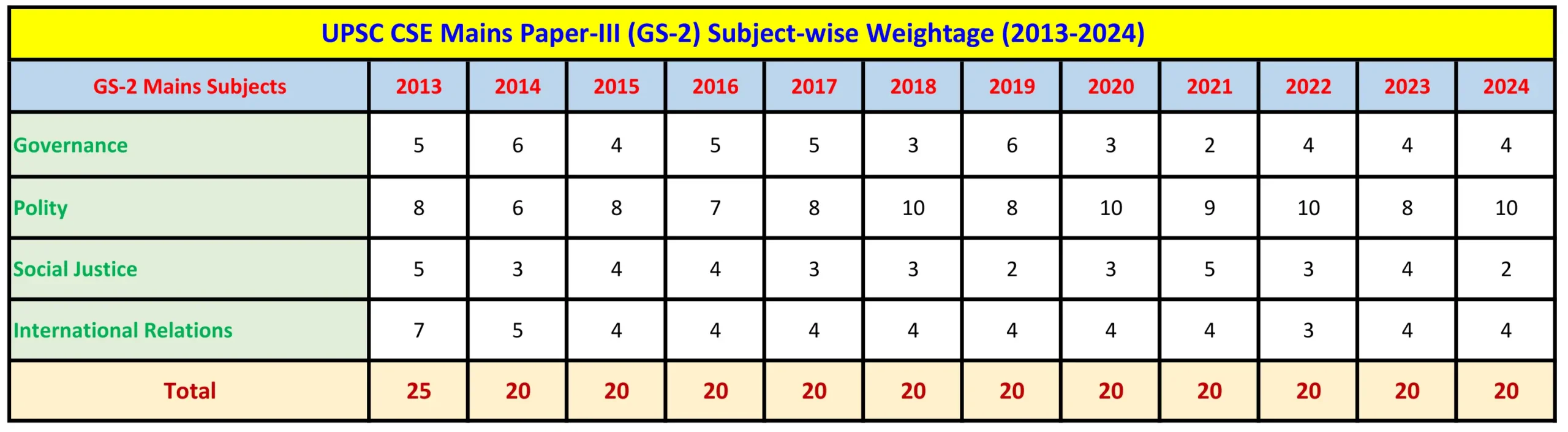
- Polity is the Structural Anchor: Indian Polity consistently claims 8 to 10 questions, hitting a peak of 10 questions in 2024. High-yield themes center on federal disputes, discretionary powers of governors, parliamentary scrutiny deficits, and judicial review.
- Reliable Pillars (Governance & IR): Governance and International Relations deliver a steady average of 4 questions each. IR has expanded beyond simple bilateral ties to examine multilateral alignments (e.g., QUAD, I2U2, Global South advocacy) and supply chain resilience initiatives.
- Social Justice Dynamics: Contributing 2 to 5 questions, this section addresses healthcare, primary education, welfare delivery deficits, and affirmative action frameworks.
-
GS-2 Answer-Writing Framework:
- Cite Constitutional Articles: Open answers with specific Articles (e.g., Article 131 for federal disputes, Article 356 for President’s rule, Article 239AA for administrative jurisdictions).
- Incorporate Landmark Judgments: Support arguments with rulings such as S.R. Bommai (federalism), Puttaswamy (privacy), Minerva Mills (basic structure), and Indira Sawhney (affirmative action).
- Reference Official Recommendations: Anchor conclusions in proposals from the 2nd Administrative Reforms Commission (ARC), Law Commission reports, the Punchhi Commission, and the Sarkaria Commission.
5. Paper-IV (GS-3): Technology, Economy, Environment, Security & Disaster Management
GS Paper-3 has the broadest syllabus footprint, requiring a strong understanding of macroeconomic policy, infrastructure planning, and internal security challenges:
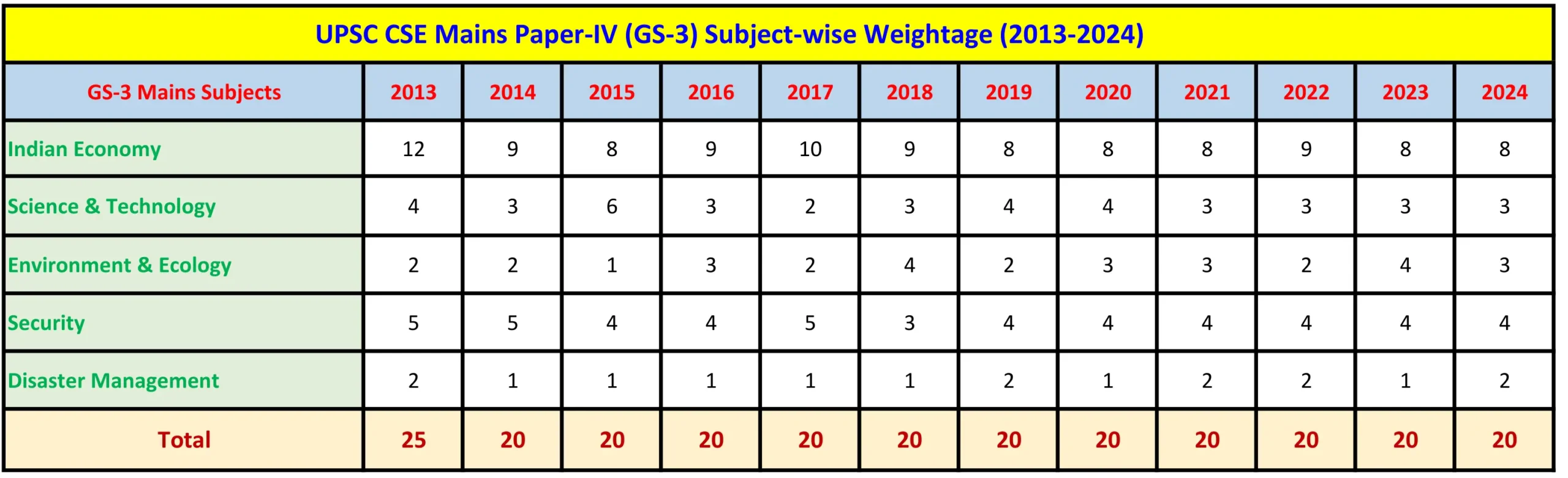
- Indian Economy & Agriculture Form the Backbone: Out of 20 questions, Economy and Agriculture regularly account for 8 to 10 questions, representing roughly 45% of the paper’s total marks. Core themes include MSP diversification, agricultural supply chains, capital expenditure, and macro-financial stability.
- High Predictability Across Supporting Topics: Science & Technology (3 to 4 questions), Environment (3 to 4 questions), and Internal Security (4 questions) exhibit consistent, stable distributions year after year. Their defined syllabus boundaries offer reliable scoring opportunities.
-
GS-3 Answer-Writing Framework:
- Anchor Answers with Hard Economic Data: Cite reliable figures from the Union Budget and Economic Survey (e.g., logistics costs as a % of GDP, gross non-performing assets ratio, renewable energy capacity, agricultural exports).
- Emphasize Applied Technology: Focus on real-world governance use cases—such as AI in precision agriculture, Quantum Key Distribution in national security, and Green Hydrogen production.
- Structure Internal Security Clearly: Maintain concise, structured revision notes for border security, cyber-warfare, terror financing, and Left-Wing Extremism to answer directly in bullet points.
6. Paper-V (GS-4): Ethics, Integrity, and Aptitude
The Ethics paper evaluates your personal value system, moral reasoning, and aptitude for resolving complex administrative dilemmas:

- Complete Structural Stability: From 2018 through 2024, GS-4 has maintained an identical format: 6 theoretical questions in Section-A (125 Marks) and 6 practical case studies in Section-B (125 Marks).
- Section-A Preparation: Prepare a precise two-line definition for every syllabus term (e.g., Probity, Objectivity, Empathy, Fortitude), along with two real-world examples (one from a respected historical figure and one from an administrative context).
-
The 6-Step Case Study Method (Section-B):
- 1. Stakeholder Mapping: Identify direct, indirect, and institutional stakeholders (including public trust and rule of law).
- 2. Ethical Dilemmas: Define the conflicts of interest (e.g., Compassion vs. Rule of Law, Public Duty vs. Personal Relationships).
- 3. Evaluate Options: Outline 3 to 4 viable courses of action with balanced pros and cons.
- 4. State Course of Action: Recommend a practical, legally sound decision grounded in constitutional values.
- 5. Ethical Justification: Defend the decision using ethical principles, highlighting long-term public benefit.
- 6. Long-Term Systemic Safeguards: Conclude with structural and institutional reforms to prevent future occurrences.
7. Papers VI & VII: Optional Subject Strategy (The 500-Mark Game-Changer)
With 500 marks at stake, your Optional subject remains a critical factor in determining your final rank and service allocation:
- Interlinking Paper-1 and Paper-2: Modern Optional questions require candidates to apply Paper-1 theoretical frameworks to Paper-2 contemporary Indian scenarios. Pure descriptive answers without conceptual backing earn lower marks.
- The 60% PYQ Repetition Principle: In almost every standard optional subject, 50% to 60% of core themes recur every 5 to 7 years. Preparing structured, model answers for the last 10 years of PYQs is essential to cross the 280+ mark threshold.
8. Exam Hall Answer Writing & Time Management Blueprint
Success in Mains is determined not just by your preparation, but by your ability to complete 20 comprehensive answers in 180 minutes:
- 10-Marker Questions (150 Words): Allocate roughly 7 minutes per question. Structure answers with a 2-line intro, 4 to 5 bulleted arguments with subheadings, a concise micro-diagram, and a 2-line forward-looking conclusion.
- 15-Marker Questions (250 Words): Allocate roughly 10.5 minutes per question. Provide multi-dimensional causal analysis, address counter-perspectives, cite institutional data, and suggest actionable policy remedies.
- Attempt Strategy: Many high-scoring aspirants begin with the 15-marker questions (Questions 11 to 20) to secure the 150-mark block while mental energy and time reserves are highest.
Frequently Asked Questions (FAQs)
Q1. Why is understanding Mains trend analysis so crucial?
Q2. Can this trend analysis predict exact questions in upcoming Mains?
Q3. What is the single biggest takeaway from the last decade’s Mains trends?
Q4. Based on data, can I afford to skip subjects with lower question counts?
Q5. How should I prepare for philosophical and abstract essays?
Q6. How important is daily answer writing practice in relation to these trends?
Q7. Where can I access official question papers to verify these trends?
Take your Mains preparation to the next level!
Decode a decade of trends. This analysis covers Essay and GS I-IV, providing the strategic insights needed for high-scoring answers.
Download the free, print-friendly PDF for your offline study notes.
📥 Download PDF Now