Master the intricacies of the Indian Constitution and governance system with our comprehensive notes and analysis. Our resources simplify complex topics like fundamental rights, parliamentary functions, and constitutional bodies, making them easy to grasp for both UPSC and State PCS examinations.
The concept of Fundamental Duties in the Indian Constitution is borrowed from the Constitution of the former USSR (Union of Soviet Socialist Republics). These duties were integrated into Part IV-A of the Constitution under Article 51-A by the 42nd Amendment in 1976, based on the recommendations of the Swaran Singh Committee. The committee emphasized that citizens have duties to perform in addition to enjoying their rights. Initially, ten duties were added, and the eleventh duty was included in 2002 by the 86th Amendment.
The 11 Fundamental Duties
Here is the complete list of all 11 Fundamental Duties for every citizen of India:
(a)📜 To abide by the Constitution and respect its ideals and institutions, the National Flag, and the National Anthem.
(b)🇮🇳 To cherish and follow the noble ideals that inspired our national struggle for freedom.
(c)🤝 To uphold and protect the sovereignty, unity, and integrity of India.
(d)🛡️ To defend the country and render national service when called upon to do so.
(e)🕊️ To promote harmony and the spirit of common brotherhood amongst all the people of India, transcending religious, linguistic, and regional or sectional diversities; and to renounce practices derogatory to the dignity of women.
(f)🏛️ To value and preserve the rich heritage of our composite culture.
(g)🌳 To protect and improve the natural environment, including forests, lakes, rivers, and wildlife, and to have compassion for living creatures.
(h)👩🔬 To develop a scientific temper, humanism, and the spirit of inquiry and reform.
(i)🚮 To safeguard public property and to abjure violence.
(j)📈 To strive towards excellence in all spheres of individual and collective activity so that the nation constantly rises to higher levels of endeavor and achievement.
(k)🧑🏫 To provide opportunities for education to one’s child or ward between the age of six and fourteen years.
Key Aspects:
Borrowed from: Former USSR.
Purpose: To foster patriotism, unity, and civic responsibility, and to contribute to national progress.
Nature: Primarily moral and non-justiciable (not directly enforceable by courts), but they can be used by courts to interpret laws.
Balance: They serve to balance Fundamental Rights with corresponding duties.
In short, the Fundamental Duties outline the moral and civic responsibilities of a citizen, showing them how to contribute positively to the nation and respect its foundational principles and structures. They are the “do’s” that complement the “don’ts” and the rights given by the Constitution.
Indian Polity and Governance Syllabus, Trend Analysis, Preparation Strategy & Some PYQs
Indian Polity and Governance is one of the most important and scoring subjects in the UPSC Civil Services Examination. It forms a substantial portion of both the Preliminary Examination and the General Studies Paper-II of the Main Examination. Questions from Polity are generally concept-based, factual, and closely linked with current affairs, making this subject highly rewarding for aspirants.
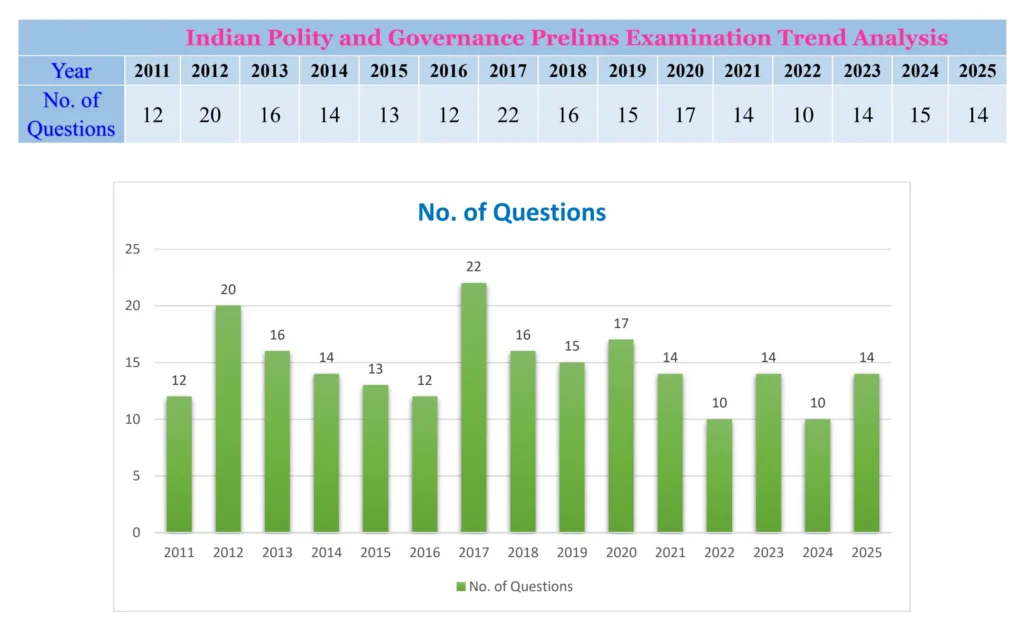
Every year, around 12–18 questions are asked in UPSC Prelims from Indian Polity and Governance, while in UPSC Mains, General Studies Paper-II is largely based on topics related to the Constitution, Governance, Parliament, Judiciary, Federalism, Constitutional Bodies, Social Justice, and International Relations.
In this article, we shall discuss:
UPSC Indian Polity and Governance Syllabus for Prelims.
UPSC Indian Polity and Governance Syllabus for Mains (GS Paper-II).
Indian Polity is considered one of the most scoring subjects in the Civil Services Examination because:
It has a largely static syllabus.
Questions are concept-oriented and predictable.
Current affairs can easily be linked with constitutional provisions.
A strong command over Polity helps in Essay, Ethics, and Interview.
It contributes significantly to both Prelims and Mains.
It requires comparatively less memorization than History or Geography.
A thorough understanding of the Constitution and governance mechanisms also helps aspirants develop analytical ability required for answer writing.
UPSC Prelims Syllabus for Indian Polity and Governance
According to the official UPSC Prelims syllabus, Indian Polity and Governance includes:
“Constitution, Political System, Panchayati Raj, Public Policy, Rights Issues, etc.”
The broad areas covered under this syllabus are:
Historical Background of the Constitution.
Making of the Constitution.
Salient Features of the Constitution.
Preamble.
Union and its Territory.
Citizenship.
Fundamental Rights.
Directive Principles of State Policy.
Fundamental Duties.
Amendment of the Constitution.
Basic Structure Doctrine.
Union Executive.
Parliament.
Judiciary.
State Government.
Centre-State Relations.
Emergency Provisions.
Constitutional Bodies.
Non-Constitutional Bodies.
Panchayati Raj.
Municipalities.
Elections and Electoral Reforms.
Political Parties.
Pressure Groups.
Governance and Public Policy.
Transparency and Accountability.
E-Governance.
Rights Issues.
Civil Services.
UPSC Mains GS Paper-II Syllabus (Indian Polity and Governance)
According to the official UPSC Mains syllabus, General Studies Paper-II consists of 250 marks and covers the following areas:
Indian Constitution — historical underpinnings, evolution, features, amendments, significant provisions, and basic structure.
Functions and responsibilities of the Union and the States, issues and challenges pertaining to the federal structure, devolution of powers and finances up to local levels, and challenges therein.
Separation of powers between various organs disputes redressal mechanisms and institutions.
Comparison of the Indian constitutional scheme with that of other countries.
Parliament and State legislatures — structure, functioning, conduct of business, powers & privileges, and issues arising out of these.
Structure, organization, and functioning of the Executive and the Judiciary — Ministries and Departments of the Government; pressure groups and formal/informal associations and their role in the Polity.
Salient features of the Representation of People’s Act.
Appointment to various Constitutional posts, powers, functions, and responsibilities of various Constitutional Bodies.
Statutory, regulatory, and various quasi-judicial bodies.
Government policies and interventions for development in various sectors and issues arising out of their design and implementation.
Development processes and the development industry — the role of NGOs, SHGs, various groups and associations, donors, charities, institutional and other stakeholders.
Important aspects of governance, transparency and accountability, e-governance- applications, models, successes, limitations, and potential; citizens charters, transparency & accountability, and institutional and other measures.
Role of civil services in a democracy.
The broad areas covered under this syllabus are:
Indian Constitution
Historical underpinnings.
Evolution of the Constitution.
Salient features.
Amendments.
Significant provisions.
Basic structure doctrine.
Federalism
Functions and responsibilities of Union and States.
Challenges pertaining to federal structure.
Devolution of powers and finances to local levels.
Issues and challenges associated with federalism.
Separation of Powers
Separation of powers among Legislature, Executive and Judiciary.
Dispute redressal mechanisms.
Institutional arrangements.
Comparative Constitutional Systems
Comparison of the Indian constitutional scheme with other countries.
Parliament and State Legislatures
Structure and functioning.
Conduct of business.
Powers and privileges.
Issues arising out of these institutions.
Executive and Judiciary
Structure and organization.
Ministries and departments.
Pressure groups.
Formal and informal associations.
Representation of People Act
Salient features.
Electoral reforms.
Anti-defection provisions.
Constitutional Bodies
Election Commission.
Finance Commission.
UPSC.
CAG.
Attorney General.
National Commissions.
Statutory and Regulatory Bodies
NHRC.
CVC.
CIC.
Lokpal.
NITI Aayog.
SEBI and other regulators.
Government Policies and Interventions
Welfare schemes.
Development programmes.
Issues in implementation.
Governance
NGOs and SHGs.
Transparency and accountability.
Citizen’s Charter.
E-Governance.
Role of civil services in democracy.
Weightage of Indian Polity in UPSC
Indian Polity has consistently occupied an important place in the Civil Services Examination.
In Prelims
Average questions per year: 12–18.
Weightage: Nearly 15–20% of GS Paper-I.
In Mains
GS Paper-II carries 250 marks.
Around 100–150 marks are directly related to Polity and Governance.
Therefore, Indian Polity remains one of the highest-scoring subjects in UPSC preparation.
UPSC Indian Polity and Governance Trend Analysis (2011–2025)
Indian Polity is one of the most consistent subjects in UPSC. Every year, a significant number of questions are asked in both Prelims and Mains. The trend indicates that UPSC increasingly focuses on conceptual clarity rather than rote learning.
Key Observations
Indian Polity contributes around 12–18 questions every year.
Questions are increasingly analytical.
UPSC emphasizes constitutional provisions and current developments.
Fundamental Rights, Parliament, Judiciary, Constitutional Bodies and Local Government are favorite areas.
Articles and constitutional amendments are frequently tested.
UPSC Mains Trend Analysis
Polity forms the backbone of General Studies Paper-II.
Frequently Asked Areas
Constitution and Basic Structure
Questions are regularly asked on:
Constitutional amendments.
Judicial review.
Basic Structure Doctrine.
Federalism.
Constitutional morality.
Parliament
Important themes include:
Parliamentary committees.
Declining productivity.
Privileges.
Role of Rajya Sabha.
Anti-defection law.
Judiciary
UPSC frequently asks about:
Judicial activism.
Judicial overreach.
Independence of judiciary.
Pendency of cases.
Collegium system.
Federalism
Major themes are:
Cooperative federalism.
Fiscal federalism.
Inter-State disputes.
Centre-State relations.
Governance
Questions are asked on:
Transparency and accountability.
Citizen’s Charter.
Civil services reforms.
E-governance.
Public policy implementation.
Topic-wise Roadmap for Indian Polity
Indian Polity can be divided into the following sections:
Historical Background
Regulating Act, 1773
Pitt’s India Act, 1784
Charter Acts
Government of India Acts
Indian Independence Act, 1947
Making of the Constitution
Constituent Assembly
Committees
Drafting Committee
Adoption and enforcement
Salient Features
Lengthiest Constitution
Parliamentary System
Federal System
Independent Judiciary
Fundamental Rights
Universal Adult Franchise
Preamble
Philosophy of the Constitution
Keywords and significance
Union and Territory
Articles 1–4
States and Union Territories
Citizenship
Articles 5–11
Citizenship Act, 1955
OCI and PIO
Fundamental Rights
Articles 12–35
Writs
Doctrine of Eclipse
Doctrine of Severability
Directive Principles of State Policy
Articles 36–51
Classification
Relationship with Fundamental Rights
Fundamental Duties
Article 51A
42nd and 86th Constitutional Amendments
Amendment Procedure
Article 368
Types of amendments
Basic Structure Doctrine
Kesavananda Bharati Case, 1973
Union Executive
President
Vice-President
Prime Minister
Council of Ministers
Attorney General
Parliament
Lok Sabha
Rajya Sabha
Legislative Procedure
Parliamentary Committees
Judiciary
Supreme Court
High Courts
Judicial Review
Judicial Activism
State Government
Governor
Chief Minister
State Legislature
Centre-State Relations
Legislative relations
Administrative relations
Financial relations
Emergency Provisions
National Emergency
President’s Rule
Financial Emergency
Constitutional Bodies
Election Commission
Finance Commission
UPSC
CAG
Attorney General
Non-Constitutional Bodies
NITI Aayog
NHRC
CVC
CIC
Lokpal
Local Government
Panchayati Raj
Municipalities
Elections and Political Parties
Representation of the People Act
Electoral reforms
Anti-defection law
Governance
Public Policy
Transparency
Accountability
Citizen’s Charter
E-Governance
Social Justice
Welfare schemes
Vulnerable sections
Inclusive development
Civil Services
Role of civil services
Reforms and ethics
Most Important Topics for UPSC Prelims
High Priority Topics
★★★★★
Fundamental Rights
Parliament
President and Prime Minister
Judiciary
Constitutional Bodies
Panchayati Raj
Amendment Procedure
Emergency Provisions
Centre-State Relations
Schedules of the Constitution
Moderate Priority Topics
★★★★☆
Citizenship
Governor
DPSPs
Fundamental Duties
Political Parties
Election Commission
Lower Priority Topics
★★★☆☆
Pressure Groups
Non-Constitutional Bodies
Tribunals
Sources and Books for Indian Polity
Standard Books
M. Laxmikanth
The most important book for both Prelims and Mains.
NCERT Books
Class XI:
Indian Constitution at Work
Political Theory
Class XII:
Politics in India Since Independence
Contemporary World Politics
Advanced Sources
D. D. Basu: For conceptual understanding.
Subhash Kashyap: For Parliament and Constitution.
ARC Reports: For Governance and Civil Services.
PRS Legislative Research: Useful for Bills and Acts.
PIB and Government Reports: For current affairs integration.
Golden Rule
For Prelims, M. Laxmikanth + PYQs + Revision are sufficient.
For Mains, combine static Polity with current affairs, Supreme Court judgments, committee recommendations and examples.
Indian Polity Preparation Strategy for UPSC Prelims and Mains
Indian Polity is one of the most rewarding subjects in the Civil Services Examination. Unlike History or Geography, Polity is highly logical and comparatively static. With proper planning and regular revision, aspirants can score exceptionally well in both Prelims and Mains.
How to Prepare Indian Polity for UPSC Prelims?
Step 1: Build Basic Understanding
Begin with NCERTs and understand:
Historical background of the Constitution.
Constituent Assembly.
Fundamental Rights.
Parliament and Judiciary.
Local Government.
Develop conceptual clarity before memorizing Articles.
Step 2: Study M. Laxmikanth Thoroughly
Read each chapter multiple times.
First Reading: Focus on understanding concepts.
Second Reading: Prepare short notes and highlight important points.
Third Reading: Memorize constitutional Articles, amendments, committees and facts.
Fourth Reading: Revise repeatedly and solve previous year questions.
Step 3: Practice Previous Year Questions
UPSC often repeats concepts, though not necessarily the exact questions.
Analyze:
Why an option is correct.
Why other options are incorrect.
Which chapter the question belongs to.
Whether it is factual or conceptual.
Solve PYQs from 2011 onwards at least three times.
Step 4: Current Affairs Integration
Link static Polity with current developments.
Examples:
One Nation One Election.
Simultaneous Elections.
Delimitation Commission.
Electoral Bonds.
Collegium System.
Uniform Civil Code.
Anti-Defection Law.
Governors and Centre-State relations.
Parliamentary Committees.
New Criminal Laws.
Current affairs make static Polity more dynamic and relevant.
Financial Dimension: GST Council and Finance Commission.
Political Dimension: Coalition politics and regional parties.
Judicial Dimension: Supreme Court judgments.
Contemporary Dimension: Recent issues and reforms.
Include Constitutional Articles
Examples:
Article 14 – Equality before law.
Article 19 – Freedom of speech.
Article 21 – Right to life.
Article 32 – Right to constitutional remedies.
Article 368 – Amendment procedure.
Article 356 – President’s Rule.
Articles enrich answers and improve quality.
Use Supreme Court Judgments
Judgments add depth to Mains answers.
Examples:
Kesavananda Bharati Case (1973)
Golaknath Case (1967)
Minerva Mills Case (1980)
S. R. Bommai Case (1994)
Indra Sawhney Case (1992)
Puttaswamy Judgment (2017)
Coelho Case (2007)
Kihoto Hollohan Case (1992)
Most Important Supreme Court Cases for UPSC
Golaknath Case (1967):
Held that Parliament cannot curtail Fundamental Rights through Constitutional Amendments.
Kesavananda Bharati Case (1973):
Introduced the Basic Structure Doctrine.
Parliament can amend the Constitution but cannot destroy its basic structure.
Minerva Mills Case (1980):
Balanced Fundamental Rights and Directive Principles.
Reinforced Basic Structure Doctrine.
S. R. Bommai Case (1994):
Established limitations on Article 356 and strengthened federalism.
Indra Sawhney Case (1992):
Related to reservations.
Introduced the 50% ceiling principle.
Kihoto Hollohan Case (1992):
Validated Anti-Defection Law.
I. R. Coelho Case (2007):
Judicial review is part of the Basic Structure.
Puttaswamy Judgment (2017):
Declared Right to Privacy as a Fundamental Right under Article 21.
Previous Year Questions (PYQs) of UPSC Indian Polity and Governance
Previous Year Questions (PYQs) are one of the most reliable sources for understanding the UPSC pattern. They help aspirants identify important topics and the changing nature of questions.
Some Previous Years’ UPSC Prelims Questions (Indian Polity and Governance)
Q1. The Constitution (Seventy-Third Amendment) Act, 1992, which aims at promoting the Panchayati Raj Institutions in the country, provides for which of the following? (2011) 1. Constitution of District Planning Committees. 2. State Election Commissions to conduct all panchayat elections. 3. Establishment of State Finance Commissions. Select the correct answer using the codes given below: a) 1 only b) 1 and 2 only c) 2 and 3 only d) 1, 2 and 3
Q2. Which of the following can be said to be essentially the parts of ‘Inclusive Governance’? (2012) 1. Permitting the Non-Banking financial Companies to do banking. 2. Establishing effective District Planning Committees in all the districts. 3. Increasing the government spending on public health. 4. Strengthening the Mid-day Meal Scheme. Select the correct answer using the codes given below: a) 1 and 2 only b) 3 and 4 only c) 2, 3 and 4 only d) 1, 2, 3 and 4
Q3. Consider the following statements: (2013) Attorney General of India can 1. take part in the proceedings of the Lok Sabha 2. be a member of a committee of the Lok Sabha 3. speak in the Lok Sabha 4. vote in the Lok Sabha Which of the statements given above is/are connect ? a) 1 only b) 2 and 4 c) 1, 2 and 3 d) 1 and 3 only
Q4. Which of the following is/are the function/functions of the Cabinet Secretariat? (2014) 1. Preparation of agenda for Cabinet Meetings 2. Secretarial assistance to Cabinet Committees 3. Allocation of financial resources to the Ministries Select the correct answer using the code given below: a) 1 only b) 2 and 3 only c) 1 and 2 only d) 1, 2 and 3
Q5. Consider the following statements: (2015) 1. The Rajya Sabha has no power either to reject or to amend a Money Bill. 2. The Rajya Sabha cannot vote on the Demands for Grants. 3. The Rajya Sabha cannot discuss the Annual Financial Statement. Which of the statements given above is/are connect? a) 1 only b) 1 and 2 only c) 2 and 3 only d) 1, 2 and 3
Q6. The Parliament of India acquires the power to legislate on any item in the State List in the national interest if a resolution to that effect is passed by the (2016) a) Lok Sabha by a simple majority of its total membership b) Lok Sabha by majority of not less than two thirds of its total membership c) Rajya Sabha by a simple majority of its total membership d) Rajya Sabha by a majority of not less than two-thirds of its members present and voting
Q7. Which one of the following objectives is not embodied in the Preamble to the Constitution of India? (2017) a) Liberty of thought b) Economic Liberty c) Liberty of expression d) Liberty of belief
Q8. Consider the following statements: (2018) 1. No criminal proceedings shall be instituted against the Governor of a State in any court during his term of office. 2. The emoluments and allowances of the Governor of a State shall not be diminished during his term of office. Which of the statements given above is/are correct? a) 1 only b) 2 only c) Both 1 and 2 d) Neither 1 nor 2
Q9. With reference to the Constitution of India, consider the following statements: (2019) 1. No High Court shall have the jurisdiction to declare any central law to be constitutionally invalid. 2. An amendment to the constitution of India cannot be called into question by the Supreme Court of India. Which of the statements given above is/are correct? a) 1 only b) 2 only c) Both 1 and 2 d) Neither 1 nor 2
Q10. With reference to the provisions contained in Part IV of the Constitution of India, which of the following statements is/are correct? (2020) 1. They shall be enforceable by courts. 2. They shall not be enforceable by any court. 3. The principles laid down in this part are to influence the making of law by the State. Select the correct answer using the code given below: a) 1 only b) 2 only c) 1 and 3 only d) 2 and 3 only
Q11. A legislation which confers on the executive or administrative authority an unguided and uncontrolled discretionary power in the matter of application of low violates which one of the following Articles of the Constitution of India? (2021) a) Article 14 b) Article 28 c) Article 32 d) Article 44
Q12. If a particular area is brought under the Fifth Schedule of the Constitution of India, which one of the following statements best reflects the consequences of it? (2022) a) This would prevent the transfer of land of tribal people to non-tribal people. b) This would create a local self-governing body in that area. c) This would convert that area into a Union Territory. d) The State having such areas would be declared a Special Category state.
Q13. Consider the following statements: (2023) 1. If the election of the President of India is declared void by the Supreme Court of India, all acts done by him/her in the performance of duties of his/her office of President before the date of decision become invalid. 2. Election for the post of the President of India can be postponed on the ground that some legislative Assemblies have been dissolved and elections are yet to take place. 3. When a Bill is presented to the President of India, the Constitution prescribes time limits within which he/she has to declare his/her ascent. How many of the above statements are correct? a) Only one b Only two c) All three d) None
Q14. With reference to the Government of India Act, 1935, consider the following statements:(2024) 1. It provided for the establishment of an All India Federation based on the union of the British Indian Provinces and Princely States. 2. Defence and Foreign Affairs were kept under the control of the federal legislature. Which of the statements given above is/are correct ? a) 1 only b) 2 only c) Both 1 and 2 d) Neither 1 nor 2
Q15. Consider the following statements with regard to pardoning power of the President of India:(2025) I. The exercise of this power by the President can be subjected to limited judicial review. II. The President can exercise this power without the advice of the Central Government. Which of the statements given above is/are correct? a) I only b) II only c) Both I and II d) Neither I nor II
Some Previous Years’ UPSC Mains Questions (Indian Polity and Governance)
Q1. ‘The Supreme Court of India keeps a check on arbitrary power of the Parliament in amending the Constitution.’ Discuss critically. (200 Words) [10 Marks] (2013)
Q2. What do you understand by the concept “freedom of speech and expression”? Does it cover hate speech also? Why do the films in India stand on a slightly different plane from other forms of expression? Discuss. (250 Words) [12.5 Marks] (2014)
Q3. In absence of a well-educated and organized local level government system, ‘Panchayats’ and ‘Samitis’ have remained mainly political institutions and not effective instruments of governance. Critically discuss. (200 Words) [12.5 Marks] (2015)
Q4. What was held in the Coelho case ? In this context, can you say that judicial review is of key importance amongst the basic features of the constitution? (200 Words) [12.5 Marks] (2016)
Q5. Discuss the role of Public Accounts Committee in establishing accountability of the government to the people. (150 Words) [10 Marks] (2017)
Q6. “The Comptroller and Auditor General (CAG) has a very vital role to play.” Explain how this is reflected in the method and terms of his appointment as well as the range of powers he can exercise. (Answer in 150 Words) [10 Marks](2018)
Q7. Do you think that Constitution of India does not accept principle of strict separation of powers rather it is based the principle of ‘checks and balance’? Explain. (Answer in 150 Words) [10 Marks](2019)
Q8. Rajya Sabha has been transformed from a ‘useless stepney tyre’ to the most useful supporting organ in past four decades. Highlight the factors as well as the areas in which this transformation could be visible. (Answer in 250 Words) [15 Marks](2020)
Q9. Explain the constitutional provisions under which Legislative Councils are established. Review the working and current status of Legislative Councils with suitable illustrations. (Answer in 250 Words) [15 Marks](2021)
Q10. To what extent, in your opinion, has the decentralisation of power in India changed the governance landscape at the grassroots? (Answer in 150 Words) [10 Marks](2022)
Q11. Explain the significance of the 101st Constitutional Amendment Act. To what extent does it reflect the accommodative spirit of federalism? (Answer in 250 Words) [15 Marks](2023)
Q12. Right to privacy is intrinsic to life and personal liberty and is inherently protected under Article 21 of the constitution. Explain. In this reference discuss the law relating to D.N.A. testing of child in the womb to establish its paternity. (Answer in 250 Words) [15 Marks](2024)
Q13. e-governance projects have a built-in bias towards technology and back-end integration than user-centric designs. Examine. (Answer in 150 Words) [10 Marks](2025)
Conclusion
Indian Polity and Governance is one of the most important subjects for the Civil Services Examination. It plays a significant role in UPSC Prelims, General Studies Paper-II, Essay and Interview.
The subject is highly scoring because of its static nature and conceptual clarity. A systematic study of the Constitution, regular revision, previous year questions, current affairs integration and answer-writing practice can help aspirants secure excellent marks.
For beginners, M. Laxmikanth remains the most trusted source, while advanced aspirants should supplement their preparation with Supreme Court judgments, government reports, ARC recommendations and current affairs.
Consistency, multiple revisions and proper analysis of PYQs are the keys to mastering Indian Polity and Governance.
Frequently Asked Questions (FAQs)
Q. How many questions are asked from Polity in UPSC Prelims? Ans. Generally, 12–18 questions are asked every year.
Q. Which book is best for Indian Polity? Ans. M. Laxmikanth is considered the standard and most comprehensive book.
Q.Is Polity enough for GS Paper-II? Ans. No. Governance, Social Justice and International Relations are also important components of GS Paper-II.
Q. Is Polity easy for beginners? Ans. Yes. Indian Polity is one of the most beginner-friendly and scoring subjects.
Q. Is M. Laxmikanth sufficient? Ans. For Prelims, yes. For Mains, supplement it with: Current affairs. Supreme Court judgments. ARC Reports. Government reports. Newspaper editorials.
Q. Which chapters are most important? Ans. ★★★★★ High Priority Fundamental Rights Parliament Judiciary President Prime Minister Constitutional Bodies Emergency Provisions Centre-State Relations Local Government Amendment Procedure
Q. How many times should I revise Polity? Ans. At least 4–5 revisions are recommended.
Q. Is Polity useful in Interview? Ans. Yes. Questions on Constitution, Governance, Judiciary, Current Affairs and Public Administration are frequently asked in Personality Test.
Q. Is Indian Polity important for UPSC? Ans. Yes. Indian Polity is one of the highest-weightage and most scoring subjects in UPSC.
Q. Is current affairs necessary for Polity? Ans. Yes. Current affairs and constitutional developments should be integrated with static topics.
Recommended Sources
Indian Polity by M. Laxmikanth
NCERT Political Science Books (Class XI and XII)
D. D. Basu’s Introduction to the Constitution of India
Second Administrative Reforms Commission Reports
PRS Legislative Research
PIB and Government Reports
The Hindu and Indian Express Editorials
Some Important Links
Download Indian Polity and Governance Syllabus PDF