


UPSC CSE Prelims Trend Analysis (2011–2026)
If you look at the way most people prepare for the UPSC Civil Services Preliminary examination, they tend to treat it like an extension of university exams. They buy the standard booklist, join a test series, and spend months trying to memorize facts. Yet, year after year, the pass percentage remains incredibly low.
The reason is simple: the Prelims exam has evolved into a test of strategic decision-making and pattern recognition under pressure, rather than just a test of memory.
To help make sense of how the exam is changing, we have put together a detailed, data-backed analysis of the question papers over a 16-year period, from 2011 to 2026. By looking at how subjects have risen and fallen in weightage—and how the style of questions has changed—we can build a much more realistic study plan.
Part 1: GS Paper-I — The Reality of Subject Weightage
Instead of treating the GS syllabus as a flat list of subjects, it helps to categorize them based on how reliably they yield marks. In any given year, your preparation should be divided into three distinct categories: the constants, the high-yield areas, and the unpredictable variables.
1. The Constants: Polity & Economy
These are the foundational subjects of your preparation. They are highly standard, and their sources are well-defined.
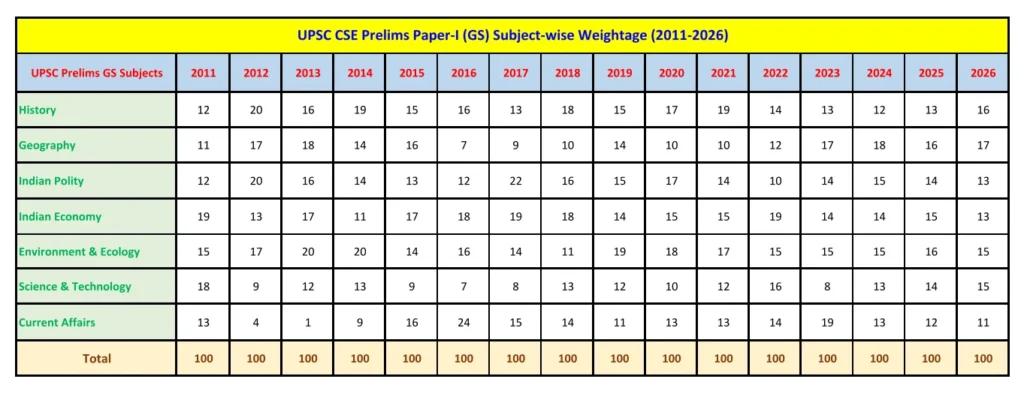
- What the numbers show (2011–2026): Polity and Economy have consistently provided a combined baseline of 26 to 29 questions. Even in the papers of 2025 and 2026, these two subjects remained the most stable source of questions.
- The practical shift: While the volume is stable, the style of testing is changing.
- Polity: UPSC is moving away from direct constitutional articles toward applied administrative scenarios. For example, the 2026 paper introduced practical case-study questions on administrative coordination during vaccine distribution and ethical handling of government contracts.
- Economy: Rote memorization of basic economic terms is no longer enough. The focus is now on institutional frameworks, capital markets (like Alternative Investment Funds in 2025), and the actual operational mechanics of the RBI.
- The Strategy: Aim for maximum accuracy here. Because these sources are standard, your competition will get these right. Focus on understanding the conceptual reasoning behind policies and judgments rather than just memorizing facts.
2. The High-Yield Areas: Geography & Environment
These two subjects have effectively merged into a single major block that now dictates a massive portion of the cutoff.
- What the numbers show (2011–2026): Since the integration of the Indian Forest Service (IFoS) Prelims, Geography and Environment have collectively commanded 31 to 32 questions in both the 2025 and 2026 papers. This means nearly a third of your entire GS paper comes from this combined segment.
- The practical shift: The questions are becoming deeply specific and highly integrated.
- In Geography, standard physical geography has been replaced by highly detailed, current-affairs-linked mapping questions. Recent papers featured specific geographical coordinates, volcanic sites (like Ecuador’s Tungurahua Volcano), and precise river basins.
- In Environment, there is a heavy emphasis on global regulatory frameworks (such as the Paris Agreement’s Article 6 carbon markets and COP28 resolutions) alongside complex conservation biology (focusing on species like the Western Hoolock Gibbon and migration patterns of the Amur Falcon).
- The Strategy: Do not study these two subjects in separate silos. When you study a national park or sanctuary, map its physical terrain, major rivers, and soil types at the same time.
3. The Unpredictable Variables: History, Science & Tech, and Current Affairs
These are the areas where UPSC regularly introduces high volatility, making selective study a risky gamble.
- What the numbers show (2011–2026):
- History saw a notable increase to 16 questions in 2026. The papers show a clear move away from generic Modern History toward highly specific socio-economic terminologies of Ancient and Medieval India (such as kshetra-patni and Araghatta), as well as regional histories like the Ahom kingdom Moidams.
- Science & Technology contributed 14 to 15 questions in 2025 and 2026. The testing has shifted almost entirely to applied, cutting-edge engineering and IT—including Large Language Models (LLMs), Quantum Computing, drone swarms, stealth materials, and deep-sea exploration tech (Matsya-6000).
- Current Affairs is no longer a separate section. It has been integrated into static topics, meaning you are expected to know the static background of any major news event.
- The Strategy: Focus on risk mitigation. Cover the high-yield core areas (like the Indian freedom struggle in History and applied technology in S&T), and don’t spend excessive time trying to cover every minor detail in these volatile subjects.
Part 2: CSAT Paper-II — The Real Roadblock
For years, many aspirants viewed CSAT as a minor hurdle that could be cleared with a week of casual preparation. Today, the data shows that CSAT has become a primary reason for rejection, even for candidates who score well above the cutoff in GS Paper-I.
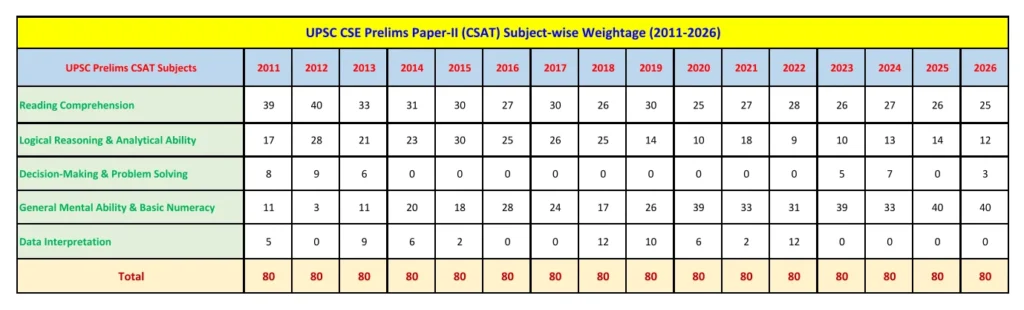
Below is the actual, year-by-year question distribution of the CSAT paper over the last 16 years (2011-2026) papers:
1. The Steady Rise of Basic Numeracy & Mathematics
If you look at the entire timeline from 2011 to 2026, the single most dramatic change is the growth of Mathematics and Basic Numeracy.
- In 2011 and 2012, math was almost non-existent, accounting for only 11 and 3 questions respectively. The paper was heavily language-oriented.
- From 2014 onwards, a steady upward trajectory began, with math questions climbing to 20, breaking into the late 20s by 2016, and eventually taking over the paper with 39 to 40 questions in the 2023–2026 period.
- Today, half of the entire CSAT paper is pure mathematics.
2. The Slow Decline and Stabilization of Reading Comprehension (RC)
- In the early years (2011–2012), RC dominated the exam with 39 to 40 questions.
- Since 2015, UPSC has systematically reduced the share of RC, stabilizing it at a baseline of 25 to 27 questions.
- While RC is no longer enough to clear the paper on its own, it remains a critical safety net. The passages have also evolved from simple factual understandings to deep, interdisciplinary arguments on climate science, technology, and economic policy.
3. The Vanishing and Reappearance of Decision-Making
- Decision-Making was a standard feature from 2011 to 2013 (averaging 6 to 9 questions), where candidates faced no negative marking for these questions.
- In 2014, it completely vanished (0 questions) and remained absent for nearly a decade.
- However, 2023, 2024, and 2026 saw its sudden, unannounced return. In 2026, UPSC introduced 3 applied case-study questions based on administrative ethics. This is a clear warning that no portion of the syllabus is ever truly obsolete.
4. The Unreliability of Data Interpretation (DI)
- DI is highly volatile. It peaked in 2018, 2019, and 2022 (averaging 10 to 12 questions) but dropped to 0 questions in multiple years, including the entire 2023–2026 stretch.
- Relying heavily on DI as a major scoring area is a risky strategy. It is tested as an occasional variable rather than a constant.
Action Plan for Prelims Preparation
- Integrate Geography and Environment: Stop treating them as separate subjects. Use map-based learning to tie ecological concepts directly to physical locations.
- Prioritize Polity & Economy Concepts: Ensure you can explain the core operational logic behind economic indicators or constitutional principles, rather than just memorizing articles and definitions.
- Practice Daily CSAT: Treat CSAT as a core subject. Dedicate an hour every day to building a strong foundation in number properties, logical puzzles, and comprehension reading, rather than leaving it for the final month.
- Develop Data Sufficiency Skills: Practice converting standard mathematical problems into data sufficiency formats. This will help build the deep logical clarity that recent papers require.
Crack UPSC Prelims with a Data-Driven Strategy!
Study smart, not just hard. This analysis decodes 16 years of Prelims (2011-2026), pinpointing high-priority topics in GS-I and CSAT.
Get the free, print-friendly PDF for your offline study sessions.
📥 Download PDF Now| FAQ – UPSC CSE Prelims Trend Analysis |
| Q. With History questions rising, is it safe to skip Ancient and Medieval history? Ans. No, this is highly risky. Recent papers show a clear shift toward deep ancient/medieval terminologies (like kshetra-patni and Araghatta) and regional histories. Focus on high-yield themes like administrative terms, traveler accounts, and religious movements instead of skipping them entirely. Q. Polity is shifting toward applied scenarios. Is standard reading of Laxmikanth still sufficient? Ans. It remains necessary for basic facts, but it is no longer sufficient on its own. You must read constitutional provisions with an analytical eye toward real-world implementation—understanding how laws function on the ground and where administrative friction can occur. Q. S&T tests complex topics like LLMs and Quantum Computing. Do I need a technical background? Ans. No. UPSC only tests the practical application and real-world implications of these technologies. Focus on what the technology does, its basic working mechanism, and why it is of public importance, rather than deep coding or engineering theories. Q. Data Sufficiency dominated CSAT math in 2026. How do I prepare for this? Ans. Shift your focus from calculations to conditions. When solving standard math problems during your practice, identify exactly which pieces of information in the question are absolutely necessary to reach the solution. Q. Can I clear CSAT solely relying on Reading Comprehension? Ans. This is extremely risky. With math and data sufficiency consistently making up half the paper, relying only on English requires near-perfect accuracy under intense exam pressure. It is far safer to build a basic competence in core math topics like number systems, percentages, and ratios. Q. How far back should my Current Affairs preparation go? Ans. Focus on major issues from the last 18 to 24 months. Instead of memorizing minor daily news snippets, understand the static background and long-term policy context of major, recurring national and international themes. |