


UPSC CSE Prelims Syllabus: Comprehensive Paper-Wise Guide & Exam Pattern
The UPSC Civil Services Preliminary Examination serves as the national gateway filter to recruit candidates into prestigious posts such as the IAS, IPS, IFS, IRS, and allied Group ‘A’ and Group ‘B’ central civil services. It is strictly an elimination and screening stage designed to shortlist eligible candidates for the written Mains examination.
Marks obtained in the Preliminary examination are not counted toward the final merit ranking. However, navigating this stage demands absolute precision. This guide presents an exhaustive, micro-topic breakdown of the official syllabus for both Paper-I (General Studies) and Paper-II (CSAT), supported by exam patterns, negative marking dynamics, and actionable preparation blueprints.
Marks obtained in the Preliminary examination are not counted toward the final merit ranking. However, navigating this stage demands absolute precision. This guide presents an exhaustive, micro-topic breakdown of the official syllabus for both Paper-I (General Studies) and Paper-II (CSAT), supported by exam patterns, negative marking dynamics, and actionable preparation blueprints.
1. UPSC CSE Prelims Exam Pattern & Architecture
The Civil Services Preliminary Examination consists of two compulsory objective-type papers conducted offline on OMR sheets on the same day in two sessions:
| Examination Parameter | Official Specification |
|---|---|
| Upcoming Exam Date | 24th May 2026 (Sunday) |
| Number of Compulsory Papers | 2 Compulsory Papers: Paper-I (GS) & Paper-II (CSAT) |
| Mode of Examination | Offline (Pen & Paper mode on OMR response sheets) |
| Question Type | Objective Type (Multiple Choice Questions with 4 options) |
| Total Marks | 400 Marks (200 Marks for Paper-I + 200 Marks for Paper-II) |
| Number of Questions | Paper-I: 100 Questions | Paper-II: 80 Questions |
| Duration of Examination | 2 Hours (120 minutes) per paper [20 min/hour compensatory time for eligible PwBD candidates] |
| Negative Marking Penalty | 1/3rd (33.33%) deduction for every wrong answer marked |
| Language / Medium | Bilingual (Questions printed in both English and Hindi) |
| Counted in Final Merit Ranking? | No (Purely a screening gateway to qualify for Mains) |
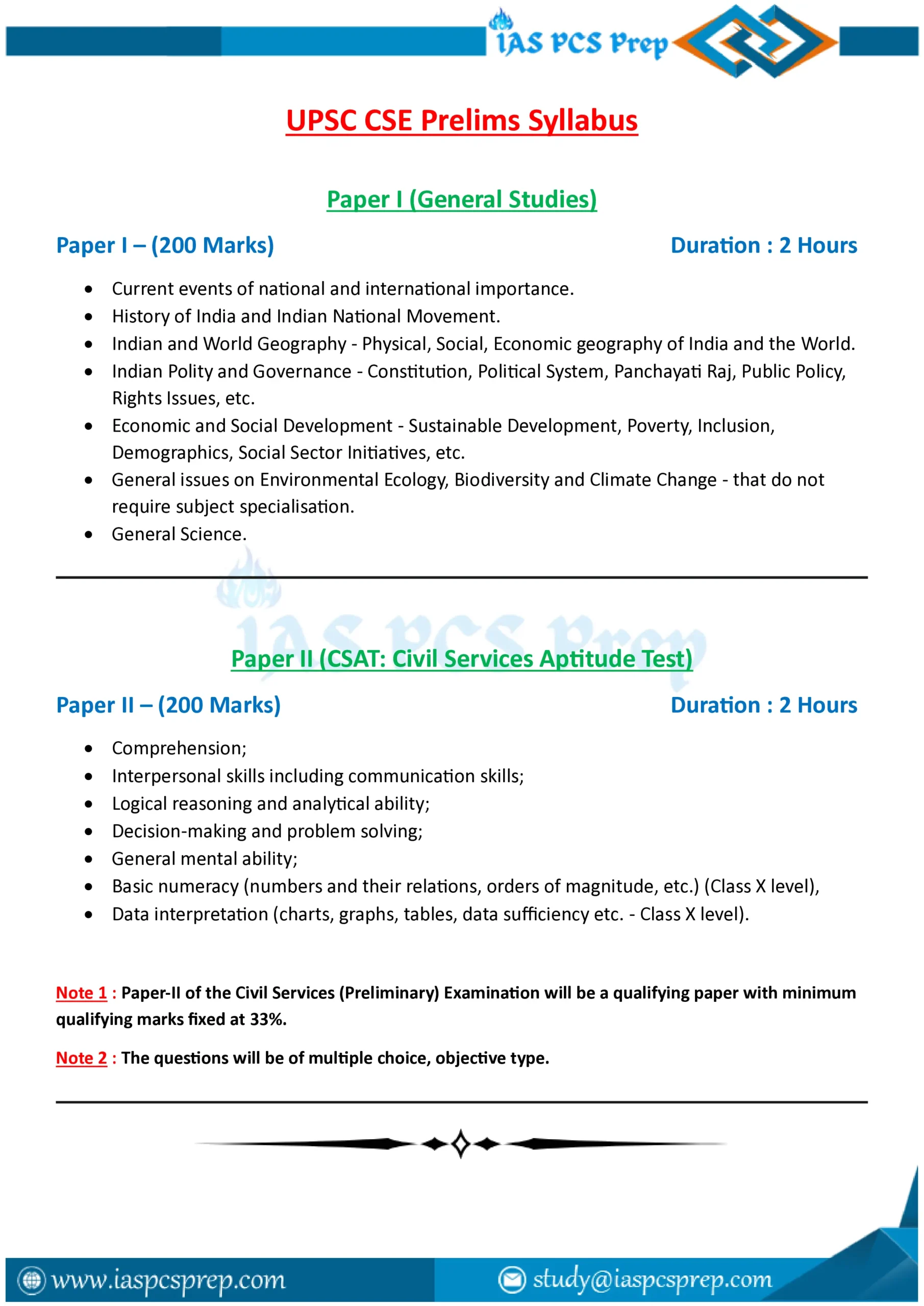
Figure: Official Structure and Core Syllabus of UPSC Civil Services Preliminary Examination
2. Paper-I: General Studies (GS) Complete Syllabus
- Maximum Marks: 200 | Total Questions: 100 | Duration: 2 Hours
- Negative Penalty: -0.66 marks deducted for each incorrect attempt.
- Cutoff Benchmark: Your score in Paper-I alone determines whether you clear the cutoff to write the Mains Examination, provided Paper-II is qualified.
Official Syllabus Breakdown with Micro-Topics:
-
1. Current Events of National and International Importance:
- Major geopolitical summits (G20, BRICS, SCO, COP climate conferences).
- Landmark governmental policies, socio-economic welfare schemes, and legislative acts.
- Bilateral treaties, maritime initiatives, strategic global defense pacts, and international organizations.
- Significant awards, indices, and national rankings released by NITI Aayog and global bodies.
-
2. History of India and Indian National Movement:
- Ancient India: Indus Valley Civilization settlements, Vedic literature, rise of Mahajanapadas, Buddhism & Jainism, Mauryan administrative architecture, and the Gupta Empire.
- Medieval India: Early regional dynasties (Cholas, Pallavas), Delhi Sultanate governance, Vijayanagara Empire, Mughal administrative systems (Mansabdari), and Bhakti-Sufi traditions.
- Modern India & National Movement: British expansion, 1857 revolt, tribal and peasant uprisings, socio-religious reform movements, early congress phase, Swadeshi movement, Gandhian mass movements, revolutionary activities, and Indian Independence Act 1947.
-
3. Indian and World Geography – Physical, Social, Economic:
- Physical Geography: Geomorphology (earthquakes, volcanoes, plate tectonics), Climatology (monsoons, cyclones, atmospheric pressure belts), and Oceanography (ocean currents, salinity, coral reefs).
- Indian Geography: River drainage basins, mountain passes, climate zones, natural vegetation, and soil classification.
- Economic & Human Geography: Mineral resources distribution, industrial corridors, energy reserves, migration patterns, and agricultural crop belts.
-
4. Indian Polity and Governance – Constitution, Political System, Panchayati Raj:
- Preamble, Fundamental Rights (Part III), Directive Principles (Part IV), and Fundamental Duties.
- Union and State Executive (President, Governor, Prime Minister, Chief Minister).
- Parliament and State Legislatures (legislative procedures, bills, committees, parliamentary privileges).
- Indian Judiciary (Supreme Court, High Courts, Judicial Review, Public Interest Litigation).
- Local Self-Government (73rd and 74th Constitutional Amendment Acts, PESA Act).
- Constitutional and Non-Constitutional Bodies (ECI, UPSC, CAG, Finance Commission, NITI Aayog).
-
5. Economic and Social Development:
- National Income Accounting (GDP, GNP, NNP, inflation indices – CPI, WPI).
- Fiscal and Monetary Policy (RBI instruments, Repo, SDF, budget classifications, tax reforms).
- Banking Sector & Capital Markets (NPAs, IBC, SEBI regulations, stock and bond markets).
- Inclusive growth, poverty alleviation, demographic dividend, and Sustainable Development Goals (SDGs).
-
6. Environmental Ecology, Biodiversity, and Climate Change:
- Ecosystem functioning, food chains, trophic levels, and ecological succession.
- Biodiversity conservation: National Parks, Wildlife Sanctuaries, Biosphere Reserves, Ramsar Wetlands.
- IUCN Red List status of endangered and critically endangered species.
- International environmental conventions: UNFCCC, CBD, CITES, Ramsar, Vienna Convention.
-
7. General Science & Emerging Technologies:
- Core scientific principles in Biology, Physics, and Chemistry (everyday applications).
- Frontier technologies: Artificial Intelligence, Quantum Computing, Blockchain, Biotechnology, Gene Editing (CRISPR-Cas9), Space missions (ISRO/NASA), and defense systems.
WhatsApp Channel
Follow Now3. Paper-II: Civil Services Aptitude Test (CSAT) Syllabus
- Maximum Marks: 200 | Total Questions: 80 | Duration: 2 Hours
- Negative Penalty: -0.83 marks deducted for each incorrect attempt.
- Mandatory Qualifying Nature: Candidates must score a minimum of 33% (66 marks out of 200) to qualify. Marks scored in CSAT are not included in the cutoff determination, but failing CSAT results in immediate disqualification regardless of your score in Paper-I.
Official CSAT Syllabus Curriculum:
- Comprehension: Short and long unseen reading passages evaluating logical inference, analytical deductions, central themes, and contextual implications.
- Interpersonal Skills including Communication Skills: Understanding verbal context and scenario-based communication.
- Logical Reasoning and Analytical Ability: Syllogisms, coding-decoding, blood relations, seating arrangements, directional puzzles, statement-assumption, and critical reasoning.
- Decision-Making and Problem-Solving: Practical administrative dilemmas requiring balanced ethical choices.
- General Mental Ability: Series completion, clocks, calendars, cubes and dice, spatial and Venn diagrammatic reasoning.
- Basic Numeracy (Class X Level): Number systems, divisibility rules, remainders, LCM & HCF, percentages, profit & loss, simple & compound interest, ratio & proportion, averages, time & work, permutations & combinations, and probability.
- Data Interpretation (Class X Level): Charts, bar graphs, tables, pie charts, and data sufficiency analysis.
Mandatory Examination Attendance Rule: Candidates must physically appear in both papers (Paper-I and Paper-II) of the Preliminary Examination. If a candidate appears in Paper-I in the morning session but remains absent in Paper-II in the afternoon session, they will be summarily disqualified, and their Paper-I will not be evaluated.
4. Official Rules Governing Attempts & Evaluation
- What Officially Constitutes an “Attempt”?
- An attempt is officially counted if a candidate appears in at least one paper of the Preliminary Examination.
- Simply filling out and submitting the online application form does not count as an attempt if the candidate remains absent on exam day.
- If a candidate writes Paper-I, marks attendance, and leaves without writing Paper-II, the attempt is officially recorded.
- Even if a candidate’s candidature is subsequently cancelled or disqualified during the exam, the appearance still counts as an attempt.
- Negative Marking Protocol:
- Every question features four answer alternatives. Marking an incorrect option results in a deduction of one-third (1/3rd) of the marks assigned to that question.
- If a candidate selects more than one bubble on the OMR sheet for a single question, it is treated as an incorrect answer—even if one of the choices happens to be correct—and the penalty applies.
- Unanswered questions left completely blank incur zero penalty.
Frequently Asked Questions (FAQs)
Q1. What is the official website to verify the UPSC CSE Prelims Syllabus?
Ans. The authentic official portal for checking and downloading the UPSC Civil Services Preliminary examination syllabus is upsc.gov.in.
Q2. What is the overall structure of the Civil Services Examination?
Ans. The Civil Services Examination consists of two sequential stages:
- Stage 1: Civil Services (Preliminary) Examination (Objective type screening test comprising GS Paper-I and CSAT Paper-II).
- Stage 2: Civil Services (Main) Examination, which includes the Written Descriptive Examination (9 papers totaling 1750 marks) followed by the Personality Test / Interview (275 marks).
Q3. If I fill out the Prelims application form but do not appear on exam day, is my attempt counted?
Ans. No. Merely submitting the application form does not consume an attempt. Your attempt is counted only if you physically attend the exam center and appear for at least one paper in the Preliminary examination.
Q4. What are the minimum qualifying marks for CSAT (Paper-II)?
Ans. Under current UPSC examination rules, CSAT (General Studies Paper-II) requires a fixed qualifying benchmark of 33%, which translates to a minimum of 66 marks out of 200 (net of negative marking).
Q5. Are Prelims marks added to determine the final rank and service allotment?
Ans. No. The Preliminary examination functions purely as a screening filter. Marks scored in Prelims are completely excluded from the final merit order. Final selection, ranking, and service allocations (IAS, IPS, IFS, etc.) depend entirely on the combined marks scored in the written Mains examination (1750 marks) and the Personality Test (275 marks), totaling 2025 marks.
Q6. How does the negative marking mechanism operate in Prelims?
Ans. One-third (1/3rd) of the marks allocated to a question is deducted as penalty for every wrong attempt (-0.66 marks in Paper-I and -0.83 marks in Paper-II). If you select multiple options for a single question, it is evaluated as a wrong answer and penalized. Questions left unattempted carry zero deduction.
Q7. Where can I find more authentic information and official notifications about UPSC CSE?
Ans. Aspirants can access comprehensive exam notifications, previous years’ official question papers, and authentic commission updates directly from the official portal at upsc.gov.in and its dedicated FAQ repository at upsc.gov.in/faqs.
Master the UPSC Prelims Syllabus!
Know what to study. Success starts with a clear understanding of the GS and CSAT topics.
Download the simplified PDF to track your progress.
📥 Download PDF Now