

History Syllabus and Some PYQs
To help you stay focused, this post puts everything you need in one place: the exact syllabus, a topic-by-topic timeline from Ancient to World History, past year trends, and actual PYQs with solutions so you know exactly how UPSC asks questions.
Syllabus for UPSC Prelims (History):
- History of India and Indian National Movement.
Syllabus for UPSC Mains (History):
- Indian culture will cover the salient aspects of Art Forms, literature, and Architecture from ancient to modern times.
- Modern Indian history from about the middle of the eighteenth century until the present- significant events, personalities, issues.
- The Freedom Struggle — its various stages and important contributors/contributions from different parts of the country.
- Post-independence consolidation and reorganization within the country.
- History of the world will include events from the 18th century such as the Industrial Revolution, world wars, redrawal of national boundaries, colonization, decolonization, political philosophies like communism, capitalism, socialism, etc.— their forms and effects on society.
UPSC History Trend Analysis (Prelims) (2011-2026)
| History Prelims Examination Trend Analysis (2011-2026) | ||||||||||||||||
|---|---|---|---|---|---|---|---|---|---|---|---|---|---|---|---|---|
| Year | 2011 | 2012 | 2013 | 2014 | 2015 | 2016 | 2017 | 2018 | 2019 | 2020 | 2021 | 2022 | 2023 | 2024 | 2025 | 2026 |
| No. of Questions | 12 | 20 | 16 | 19 | 15 | 16 | 13 | 18 | 15 | 17 | 19 | 14 | 13 | 12 | 13 | 16 |
UPSC History Trend Analysis (Mains) (2013-2025)
| History Mains Examination Trend Analysis (2013-2025) | |||||||||||||
|---|---|---|---|---|---|---|---|---|---|---|---|---|---|
| Year | 2013 | 2014 | 2015 | 2016 | 2017 | 2018 | 2019 | 2020 | 2021 | 2022 | 2023 | 2024 | 2025 |
| No. of Questions (Marks) |
13 (130) |
10 (100) |
6 (75) |
6 (75) |
7 (90) |
6 (75) |
5 (60) |
6 (75) |
7 (75) |
6 (75) |
6 (75) |
6 (75) |
6 (75) |
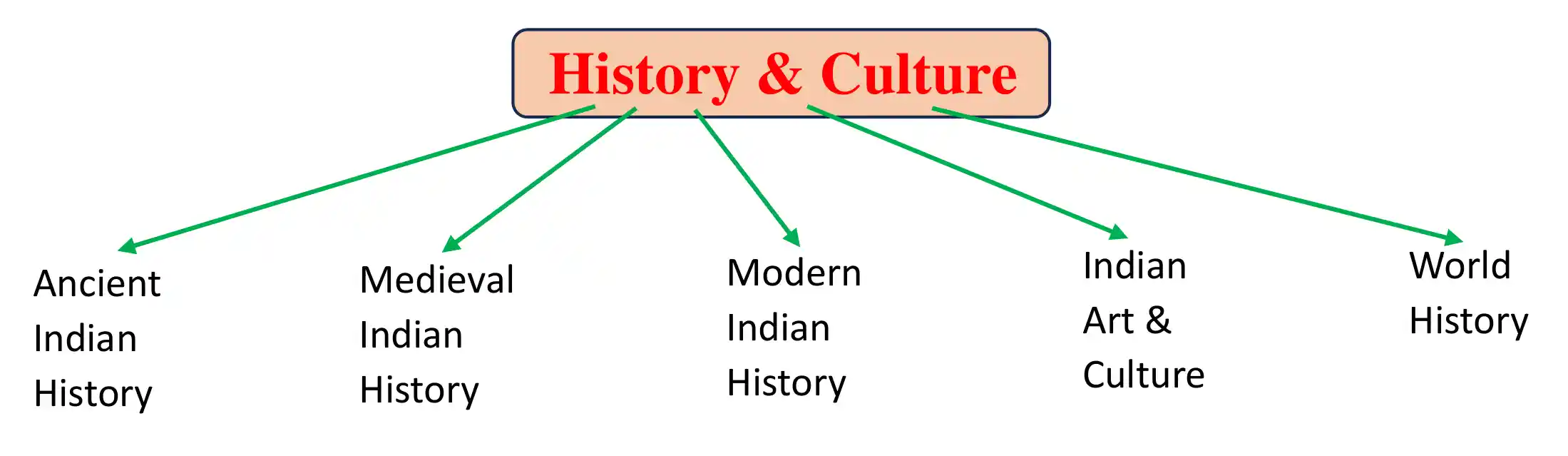
Ancient Indian History (20 lakh BC – 750 AD)
- Sources
- Pre-Historic Period (Stone Age) (2 Million BC – 1000 BC)
- Palaeolithic Age (Old Stone Age) (2 Million BC – 10,000 BC)
- Mesolithic Age (Middle Stone Age) (10,000 BC – 6000 BC)
- Neolithic Age (New Stone Age) (6000 BC – 2000 BC)
- Chalcolithic Age (Copper-Stone Age) (3500 BC – 1000 BC)
- Indus Valley Civilization (IVC) (2600 BC – 1900 BC)
- Vedic Period: Early Vedic Period (Rigvedic Age) (1500 BC – 1000 BC)
- Vedic Period: Later Vedic Period (1000 BC – 600 BC)
- Mahajanapadas and Rise of Magadha (600 BC – 321 BC)
- Rise of Jainism and Buddhism (6th Century BC – 5th Century BC)
- Persian and Macedonian (Alexander) Invasions (550 BC – 326 BC)
- Mauryan Empire (322 BC – 185 BC)
- Post-Mauryan Period: Indigenous Rulers (Sungas, Kanvas, Satavahanas, Chedis) (185 BC – 300 AD)
- Post-Mauryan Period: Foreign Invasions (Indo-Greeks, Shakas, Parthians, Kushans) (200 BC – 250 AD)
- Early Sangam Age in South India (Cheras, Cholas, Pandyas) (300 BC – 300 AD)
- Gupta Empire (Golden Age) (319 AD – 550 AD)
- Post-Gupta Period and Vardhana Dynasty (Harshavardhana) (550 AD – 647 AD)
- Early Chalukyas of Badami and Pallavas of Kanchi (550 AD – 750 AD)
Medieval Indian History
- Early Medieval Period and Tripartite Struggle (Palas, Pratiharas, Rashtrakutas) (750 AD – 1000 AD)
- Imperial Cholas of Thanjavur (850 AD – 1279 AD)
- Arab Conquest of Sindh (Muhammad bin Qasim) (712 AD)
- Ghaznavid and Ghorid Invasions (Battles of Tarain) (1000 AD – 1192 AD)
- Delhi Sultanate: Slave / Mamluk Dynasty (1206 AD – 1290 AD)
- Delhi Sultanate: Khalji Dynasty (1290 AD – 1320 AD)
- Delhi Sultanate: Tughlaq Dynasty (1320 AD – 1414 AD)
- Delhi Sultanate: Sayyid Dynasty (1414 AD – 1451 AD)
- Delhi Sultanate: Lodi Dynasty (1451 AD – 1526 AD)
- Vijayanagara Empire (1336 AD – 1646 AD)
- Bahmani Kingdom and Deccan Sultanates (1347 AD – 1687 AD)
- Bhakti and Sufi Movements (8th Century AD – 17th Century AD)
- Early Mughal Empire (Babur and Humayun) (1526 AD – 1540 AD)
- Sur Empire (Sher Shah Suri) (1540 AD – 1555 AD)
- Mughal Empire at its Zenith (Akbar, Jahangir, Shah Jahan, Aurangzeb) (1556 AD – 1707 AD)
- Rise of the Marathas and Shivaji Maharaj (1627 AD – 1680 AD)
- Peshwa Rule and Maratha Confederacy (1713 AD – 1818 AD)
- Later Mughals and 18th Century Regional States (Bengal, Awadh, Hyderabad, Mysore, Punjab) (1707 AD – 1761 AD)
Modern Indian History & Freedom Struggle
- Advent of European Powers (Portuguese, Dutch, British, French) (1498 AD – 1740 AD)
- Anglo-French Carnatic Wars (1746 AD – 1763 AD)
- British Conquest of Bengal (Plassey, Buxar, Dual System) (1757 AD – 1772 AD)
- British Expansion (Anglo-Mysore, Anglo-Maratha, Anglo-Sikh Wars) (1767 AD – 1849 AD)
- British Land Revenue Systems (Permanent, Ryotwari, Mahalwari) (1793 AD – 1833 AD)
- Early Peasant, Civil, and Tribal Uprisings (1763 AD – 1856 AD)
- Socio-Religious Reform Movements (19th Century) (1815 AD – 1900 AD)
- Great Revolt of 1857 and End of Company Rule (1857 AD – 1858 AD)
- Development of Press and Modern Education (1813 AD – 1944 AD)
- Rise of Early Nationalism and Pre-Congress Bodies (1866 AD – 1884 AD)
- Foundation of INC and Moderate Phase (1885 AD – 1905 AD)
- Partition of Bengal, Swadeshi Movement and Rise of Extremism (1905 AD – 1911 AD)
- Surat Split (1907 AD) and Morley-Minto Reforms (1909 AD)
- Early Revolutionary Phase (India and Abroad) (1907 AD – 1917 AD)
- Home Rule League Movement and Lucknow Pact (1916 AD)
- Arrival of Mahatma Gandhi and Early Satyagrahas (Champaran, Ahmedabad, Kheda) (1915 AD – 1918 AD)
- Rowlatt Act, Jallianwala Bagh and Montagu-Chelmsford Reforms (1919 AD)
- Khilafat and Non-Cooperation Movement (1920 AD – 1922 AD)
- Swarajists Phase and Constructive Work (1922 AD – 1927 AD)
- Simon Commission, Nehru Report and 14 Points (1927 AD – 1929 AD)
- Second Revolutionary Phase (HRA, HSRA, Chittagong Raid) (1924 AD – 1934 AD)
- Lahore Session and Civil Disobedience Movement (1929 AD – 1934 AD)
- Round Table Conferences and Poona Pact (1930 AD – 1932 AD)
- Government of India Act 1935 and 1937 Elections (1935 AD – 1939 AD)
- August Offer (1940 AD) and Cripps Mission (1942 AD)
- Quit India Movement (1942 AD)
- Subhash Chandra Bose, INA and INA Trials (1942 AD – 1946 AD)
- Cabinet Mission, Direct Action Day and Interim Government (1946 AD)
- Mountbatten Plan, Partition and Indian Independence Act (1947 AD)
Post-Independence India
- Partition Aftermath and Refugee Rehabilitation (1947 AD – 1950 AD)
- Integration of Princely States (Sardar Patel and V.P. Menon) (1947 AD – 1949 AD)
- Enactment of the Indian Constitution (1950 AD)
- First General Elections (1951 AD – 1952 AD)
- Linguistic Reorganisation of States (Fazal Ali Commission) (1953 AD – 1956 AD)
- Tribal Policies (Panchsheel) and Border Settlements (1950s AD – 1960s AD)
- Land Reforms, Five-Year Plans and Industrial Policy (1951 AD – 1966 AD)
- Green Revolution and White Revolution (1965 AD – 1975 AD)
- Evolution of Non-Alignment Movement (NAM) and Foreign Policy (1954 AD – 1961 AD)
- Major Wars: 1947-48 (Pak), 1962 (China), 1965 (Pak), 1971 (Bangladesh Liberation) (1947 AD – 1971 AD)
- Pokhran-I (1974 AD) and Pokhran-II Nuclear Tests (1998 AD)
- JP Movement, Internal Emergency and Restoration of Democracy (1974 AD – 1977 AD)
- Regional Accords and Insurgencies (Punjab, Assam, Northeast) (1980s AD)
- LPG Economic Reforms (New Economic Policy) (1991 AD)
Indian Art and Culture
- Pre-Historic Rock Art and Cave Paintings (Bhimbetka) (10,000 BC – 2000 BC)
- Harappan Arts, Seals and Bronze Sculptures (2600 BC – 1900 BC)
- Mauryan Art and Ashokan Pillars (300 BC – 200 BC)
- Buddhist and Jain Cave Architecture (Karle, Bhaja, Ajanta, Ellora) (200 BC – 800 AD)
- Sculpture Schools: Gandhara, Mathura, and Amaravati (1st Century BC – 4th Century AD)
- Stupa Architecture (Sanchi, Bharhut, Amravati) (3rd Century BC – 2nd Century AD)
- Nagara Temple Architecture (North, Odisha, Khajuraho, Gujarat) (5th Century AD – 13th Century AD)
- Dravida Temple Architecture (Pallava, Chola, Vijayanagara) (6th Century AD – 16th Century AD)
- Vesara Temple Architecture (Chalukya, Rashtrakuta, Hoysala) (7th Century AD – 13th Century AD)
- Delhi Sultanate Architecture (Arcuate Style, Qutb Complex) (1206 AD – 1526 AD)
- Mughal Architecture and Gardens (Humayun’s Tomb, Fatehpur Sikri, Taj Mahal) (1556 AD – 1707 AD)
- Colonial and Modern Architecture (Indo-Saracenic, Lutyens’ Delhi) (1858 AD – 1947 AD)
- Miniature Painting Traditions (Pala, Mughal, Rajasthani, Pahari) (10th Century AD – 19th Century AD)
- Classical Dances (8 SNA Forms) and Major Folk Dance Traditions (Ancient to Present)
- Classical Music: Hindustani and Carnatic Traditions (Vedic to Present)
- Six Schools of Indian Philosophy (Shad-Darshana) (6th Century BC – 4th Century AD)
- Traditional Theatres, Puppetry and UNESCO Intangible Heritage (Ancient to Present)
World History
- Scientific Revolution and the Enlightenment (17th Century AD – 18th Century AD)
- American Revolution and Declaration of Independence (1775 AD – 1783 AD)
- French Revolution and Rise of Nationalism (1789 AD – 1799 AD)
- Napoleonic Era, Continental System and Battle of Waterloo (1799 AD – 1815 AD)
- Industrial Revolution (Britain to Worldwide) (1750 AD – 1850 AD)
- Rise of Political Ideologies (Capitalism, Socialism, Marxism) (19th Century AD)
- Unification of Italy (Risorgimento) (1848 AD – 1870 AD)
- Unification of Germany (Bismarck’s Blood & Iron) (1864 AD – 1871 AD)
- Imperialism and Scramble for Africa (1884 AD – 1914 AD)
- Imperialism in Asia (Opium Wars, Spheres of Influence, Meiji Restoration) (1839 AD – 1905 AD)
- First World War (Causes, Course, Global Impact) (1914 AD – 1918 AD)
- Treaty of Versailles and League of Nations (1919 AD – 1920 AD)
- Russian Revolution and Formation of the USSR (1917 AD – 1922 AD)
- The Great Economic Depression (1929 AD – 1939 AD)
- Rise of Fascism in Italy and Nazism in Germany (1922 AD – 1939 AD)
- Second World War and The Holocaust (1939 AD – 1945 AD)
- Establishment of the United Nations (UN) (1945 AD)
- Post-WWII Decolonization in Asia and Africa (1945 AD – 1975 AD)
- Cold War Flashpoints (Berlin, Korea, Cuba, Vietnam, Afghanistan) (1947 AD – 1989 AD)
- Fall of the Berlin Wall (1989 AD) and Dissolution of the USSR (1991 AD)
Some Previous Years’ UPSC Prelims Questions (History)
- a) Running the Secret Congress Radio in the wake of Quit India Movement.
- b) Participating in the Second Round Table conference.
- c) Leading a contingent of Indian National Army.
- d) Assisting in the formation of Interim Government under Pandit Jawahar Lal Nehru.
Show / Hide Answer
- 1. The rent was paid directly by the peasants to the Govt.
- 2. The government gave Pattas to the Ryots.
- 3. The lands were surveyed and assessed before being taxed.
Which of the statements given above is/are correct?
- a) 1 only
- b) 1 and 2 only
- c) 1, 2 and 3
- d) None
Show / Hide Answer
- 1. Dadu Dayal
- 2. Guru Nanak
- 3. Tyagaraja
Who among the above was/were preaching when the Lodi dynasty fell and Babur took over ?
- a) 1 and 3
- b) 2 only
- c) 2 and 3
- d) 1 and 2
Show / Hide Answer
- a) the First World War when Indian troops were needed by the British and the Partition was ended.
- b) King George V abrogated Curzon’s Act at the Royal Durbar in Delhi in 1911.
- c) Gandhiji launched his Civil Disobedience Movement.
- d) the Partition of India in 1947 when East Bengal became East Pakistan.
Show / Hide Answer
- a) V.O. Chidambaram Pillai
- b) C. Rajagopalachari
- c) K. Kamaraj
- d) Annie Besant
Show / Hide Answer
- a) agriculturists
- b) warriors
- c) weavers
- d) traders
Show / Hide Answer
- a) Define the jurisdiction of the Central & Provincial Governments.
- b) Define the powers of the Secretary of State for India.
- c) Impose censorship on national press.
- d) Improve the relationship between the Government of India and the Indian States.
Show / Hide Answer
- a) Francois Bernier
- b) Jean-Baptiste Tavernier
- c) Jean de Thevenot
- d) Abbe Barthelemy Carre
Show / Hide Answer
- a) Chanhudaro
- b) Kot diji
- c) Sohgaura
- d) Desalpur
Show / Hide Answer
- a) The Revolt of 1857
- b) The Mapilla Rebellion of 1921
- c) The Indigo Revolt of 1859-60
- d) Birsa Munda’s Revolt of 1899-1900
Show / Hide Answer
- a) Annie Besant
- b) Debendranath Tagore
- c) Ishwar Chandra Vidyasagar
- d) Sarojini Naidu
Show / Hide Answer
- 1. Barindra Kumar Ghosh
- 2. Jogesh Chandra Chatterjee
- 3. Rash Behari Bose
Who of the above was / were actively associated with the Ghadar Party?
- a) 1 and 2
- b) 2 only
- c) 1 and 3
- d) 3 only
Show / Hide Answer
- a) Ahmad Shah
- b) Mahmud Begarha
- c) Bahadur Shah
- d) Muhammad Shah
Show / Hide Answer
- a) Prajnaparamita Sutra
- b) Visuddhimagga
- c) Sarvastivada Vinaya
- d) Lalitavistara
Show / Hide Answer
- I. He possessed great love and respect for the traditional philosophical systems of the East.
- II. He desired his countrymen to accept the rational and scientific approach and the principle of human dignity and social equality of all men and women.
Which of the statements given above is/are correct?
- a) I only
- b) II only
- c) Both I and II
- d) Neither I nor II
Show / Hide Answer
The genesis of political alliances based on community lay in the very nature of the Montague-Chelmsford Reforms, 1919.
Which of the following statements support/supports the above assertion?
- 1. Reforms retained and extended the principle of separate electorates.
- 2. Separate electorates were supposed to counter Indian nationalism, which was growing stronger.
- 3. Deprived classes rallied around the favours inherent in separate electorates.
Select the answer using the code given below:
- a) 1 only
- b) 2 and 3 only
- c) 1 and 2 only
- d) 1, 2 and 3
Show / Hide Answer
Some Previous Years’ UPSC Mains Questions (History)
Q1. “In many ways, Lord Dalhousie was the founder of modern India.” Elaborate.
Q2. The third battle of Panipat was fought in 1761. Why were so many empire-shaking battles fought at Panipat?
Q3. Mesolithic rock cut architecture of India not only reflects the cultural life of the times but also a fine aesthetic sense comparable to modern painting. Critically evaluate this comment.
Q4. Highlight the differences in the approach of Subhash Chandra Bose and Mahatma Gandhi in the struggle for freedom?
Q5. Why did the ‘Moderates’ fail to carry conviction with the nation about their proclaimed ideology and political goals by the end. of the nineteenth century?
Q6. Safeguarding the Indian art heritage is the need of the moment. Discuss.
Q7. Examine the linkages between the nineteenth century’s “Indian Renaissance” and the emergence of national identity.
Q8. Pala period is the most significant phase in the history of Buddhism in India. Enumerate.
Q9. Bring out the constructive programmes of Mahatma Gandhi during Non-Cooperation Movement and Civil Disobedience Movement.
Q10. Discuss the main contributions of Gupta Period and Chola Period to Indian heritage and culture.
Q11. What was the difference between Mahatma Gandhi and Rabindranath Tagore in their approach towards education and nationalism?
Q12. What were the events that led to the Quit India Movement? Point out its results.
Q13. The French Revolution has enduring relevance to the contemporary world. Explain.
History Syllabus and Some PYQs PDF
✓ Free Download • Printable Notes