

Pre-historic Period (Stone Age)
This complete guide explores the three major divisions of the Stone Age—Palaeolithic, Mesolithic, and Neolithic—along with their tool traditions, rock art heritage, and crucial archaeological sites for UPSC & State PCS examinations.
1. Introduction & Tripartite Classification of Stone Age
- Definition of Pre-history: The era characterized by the complete absence of written records. All historical reconstructions rely on archaeological remains such as stone implements, bone tools, rock shelters, and fossil beds.
- Pioneering Discoveries: Prehistoric archaeology in India began when Robert Bruce Foote discovered the first Palaeolithic tool—a quartzite handaxe—at Pallavaram near Madras (Chennai) in 1863. Foote is rightfully regarded as the “Father of Indian Pre-history.”
- The Three-Age System: Danish scholar Christian Jürgensen Thomsen classified human antiquity into Stone, Bronze, and Iron ages. The Stone Age is further divided into three distinct phases based on geological epoch, climate, and tool technology:
- Palaeolithic Age (Old Stone Age): c. 2 Million – 10,000 BCE (Pleistocene Epoch / Ice Age)
- Mesolithic Age (Middle Stone Age / Late Stone Age): c. 10,000 – 6,000 BCE (Holocene Epoch / Warm Climate)
- Neolithic Age (New Stone Age): c. 6,000 – 1,000 BCE (Food production & settled life)
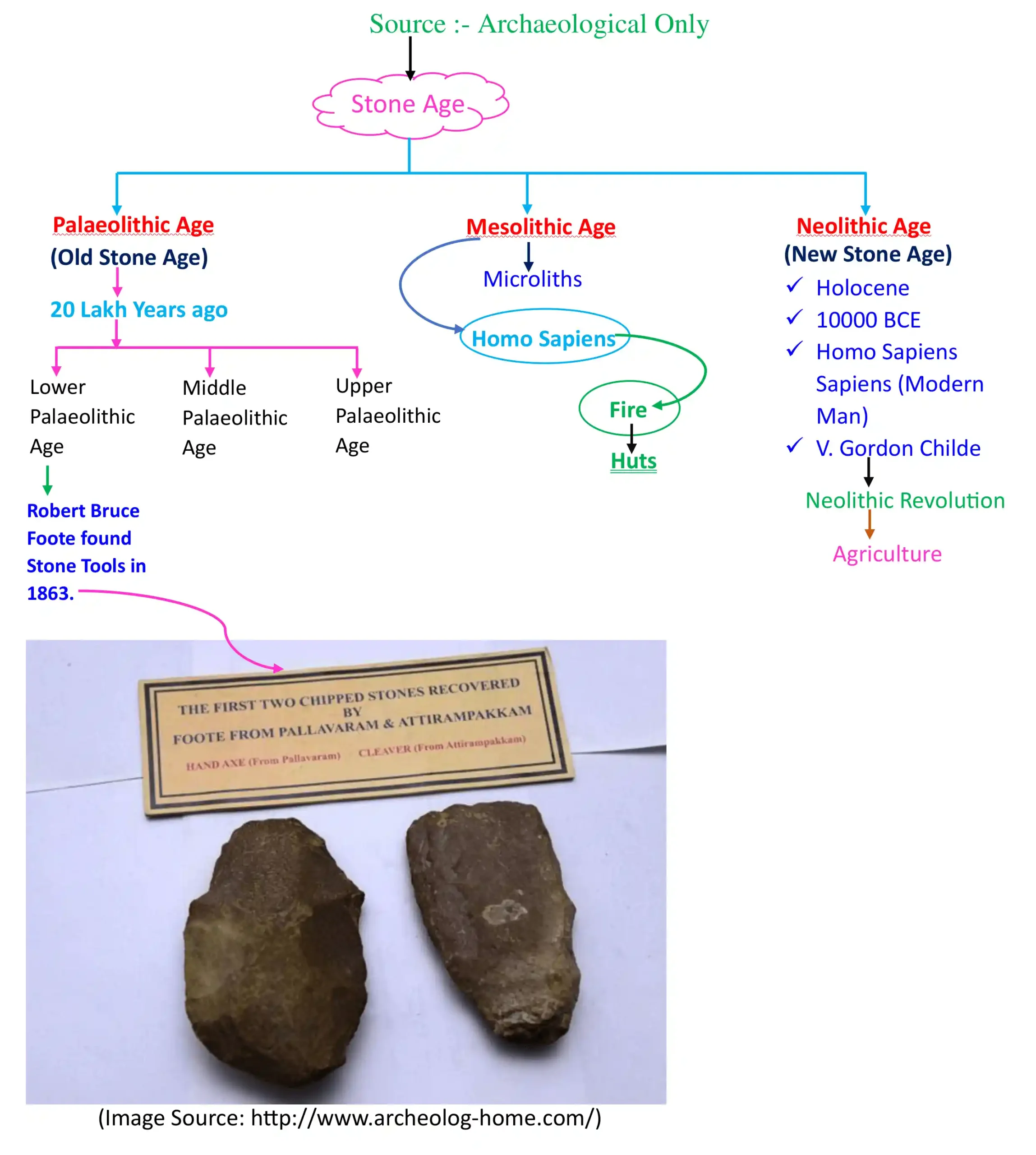
2. Palaeolithic Age (Old Stone Age | c. 2 Million – 10,000 BCE)
The Palaeolithic Age in India developed during the Pleistocene Epoch (Ice Age). Early humans lived as nomadic hunter-gatherers, possessed no knowledge of agriculture, pottery, or metal, and made heavy tools out of hard rock called Quartzite (earning them the title “Quartzite Men”).
-
A. Lower Palaeolithic (c. 2 Million – 100,000 BCE):
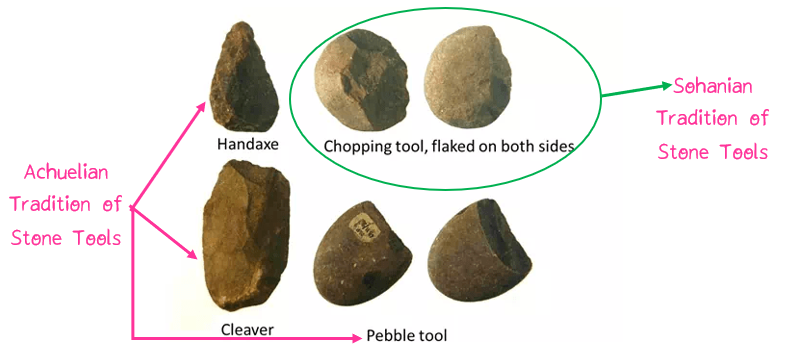
- Tool Types: Large core tools made by pebble flaking—Handaxes, Cleavers, and Chopper-Chopping tools.
- Two Distinct Traditions:
- Soan Culture (Punjab, Pakistan): Dominated by pebble/chopper-chopping implements.
- Acheulian / Madrasian Culture (South India): Dominated by bifacial handaxes and cleavers (Attirampakkam, Pallavaram).
- Key Sites: Bori (Maharashtra – earliest dated human tool site ~1.4 mya), Bhimbetka (MP), Hunsgi (Karnataka), Didwana (Rajasthan), and Belan Valley (UP).
-
B. Middle Palaeolithic (c. 100,000 – 40,000 BCE):
- Tool Technology: Shift from core tools to Flake tools made of fine-grained siliceous stones like chert, jasper, and agate. Characterized as the Nevasan Culture after the site of Nevasa (Maharashtra).
- Key Tools: Scrapers, Borers, Points, and Blades.
- Key Sites: Nevasa (Maharashtra), Bhimbetka rock shelters (MP), Samnapur in Narmada Valley (MP), and Kalpi (UP).
-
C. Upper Palaeolithic (c. 40,000 – 10,000 BCE):
- Characteristics: Emergence of anatomically modern humans (Homo sapiens), warm transition at the end of the Ice Age, and the dawn of primitive rock art.
- Tool Technology: Blade and Burin industry with long, parallel-sided flint blades; first widespread use of bone tools (harpoons, needles).
- Key Sites: Kurnool Caves and Muchchatla Chintamanu Gavi (Andhra Pradesh – bone tools), Renigunta (AP), Belan Valley (UP – bone mother goddess idol at Lohanda Nala), and Patne (Maharashtra – engraved ostrich eggshell beads).
3. Mesolithic Age (Middle Stone Age | c. 10,000 – 6,000 BCE)
- Climatic Transition: Coincided with the advent of the warm and humid Holocene Epoch. Melting glaciers created thick forests and rich grasslands, expanding fast-moving small fauna (deer, rabbits, birds) and aquatic resources.
- Microlithic Tool Technology: Characterized by tiny, refined stone tools called Microliths (measuring 1 cm to 5 cm in length), made of chalcedony, chert, and quartz.
- Geometric and Non-Geometric Tools: Blades, lunates, trapezes, triangles, and arrowheads.
- Composite Tool Mechanism: Microliths were hafted onto wooden or bone handles to make composite spears, sickles, and bows/arrows.
- Economic Shift & Domestication: Transition from exclusive big-game hunting to broad-spectrum foraging, fishing, and earliest animal domestication (dogs, cattle, sheep, goats).
- Key Mesolithic Sites:
- Adamgarh (Madhya Pradesh) & Bagor (Rajasthan): Earliest archaeological evidence of animal domestication in India (c. 5000 BCE). Bagor on river Kothari is India’s largest Mesolithic settlement.
- Sarai Nahar Rai, Mahadaha, & Damdama (Ganga Valley, UP): Rich evidence of microliths, bone ornaments, hearths, microlithic burials, and joint graves.
- Langhnaj (Gujarat): Human skeletons, microliths, and faunal remains.
- Teri Sites (Tamil Nadu): Fossilized red sand dunes yielding quartz microlith assemblages.
4. Pre-historic Rock Art in India
Prehistoric rock paintings serve as a vital visual window into the social, ritual, and economic world of Stone Age hunter-gatherers and pastoralists.
- First Discovery: Discovered in India in 1867–68 by archaeologist Archibald Carlleyle at Sohagighat in the Kaimur Hills (UP), twelve years before the famous discovery of Altamira cave paintings in Spain.
-
Bhimbetka Caves (Madhya Pradesh):
- Located in the foothills of Vindhyan ranges near Bhopal, discovered by V.S. Wakankar in 1957 and designated a UNESCO World Heritage Site in 2003.
- Contains over 750 rock shelters spanning Upper Palaeolithic, Mesolithic, Neolithic, and historic periods.
- Mesolithic Dominance: The largest and most vibrant paintings belong to the Mesolithic phase, illustrating hunting scenes, animal chases, collective stick-figure dances, childbirth, and burial rituals.
- Pigments Used: Natural mineral colors—red from hematite (geru), white from limestone/gypsum, green from chalcedony, mixed with animal fat and tree resin.
5. Neolithic Revolution (New Stone Age | c. 6,000 – 1,000 BCE)
Australian archaeologist V. Gordon Childe coined the phrase “Neolithic Revolution” because the shift from nomadic food-gathering to sedentary food-producing triggered profound transformations in human culture, economy, and society.
-
Pillars of the Neolithic Transition:
- Polished Stone Celts: Ground, pecked, and polished stone axes and adzes with sharp, durable cutting edges.
- Agriculture: Systematic cultivation of wheat, barley, rice, and pulses.
- Invention of Pottery: Hand-made and wheel-turned pottery (cord-impressed, burnished grey/black ware) to store surplus grains and cook pulses.
- Permanent Sedentary Villages: Mud-brick and wattle-and-daub huts replacing open cave shelters.
-
Major Regional Neolithic Sites in India:
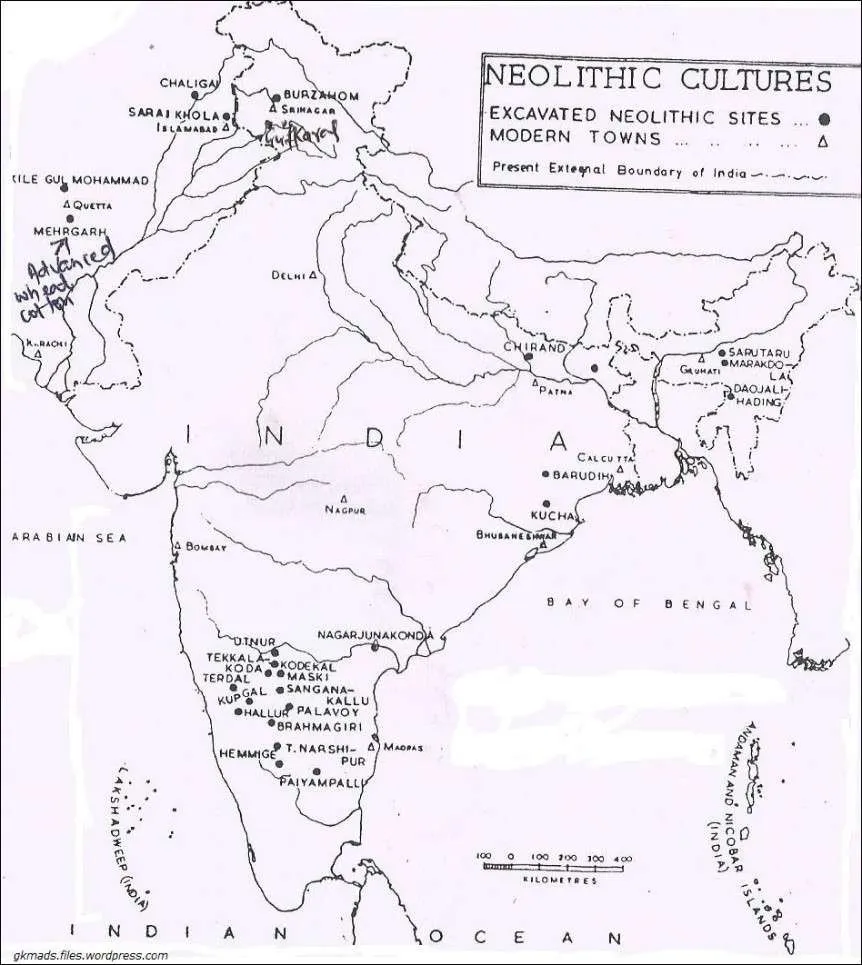
- Mehrgarh (Balochistan, Pakistan): The oldest Neolithic site in the subcontinent (c. 7000 BCE). Shows continuous evolution from aceramic Neolithic to bronze age; earliest evidence of wheat/barley farming, cattle rearing, and mud-brick houses.
- Burzahom & Gufkral (Kashmir Valley): Known for unique subterranean pit-dwellings (shelter from freezing winds), bone tools, polished stone axes, and unique graves where master and pet dogs were buried together.
- Lahuradewa (Sant Kabir Nagar, UP): Yielded earliest carbonized rice husk evidence dating back to c. 9000–7000 BCE, reshaping theories on rice domestication in Asia.
- Koldihwa & Mahagara (Belan Valley, UP): Early evidence of rice cultivation, circular huts, and cattle pens.
- Chirand (Saran, Bihar): Famous for an extraordinary abundance of refined antler bone tools alongside polished celts.
- South Indian Ashmound Sites (Piklihal, Utnur, Kupgal, Brahmagiri, Sanganakallu): Characterized by large pastoral burnt cow-dung ash mounds, millets/pulses cultivation, and stone axe grinding grooves.
- Daojali Hading & Sarutaru (Assam / Northeast): Cord-marked pottery and shoulder-axes made of fossil wood, reflecting cultural connections with Southeast Asia.
Topic-Dedicated Practice MCQs for Prelims
Show / Hide Answer
- British geologist and archaeologist Robert Bruce Foote discovered India’s first prehistoric stone implement (a quartzite handaxe) at Pallavaram (Madras) in May 1863.
- This seminal discovery laid the foundation of prehistoric studies in India, earning him the title of the Father of Indian Pre-history.
Thus, the correct answer is (b).
Show / Hide Answer
- Excavations at Adamgarh (Hoshangabad, MP) and Bagor (Bhilwara, Rajasthan) yielded faunal remains proving animal domestication dating back to c. 5000 BCE.
- Bagor on the river Kothari is also the largest excavated Mesolithic settlement in India.
Thus, the correct answer is (b).
Show / Hide Answer
- Burzahom (‘place of birch’) in the Kashmir Valley is renowned for deep circular and rectangular pit-dwellings constructed to protect early inhabitants from freezing winds.
- Burials at Burzahom uniquely feature skeletons of dogs and wolves interred alongside human masters.
Thus, the correct answer is (c).
Which of the statements given above are correct?
Show / Hide Answer
- Statement 1 is correct: Dr. V.S. Wakankar discovered the Bhimbetka rock paintings in 1957.
- Statement 2 is incorrect: The largest and most prominent cluster of paintings at Bhimbetka belongs to the Mesolithic period, featuring dynamic hunting expeditions and stick-figure community dancing.
- Statement 3 is correct: Natural minerals provided the color palette—hematite for shades of red, limestone for white, and green minerals (chlorite/chalcedony).
Thus, the correct answer is (b) 1 and 3 only.
Show / Hide Answer
- Excavations at Patne in the Jalgaon district of Maharashtra yielded engraved ostrich eggshell fragments and disc beads dating to the Upper Palaeolithic period.
- This proves the existence of ostriches in prehistoric India and demonstrates early personal ornamentation.
Thus, the correct answer is (a) Patne.
Show / Hide Answer
- A damaged bone artifact identified as a stylized female figurine (Mother Goddess) was discovered at Lohanda Nala in the Belan Valley (Mirzapur, UP).
- It belongs to the Upper Palaeolithic horizon and is considered one of the earliest pieces of portable sculpture in South Asia.
Thus, the correct answer is (b).
Show / Hide Answer
- Chirand (Saran district, Bihar) on the northern bank of the Ganga is unique because its Neolithic stratum yielded a massive collection of bone and deer antler tools (scrapers, needles, points, celts).
- Bone tools in such high concentrations are found elsewhere only at Burzahom in Kashmir.
Thus, the correct answer is (b).
Show / Hide Answer
- The diagnostic marker of the Mesolithic period is the Microlith (diminutive stone tools 1–5 cm in size like lunates, trapezes, and points).
- These were systematically slotted and glued into wood or bone grooves to make compound tools such as sickles, spearheads, and barbed arrows.
Thus, the correct answer is (b).
Show / Hide Answer
- Ashmounds found across the Deccan (Karnataka, Andhra Pradesh, Telangana) at sites like Utnur, Kupgal, Kudatini, and Piklihal were created by periodic seasonal burning of accumulated cow dung in Neolithic cattle pens.
- They prove an intensive pastoralist economy focused on cattle rearing.
Thus, the correct answer is (b).
Show / Hide Answer
- Hunsgi (Karnataka): Famous Lower Palaeolithic Acheulian limestone tool-making site.
- Didwana (Rajasthan): Lower/Middle Palaeolithic site in the Thar Desert.
- Damdama (Uttar Pradesh): Mesolithic Ganga Valley site with multiple burials and microliths.
- Daojali Hading (Assam): Neolithic site yielding cord-impressed pottery and fossil-wood adzes.
Thus, the correct matching is (a) A-2, B-3, C-1, D-4.
Mains Practice Questions with Ideal Model Answers
Q1. Why is the Neolithic phase termed as a ‘Revolution’? Discuss the major socio-economic shifts that marked the transition from hunting-gathering to food production in ancient India.
V. Gordon Childe coined the phrase “Neolithic Revolution” to denote humanity’s transformative shift from parasitic food-gathering and nomadism to active food production and sedentary village life around the 7th millennium BCE.
1. Key Socio-Economic Shifts:- Food Production over Extraction: Systematic cultivation of wheat, barley (Mehrgarh), and rice (Lahuradewa/Koldihwa) guaranteed a dependable food supply, breaking human dependence on seasonal wild game.
- Sedentism and Built Settlements: Crop cycles required communities to stay in one place, leading to permanent settlements consisting of circular mud huts or sun-dried rectangular bricks (Mehrgarh).
- Tool Innovation: Ground and polished stone celts, grinding slabs, and saddle querns enabled efficient land clearance, tree felling, and grain processing.
- Technological Genesis of Pottery: Agricultural surplus necessitated storage vessels, prompting the invention of handmade and wheel-thrown pottery (cord-impressed and grey wares).
- Social Stratification & Division of Labour: Stable food reserves allowed occupational specialization (potters, toolmakers, farmers) and laid the foundation for lineage and kinship property concepts.
The Neolithic transition was not merely a technological upgrade but an economic foundation that catalyzed population growth and directly laid the groundwork for the Bronze Age urbanism of the Harappan civilization.
Q2. “Mesolithic rock art of India is not merely an aesthetic expression, but a socio-ecological archive of early human life.” Elaborate with special reference to the Bhimbetka rock shelters.
Prehistoric rock art in India, pioneered by Archibald Carlleyle’s discoveries in 1867 and epitomized by the UNESCO World Heritage site of Bhimbetka (discovered by V.S. Wakankar), serves as a priceless documentary archive of human cognitive evolution, environmental relationships, and social dynamics during the Mesolithic era.
1. Ecological Archive and Faunal Biodiversity:- Faunal Spectrum: Paintings realistically illustrate a wide array of wildlife—tigers, elephants, rhinoceroses, boars, deer, and bison—documenting the rich Pleistocene-Holocene faunal ecology of central India.
- Human-Nature Coexistence: Visuals depict intimate awareness of animal behaviors, tracking tracks, nesting habits, and seasonal gathering of honey and forest roots.
- Collective Hunting Techniques: Dynamic compositions depict groups of hunters wielding barbed spears, bows, arrows, and sticks, illustrating coordinated community hunting strategies and traps.
- Microlithic Hafting: The depiction of barbed arrowheads and spearheads matches the archaeological recovery of geometric microliths hafted onto wooden handles.
- Community Cohesion: Vivid stick figures engaged in hand-in-hand group dancing, rhythmic beating of drums, and community feasts reflect collective social identity and shared recreation.
- Gender Roles & Family Life: Women are depicted nursing infants, foraging roots, and preparing food, while men are mostly portrayed in hunting expeditions, revealing the early emergence of division of labor.
- Spiritual & Ritual Beliefs: Depictions of mythical horned beasts, fertility motifs, child rearing, and mourning over dead bodies highlight the earliest manifestations of magical beliefs, shamanistic rituals, and funeral ceremonies.
In the complete absence of written literature, Bhimbetka’s rock art serves as an irreplaceable pictorial chronicle, bridging the gap between material stone tools and the living social fabric of prehistoric Indian communities.
Pre-Historic Period PDF
✓ Free Download • Printable Notes