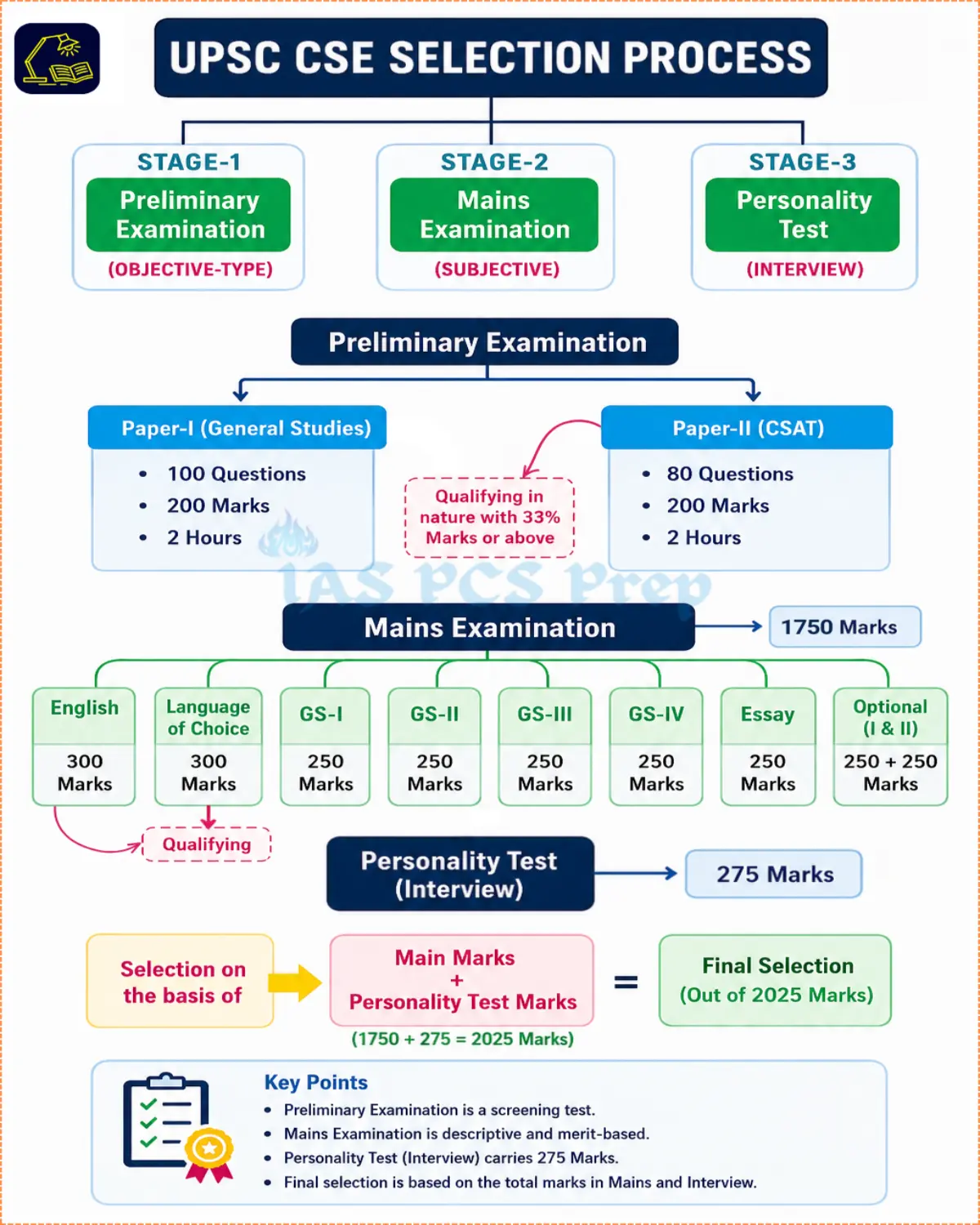


UPSC CSE Prelims Trend Analysis (2011–2026)
The reality is evident: Prelims has transformed into an intense test of applied conceptual reasoning, boundary elimination, and strategic risk management under extreme time constraints.
To understand this structural evolution, this comprehensive analysis breaks down 16 years of actual UPSC Prelims question papers (2011 to 2026). By evaluating subject weightage trajectories and question styling across both GS Paper-I and CSAT Paper-II, you can develop a realistic, high-yield preparation blueprint.
Part 1: GS Paper-I — The Reality of Subject Weightage
The General Studies syllabus should not be approached as a uniform checklist. Based on predictability and scoring return, the syllabus divides naturally into three strategic categories: The Constants, The High-Yield Core, and The Volatile Variables.
1. The Constants: Indian Polity & Indian Economy
- Predictability Anchor: Polity and Economy serve as the backbone of Prelims clearance. Their reference texts (such as standard bare acts, institutional reports, and economic surveys) have clear, finite boundaries.
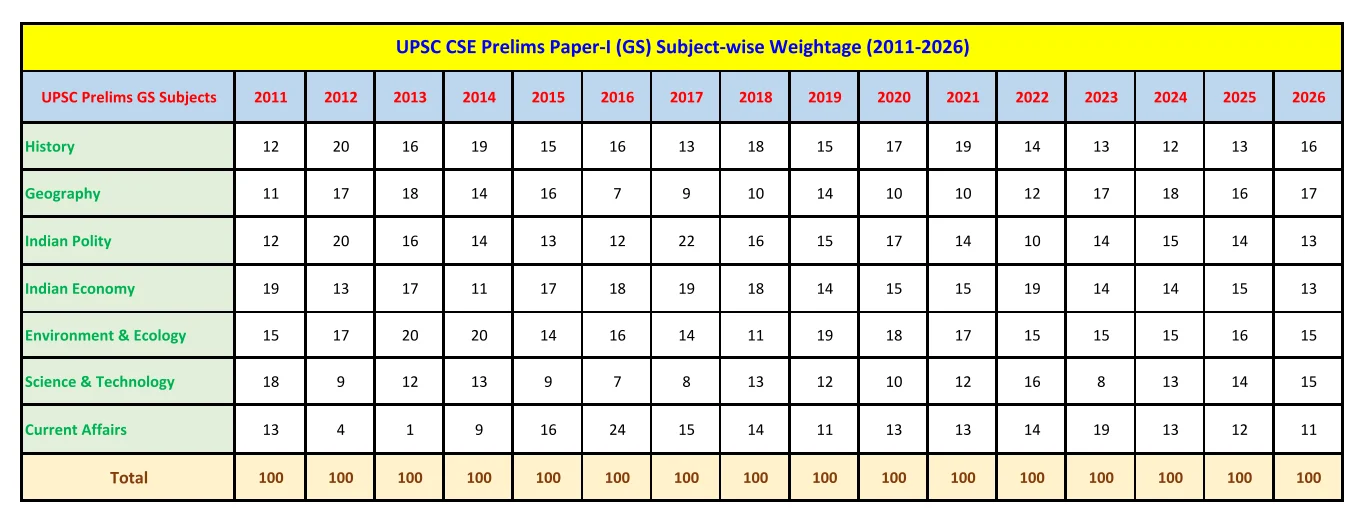
- Historical Stability (2011–2026): Together, Polity and Economy regularly deliver 26 to 29 questions in almost every examination cycle. Even in the latest 2025 and 2026 papers, they provided 29 and 26 questions respectively.
-
Shift in Testing Style:
- Polity: Rote memorization of Constitutional Articles has been replaced by practical governance case studies, administrative discretionary powers, procedural rules of legislatures, and judicial interpretations. Recent examinations presented scenario-based questions on statutory coordination during public health emergencies and procedural scrutiny in public procurement tenders.
- Economy: The emphasis has shifted from static definitions to operational mechanics: central bank liquidity absorption tools (Standing Deposit Facility, Repo mechanisms), capital market instruments (Alternative Investment Funds, green bonds), and international trade settlement frameworks.
- Strategic Mandate: Aim for over 80% accuracy in this block. Because the material is standard, errors here directly compromise your cutoff standing.
2. The High-Yield Core: Geography & Environment
- The Combined Powerhouse: Since the Preliminary screening for the Indian Forest Service (IFoS) was merged with the Civil Services Examination in 2013, the weight of Geography and Ecology has surged dramatically.
- Weightage Dominance (2011–2026): This integrated sector commanded 31 to 32 questions in both the 2025 and 2026 papers. In effect, nearly one-third of the GS Paper-I cutoff is decided exclusively by Geography and Environment.
-
Shift in Testing Style:
- Geography: Pure textbook geomorphology has receded in favor of intense map-work linked to geopolitics, trade choke points, active seismic/volcanic sites (such as Ecuador’s Tungurahua Volcano), and river basin inter-linkages.
- Environment: Questions focus on international compliance architecture (such as carbon credit markets under Article 6 of the Paris Agreement, Kunming-Montreal Global Biodiversity Framework targets) alongside conservation biology (endangered endemics like the Western Hoolock Gibbon and migratory routes of the Amur Falcon).
- Strategic Mandate: Do not treat them as separate subjects. Whenever you review a conservation reserve, simultaneously cross-verify its physical drainage, altitude gradients, and associated soil characteristics.
3. The Volatile Variables: History, Science & Technology, and Current Affairs
- High Volatility: These segments exhibit the sharpest annual fluctuations in both difficulty level and source predictability.
-
Weightage Trends:
- History (16 Questions in 2026): Modern Indian history questions have become highly analytical, while Ancient and Medieval sections prioritize obscure socio-economic terminologies (such as kshetra-patni, Araghatta, land tenure systems) and regional empires (like the Ahom dynasty and its Moidams).
- Science & Technology (14–15 Questions in 2025–2026): Rote general science has been completely replaced by frontier applied sciences: generative AI architectures (Large Language Models), quantum key distribution, drone swarming algorithms, and deep-ocean manned submersibles (such as Matsya-6000 under the Deep Ocean Mission).
- Current Affairs: Standalone one-liner current events have virtually disappeared; contemporary issues are now used as triggers to test the underlying static concepts.
- Strategic Mandate: Focus on risk mitigation. Cover well-documented themes (national freedom movement, classical architecture, and applied S&T) rather than chasing endless obscure trivia.
Part 2: CSAT Paper-II — The Decisive Elimination Bottleneck
The Civil Services Aptitude Test (CSAT) is no longer a formality. A massive number of aspirants scoring 90–100+ marks in GS Paper-I fail to qualify because they fall short of the mandatory 33% (66 marks) qualifying bar in CSAT. The historical data uncovers several critical patterns:
1. The Quantitative Dominance: 50% of the Entire Paper
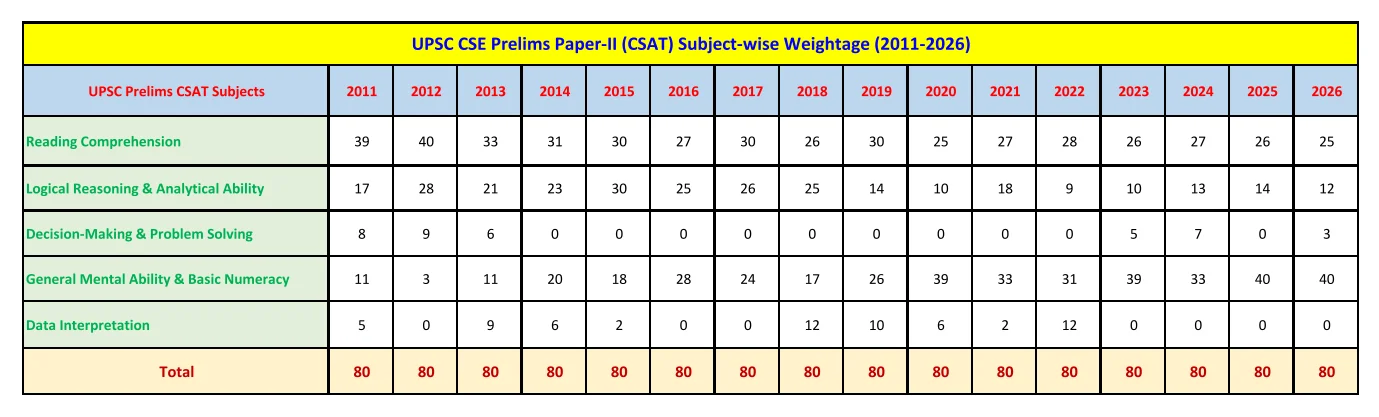
- Structural Realignment: Back in 2011 and 2012, numeracy accounted for only 11 and 3 questions. However, from 2014 onward, UPSC embarked on a steady upward trajectory in mathematics.
- The Current Standard: By 2020, math surged to 39 questions, and during the 2023–2026 window, it firmly held 39 to 40 questions out of 80. Quantitative aptitude and number properties now comprise fully half of the CSAT paper.
- Concept over Calculation: Questions rarely demand lengthy calculations; instead, they test fundamental number theory, divisibility rules, remainders, permutations, and combinatorics.
2. Reading Comprehension: Structural Baseline at 25–27 Questions
- Early Hegemony to Modern Baseline: In 2011–2012, verbal ability dominated with 39 to 40 questions. Since 2015, UPSC has locked this section to a consistent baseline of 25 to 27 questions.
- Elevated Subject Matter: The passages increasingly pull from dense academic extracts dealing with technological ethics, macroeconomic modeling, ecological degrowth, and public policy, demanding high analytical comprehension rather than skimming.
3. The Re-emergence of Decision-Making & Problem Solving
- A Forgotten Dimension Returns: Tested actively during 2011–2013 (averaging 6 to 9 questions without negative marking), Decision-Making disappeared completely from 2014 to 2022.
- Recent Renaissance: UPSC reintroduced this segment with 5 questions in 2023, 7 in 2024, and 3 in 2026. The questions present real administrative dilemmas requiring balanced ethical decision-making, proving that no area of the official notification should be ignored.
4. The Statistical Risk of Depending on Data Interpretation (DI)
- Erratic Appearance: DI accounted for peaks in 2018 (12 questions), 2019 (10 questions), and 2022 (12 questions).
- Complete Droughts: It dropped to zero questions across several cycles, including the entire 2023–2026 period. Preparing solely for DI charts while neglecting basic numeracy is a flawed exam strategy.
Actionable Strategic Plan for UPSC Prelims
Based on 16 years of empirical paper analysis, clearing Prelims is not about knowing everything—it is about managing probability, optimizing attempts, and maximizing accuracy across high-conviction areas. Here is a battle-tested, 5-pillar operational strategy:
-
1. Build and Consolidate the 55-Question Anchor (The Core Block):
- Polity, Economy, Geography, and Environment collectively contribute roughly 55 to 60 questions every single year. This is your primary scoring battlefield.
- Target an accuracy rate of 75% to 80% in this block alone. If you correctly secure 42–45 questions from these four subjects, you cross the net clearing threshold without depending on the volatility of History or unpredictable Current Affairs.
- Complete standard static sources (Laxmikanth, NCERTs, PMF/Shankar notes, and Economic Survey summaries) at least 4 to 5 times before touching sectional mock tests.
-
2. Shift to Integrated Ecosystem Mapping (Geography + Environment):
- Discontinue studying Geography and Environment as isolated subjects. Use physical maps as the visual foundation for both.
- Whenever a National Park, Wildlife Sanctuary, or Ramsar wetland appears in current affairs, locate its exact geographical coordinates, major river tributaries passing through it, surrounding mountain passes, and native endangered flora and fauna on your atlas.
- Trace international geopolitics through maritime choke points, critical mineral belts (Lithium, Rare Earth Elements), and active tectonic faultlines rather than memorizing isolated city names.
-
3. Master the 3-Iteration Exam Hall Attempt Strategy:
- Round 1 (Minutes 0–45): Attempt only 100% sure questions where no doubt exists. Mark OMR responses immediately. This establishes psychological momentum and typically secures 30 to 35 high-accuracy questions.
- Round 2 (Minutes 45–95): Tackle questions where you have successfully eliminated two incorrect options. Here, probability works in your favor. Calculate logical links, verify administrative feasibility, and make informed choices across 35 to 45 questions.
- Round 3 (Minutes 95–115): Evaluate boundary questions. Avoid blind guesses completely. Target an overall attempt range of 82 to 92 questions depending upon the paper’s difficulty curve. Attempting under 75 questions severely limits cutoff safety under negative marking.
-
4. Year-Round Daily CSAT Protocol (Non-Negotiable Routine):
- Dedicate a mandatory 60 to 75 minutes every single day to CSAT starting at least 6 months prior to the exam. Leaving CSAT for the final month after finishing GS is the primary cause of prelims rejection.
- Divide your preparation into 3 distinct weekly focus buckets: Number Theory & Algebra (Divisibility, Remainders, Unit digits, Permutations), Logical Puzzles & Syllogisms, and Analytical Reading Comprehension.
- Target solving at least 15–20 high-confidence quant and reasoning questions correctly in the exam hall to create an unbreakable safety cushion against subjective Reading Comprehension answer keys.
-
5. Condition-Based Data Sufficiency Mastery:
- With recent papers leaning heavily toward Statement-based and Data Sufficiency formats, stop solving math questions down to the last decimal digit.
- Train yourself to evaluate sufficiency conditions: determine whether Statement-I alone or Statement-II alone is sufficient, or whether both statements combined are necessary to reach a unique conclusion. This saves 40–50 seconds per question and prevents algebraic calculation errors under pressure.
-
6. PYQ Reverse-Engineering Protocol (2011–2026):
- Do not treat Previous Year Questions (PYQs) as practice tests to check your score. Treat them as a syllabus syllabus boundary indicator.
- Reverse-engineer all four options of every single question from 2011 to 2026. If an obscure term, tribe, treaty, or national park appears as an incorrect option in one year, UPSC frequently converts it into a full question 2 to 3 years later.
Frequently Asked Questions (FAQs)
Q1. With History questions rising to 16 in 2026, can I skip Ancient and Medieval History?
Q2. Polity is shifting toward scenario-based questions. Is reading Laxmikanth still enough?
Q3. Science & Technology tests advanced topics like LLMs and Quantum Computing. Do I need an engineering background?
Q4. Can an aspirant pass CSAT by attempting only Reading Comprehension?
Q5. How far back should Current Affairs preparation extend for Prelims?
Crack UPSC Prelims with a Data-Driven Strategy!
Study smart, not just hard. This analysis decodes 16 years of Prelims (2011-2026), pinpointing high-priority topics in GS-I and CSAT.
Get the free, print-friendly PDF for your offline study sessions.
📥 Download PDF Now