
UPSC CSE Optional Syllabus 2024

The Optional Paper in the UPSC CSE Main Examination is a pivotal component, allowing candidates to choose a subject of their interest and expertise. This paper holds significant weightage, with a total of 500 marks (250 marks for each paper), contributing to the overall merit and final selection of candidates. The selection of the optional subject is a critical decision that can shape a candidate’s performance, and careful consideration is given to factors like educational background, interest, and scoring potential.

Candidates are advised to go through the Optional Syllabus for the Mains Examination from the Official Website @upsc.gov.in as well as from this article. Interested Candidates can also Download the UPSC CSE Optional Syllabus 2024 from the link given below.

WhatsApp Group Join Now
Telegram Channel Join Now

1.) Subject Choices: Candidates can choose from a diverse list of optional subjects, covering various disciplines such as literature, science, humanities, social sciences, engineering, and more. Some popular choices include History, Geography, Public Administration, Sociology, Philosophy, Mathematics, and Political Science.

2.) Paper Structure: The Optional Paper consists of two papers, namely Paper I and Paper II, each carrying 250 marks. Both papers are of a descriptive nature, requiring candidates to demonstrate in-depth knowledge, analytical skills, and the ability to articulate their understanding of the subject.

3.) Scoring Potential: The Optional Paper offers candidates an opportunity to showcase their expertise in a specific subject. As the marking is relatively specific and focused, a well-prepared candidate can secure a high score, significantly impacting their overall rank in the examination.

4.) Preparation Strategy: Successful preparation for the Optional Paper involves a thorough understanding of the chosen subject, covering both conceptual clarity and applied knowledge. Candidates often refer to standard textbooks, academic journals, and research papers to enhance their command over the subject.

5.) Alignment with Overall Strategy: The choice of the optional subject should align with a candidate’s overall strategy for the Main Examination. Some candidates choose subjects aligned with their educational background, while others opt for subjects that complement their general studies preparation.

6.) Importance in Final Selection: While the Optional Paper is crucial for overall merit, it plays a pivotal role in determining a candidate’s service allocation. A strong performance in the Optional Paper can open avenues for selection in specific services and help candidates secure a position of their preference.

7.) Challenges and Considerations: Selecting the right optional subject involves weighing factors such as interest, scoring potential, and the availability of study materials. Candidates need to strategize their preparation to balance the demands of the Optional Paper with the rest of the Main Examination.

In conclusion, the Optional Paper in the UPSC CSE is a dynamic aspect of the examination, offering candidates the opportunity to demonstrate specialization in a subject of their choice. A well-chosen and well-prepared optional subject can significantly enhance a candidate’s chances of success in the UPSC CSE and pave the way for a rewarding career in the civil services.

WhatsApp Channel Follow Now

The scope of the syllabus for Optional Subject papers (Paper VI and Paper VII) for the examination is broad of the honors degree 1evel i.e. a level higher than the bachelor’s degree and lower than the master’s degree. In the case of Engineering, Medical Science, and law, the level corresponds to the bachelor’s degree.

Some Important Links
Download Optional Paper-VI & VII Syllabus PDFClick Here
If you are satisfied with our website iaspcsprep.com, Please like and share with more people.
Follow on InstagramFollow Now
Follow on FacebookFollow Now
Join TelegramJoin Now
Join WhatsApp Group for PDFJoin Now
For any Query and Feedback, Contact Us at – study@iaspcsprep.com
UPSC CSE Optional Syllabus 2024
Contact Us
UPSC Optional Paper Syllabus

[contact-form-7 id=”2f7172e” title=”Contact form 1″]

UPSC CSE Mains Syllabus

UPSC CSE Mains Syllabus: Comprehensive Paper-Wise Guide & Exam Pattern

The UPSC Civil Services Main Examination is designed to assess the overall intellectual traits, critical depth of understanding, and administrative capability of candidates rather than merely the range of their information and memory. While the Preliminary examination serves as an objective screening test, Mains is a comprehensive, written descriptive examination consisting of 9 papers that determines your final selection, rank, and cadre allotment.
The standard of questions in General Studies is framed so that a well-educated individual can answer them without hyper-specialized study. This exhaustive guide details the entire UPSC CSE Mains syllabus across the qualifying language papers, Essay, General Studies Papers I to IV, and the Optional subjects.
WhatsApp Group
Join Now
Telegram Channel
Join Now

1. Qualifying Papers on Indian Languages and English

The primary objective of these papers is to test the candidate’s ability to read and understand serious discursive prose and to express their thoughts clearly and correctly in English and the concerned Indian language. Both papers are of Matriculation (Class 10th) or equivalent standard and are strictly qualifying in nature.

UPSC Mains Qualifying Papers Pattern - Paper A and Paper B
Figure 1: UPSC Mains Qualifying Language Papers Structure (Paper-A & Paper-B)
  • Paper-A: Modern Indian Language (300 Marks | 3 Hours):
    • Comprehension of given passages.
    • Precis writing.
    • Usage and vocabulary.
    • Short essay.
    • Translation from English to the Indian Language and vice-versa.
  • Paper-B: English Language (300 Marks | 3 Hours):
    • Comprehension of given passages.
    • Precis writing.
    • Usage and vocabulary.
    • Short essay.
Mandatory Benchmark: Minimum qualifying marks are fixed at 25% (75 Marks out of 300) in each paper. Marks scored in Paper-A and Paper-B are not counted toward merit ranking. However, if a candidate fails to secure 25% in either paper, their remaining merit papers (Papers I to VII) will not be evaluated by UPSC.

2. Overall UPSC Mains & Personality Test Scheme

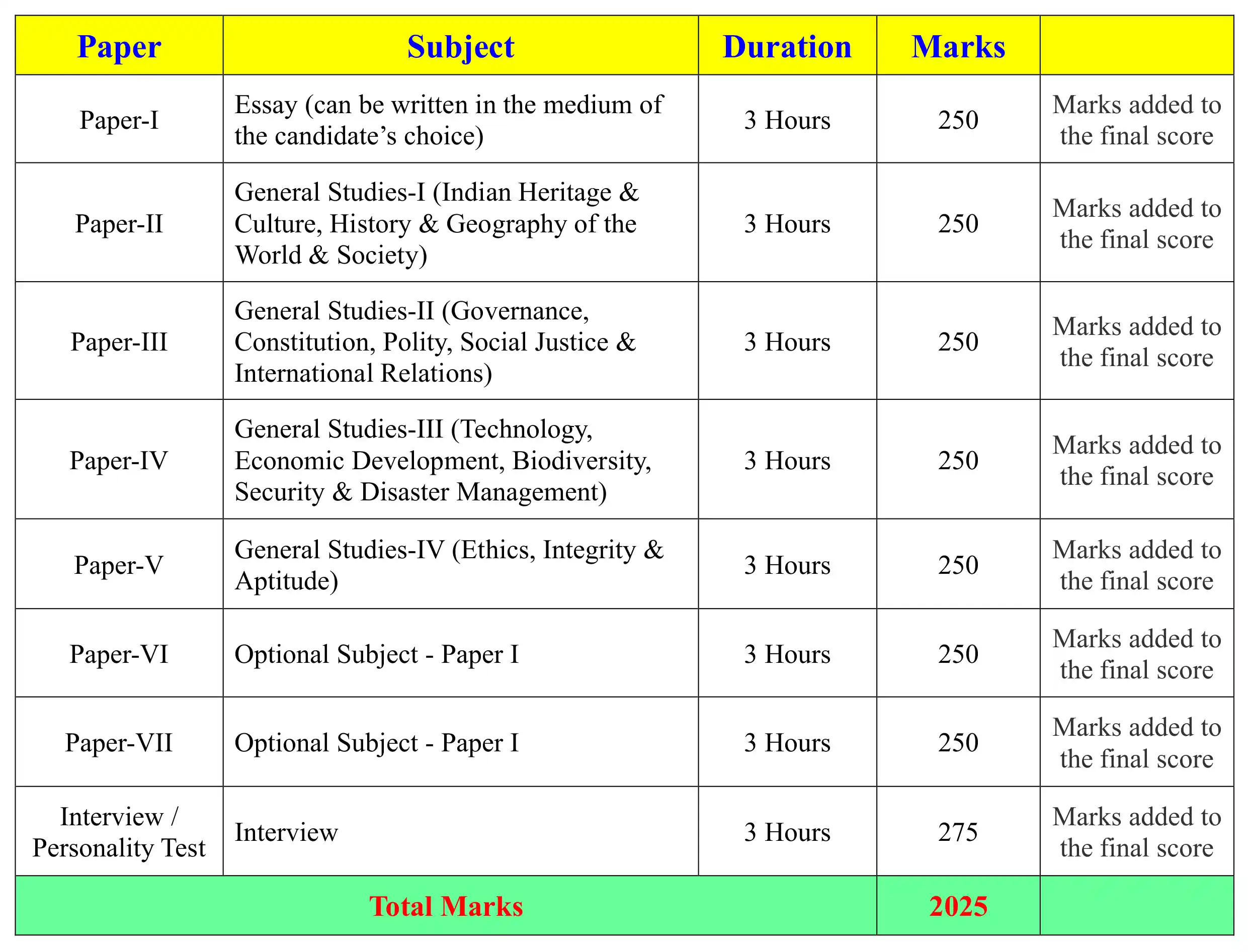
Candidates who qualify the language cutoff are evaluated on seven compulsory merit papers totaling 1750 marks, followed by the Personality Test (275 marks), yielding a combined score out of 2025 marks.

UPSC Mains Paper I to VII and Interview Exam Pattern
Figure 2: Complete Examination Pattern of UPSC Mains (Papers I to VII) and Personality Test

3. Paper-I: Essay (250 Marks | 3 Hours)

  • Syllabus Scope: Candidates are required to write two essays chosen from multiple sections. The topics cover philosophical, socio-economic, geopolitical, and cultural themes.
  • Core Expectations: Candidates are expected to keep closely to the subject of the essay, arrange their ideas in an orderly and coherent fashion, and write concisely. Special credit is given for effective, balanced, and exact expression.

4. Paper-II: General Studies-I (250 Marks | 3 Hours)

Coverage: Indian Heritage and Culture, History, and Geography of the World and Society.

  • Indian culture will cover the salient aspects of Art Forms, literature, and Architecture from ancient to modern times.
  • Modern Indian history from about the middle of the eighteenth century until the present—significant events, personalities, issues.
  • The Freedom Struggle—its various stages and important contributors/contributions from different parts of the country.
  • Post-independence consolidation and reorganization within the country.
  • History of the world will include events from the 18th century such as Industrial Revolution, world wars, redrawal of national boundaries, colonization, decolonization, political philosophies like communism, capitalism, socialism, etc.—their forms and effect on the society.
  • Salient features of Indian Society, Diversity of India.
  • Role of women and women’s organization, population and associated issues, poverty and developmental issues, urbanization, their problems and their remedies.
  • Effects of globalization on Indian society.
  • Social empowerment, communalism, regionalism & secularism.
  • Salient features of the world’s physical geography.
  • Distribution of key natural resources across the world (including South Asia and the Indian subcontinent); factors responsible for the location of primary, secondary, and tertiary sector industries in various parts of the world (including India).
  • Important Geophysical phenomena such as earthquakes, Tsunami, Volcanic activity, cyclone etc., geographical features and their location-changes in critical geographical features (including water-bodies and ice-caps) and in flora and fauna and the effects of such changes.
WhatsApp Channel
Follow Now

5. Paper-III: General Studies-II (250 Marks | 3 Hours)

Coverage: Governance, Constitution, Polity, Social Justice, and International Relations.

  • Indian Constitution—historical underpinnings, evolution, features, amendments, significant provisions, and basic structure.
  • Functions and responsibilities of the Union and the States, issues and challenges pertaining to the federal structure, devolution of powers and finances up to local levels and challenges therein.
  • Separation of powers between various organs, dispute redressal mechanisms and institutions.
  • Comparison of the Indian constitutional scheme with that of other countries.
  • Parliament and State legislatures—structure, functioning, conduct of business, powers & privileges and issues arising out of these.
  • Structure, organization and functioning of the Executive and the Judiciary—Ministries and Departments of the Government; pressure groups and formal/informal associations and their role in the Polity.
  • Salient features of the Representation of People’s Act.
  • Appointment to various Constitutional posts, powers, functions, and responsibilities of various Constitutional Bodies.
  • Statutory, regulatory, and various quasi-judicial bodies.
  • Government policies and interventions for development in various sectors and issues arising out of their design and implementation.
  • Development processes and the development industry—the role of NGOs, SHGs, various groups and associations, donors, charities, institutional and other stakeholders.
  • Welfare schemes for vulnerable sections of the population by the Centre and States and the performance of these schemes; mechanisms, laws, institutions, and Bodies constituted for the protection and betterment of these vulnerable sections.
  • Issues relating to development and management of Social Sector/Services relating to Health, Education, Human Resources.
  • Issues relating to poverty and hunger.
  • Important aspects of governance, transparency and accountability, e-governance- applications, models, successes, limitations, and potential; citizens charters, transparency & accountability, and institutional and other measures.
  • Role of civil services in a democracy.
  • India and its neighborhood—relations.
  • Bilateral, regional, and global groupings and agreements involving India and/or affecting India’s interests.
  • Effect of policies and politics of developed and developing countries on India’s interests, Indian diaspora.
  • Important International institutions, agencies, and fora—their structure, mandate.

6. Paper-IV: General Studies-III (250 Marks | 3 Hours)

Coverage: Technology, Economic Development, Biodiversity, Environment, Security, and Disaster Management.

  • Indian Economy and issues relating to planning, mobilization of resources, growth, development, and employment.
  • Inclusive growth and issues arising from it.
  • Government Budgeting.
  • Major crops—cropping patterns in various parts of the country, different types of irrigation and irrigation systems storage, transport and marketing of agricultural produce and issues and related constraints; e-technology in the aid of farmers.
  • Issues related to direct and indirect farm subsidies and minimum support prices; Public Distribution System—objectives, functioning, limitations, revamping; issues of buffer stocks and food security; Technology missions; economics of animal-rearing.
  • Food processing and related industries in India—scope and significance, location, upstream and downstream requirements, supply chain management.
  • Land reforms in India.
  • Effects of liberalization on the economy, changes in industrial policy and their effects on industrial growth.
  • Infrastructure: Energy, Ports, Roads, Airports, Railways etc.
  • Investment models.
  • Science and Technology—developments and their applications and effects in everyday life.
  • Achievements of Indians in science & technology; indigenization of technology and developing new technology.
  • Awareness in the fields of IT, Space, Computers, robotics, nano-technology, bio-technology and issues relating to intellectual property rights.
  • Conservation, environmental pollution and degradation, environmental impact assessment.
  • Disaster and disaster management.
  • Linkages between development and spread of extremism.
  • Role of external state and non-state actors in creating challenges to internal security.
  • Challenges to internal security through communication networks, role of media and social networking sites in internal security challenges, basics of cyber security; money-laundering and its prevention.
  • Security challenges and their management in border areas—linkages of organized crime with terrorism.
  • Various Security forces and agencies and their mandate.

7. Paper-V: General Studies-IV (250 Marks | 3 Hours)

Coverage: Ethics, Integrity, and Aptitude.

This paper tests the candidate’s attitude and approach to issues relating to integrity, probity in public life, and problem-solving approaches to various social and administrative conflicts. Questions utilize both direct theoretical inquiries and the practical case-study approach.

  • Ethics and Human Interface: Essence, determinants, and consequences of Ethics in human actions; dimensions of ethics; ethics in private and public relationships. Human Values—lessons from the lives and teachings of great leaders, reformers, and administrators; the role of family, society, and educational institutions in inculcating values.
  • Attitude: Content, structure, function; its influence and relation with thought and behaviour; moral and political attitudes; social influence and persuasion.
  • Aptitude and Foundational Values for Civil Service: Integrity, impartiality and non-partisanship, objectivity, dedication to public service, empathy, tolerance, and compassion towards the weaker sections.
  • Emotional Intelligence: Concepts, and their utilities and application in administration and governance.
  • Contributions of Moral Thinkers and Philosophers: Insights from prominent moral philosophers from India and the world.
  • Public/Civil Service Values and Ethics in Public Administration: Status and problems; ethical concerns and dilemmas in government and private institutions; laws, rules, regulations, and conscience as sources of ethical guidance; accountability and ethical governance; strengthening of ethical and moral values in governance; ethical issues in international relations and funding; corporate governance.
  • Probity in Governance: Concept of public service; philosophical basis of governance and probity; information sharing and transparency in government, Right to Information, Codes of Ethics, Codes of Conduct, Citizen’s Charters, work culture, quality of service delivery, utilization of public funds, challenges of corruption.
  • Case Studies: Practical situational case studies covering the above themes.

8. Papers VI & VII: Optional Subject (500 Marks Total | 250 Marks Each)

  • Standard & Academic Scope: The scope of the syllabus for the Optional Subject papers (Paper VI and Paper VII) corresponds broadly to the Honours Degree level (a standard higher than a regular Bachelor’s degree and lower than a Master’s degree).
  • Professional Disciplines: For technical disciplines such as Engineering, Medical Science, and Law, the scope corresponds directly to the professional Bachelor’s degree level.
  • Independent Choice: Candidates are free to choose any one optional subject from the list of 48 approved subjects, regardless of whether they studied it during their graduation.

Frequently Asked Questions (FAQs)

Q1. What is the official portal to check and verify the UPSC CSE Mains Syllabus?
Ans. The authentic official portal for checking and downloading the UPSC Civil Services Main Examination syllabus is upsc.gov.in. Online applications and forms are hosted at upsconline.nic.in.
Q2. Can a candidate choose an Optional Subject that they did not study in college?
Ans. Yes. Candidates have complete freedom to choose any optional subject from the UPSC notification list, irrespective of their graduation stream or academic background.
Q3. Can a candidate write different Mains papers in different languages?
Ans. No. Candidates must write all merit papers (Papers I to VII) in one single chosen medium (either English or any one of the Eighth Schedule languages) indicated during their application. You cannot write one GS paper in Hindi and another in English.
Q4. Can a candidate write the Mains written exam in English and take the Interview in Hindi or a regional language?
Ans. Yes. Candidates writing the Main Examination in English have the option to choose English, Hindi, or any other Indian language opted for the compulsory language paper as their medium for the Personality Test / Interview. The choice is formally recorded during the DAF submission.
Q5. Are candidates from North-Eastern states exempt from the Indian Language Paper (Paper-A)?
Ans. Yes. Paper-A is not compulsory for candidates hailing from the states of Arunachal Pradesh, Manipur, Meghalaya, Mizoram, Nagaland, and Sikkim. When eligible candidates apply online, the selection option for Paper-A is automatically disabled.
Q6. What are the passing marks for the compulsory language papers (Paper-A and Paper-B)?
Ans. Under official examination rules, candidates must secure a minimum of 25% marks (75 marks out of 300) in each of the two qualifying papers. Marks are not counted toward merit, but qualifying is mandatory to have Papers I to VII evaluated.
Q7. What total marks determine the final order of merit ranking in UPSC CSE?
Ans. The final merit order is computed out of 2025 Marks, comprising the 7 written merit papers (Papers I to VII totaling 1750 marks) and the Personality Test / Interview (275 marks).
Q8. Where can aspirants find comprehensive official clarifications and FAQs?
Ans. Additional official guidelines, gazette notifications, and rules can be accessed on the UPSC website at upsc.gov.in and its official FAQ repository at upsc.gov.in/faqs.

Master the UPSC Mains & Optional Syllabus!

Know what to study. Success starts with a clear understanding of the Mains and Optional topics.

Download the simplified PDFs below to track your progress.

UPSC CSE Prelims Syllabus

UPSC CSE Prelims Syllabus: Comprehensive Paper-Wise Guide & Exam Pattern

The UPSC Civil Services Preliminary Examination serves as the national gateway filter to recruit candidates into prestigious posts such as the IAS, IPS, IFS, IRS, and allied Group ‘A’ and Group ‘B’ central civil services. It is strictly an elimination and screening stage designed to shortlist eligible candidates for the written Mains examination.
Marks obtained in the Preliminary examination are not counted toward the final merit ranking. However, navigating this stage demands absolute precision. This guide presents an exhaustive, micro-topic breakdown of the official syllabus for both Paper-I (General Studies) and Paper-II (CSAT), supported by exam patterns, negative marking dynamics, and actionable preparation blueprints.
WhatsApp Group
Join Now
Telegram Channel
Join Now

1. UPSC CSE Prelims Exam Pattern & Architecture

The Civil Services Preliminary Examination consists of two compulsory objective-type papers conducted offline on OMR sheets on the same day in two sessions:

Examination Parameter Official Specification
Upcoming Exam Date24th May 2026 (Sunday)
Number of Compulsory Papers2 Compulsory Papers: Paper-I (GS) & Paper-II (CSAT)
Mode of ExaminationOffline (Pen & Paper mode on OMR response sheets)
Question TypeObjective Type (Multiple Choice Questions with 4 options)
Total Marks400 Marks (200 Marks for Paper-I + 200 Marks for Paper-II)
Number of QuestionsPaper-I: 100 Questions | Paper-II: 80 Questions
Duration of Examination2 Hours (120 minutes) per paper [20 min/hour compensatory time for eligible PwBD candidates]
Negative Marking Penalty1/3rd (33.33%) deduction for every wrong answer marked
Language / MediumBilingual (Questions printed in both English and Hindi)
Counted in Final Merit Ranking?No (Purely a screening gateway to qualify for Mains)
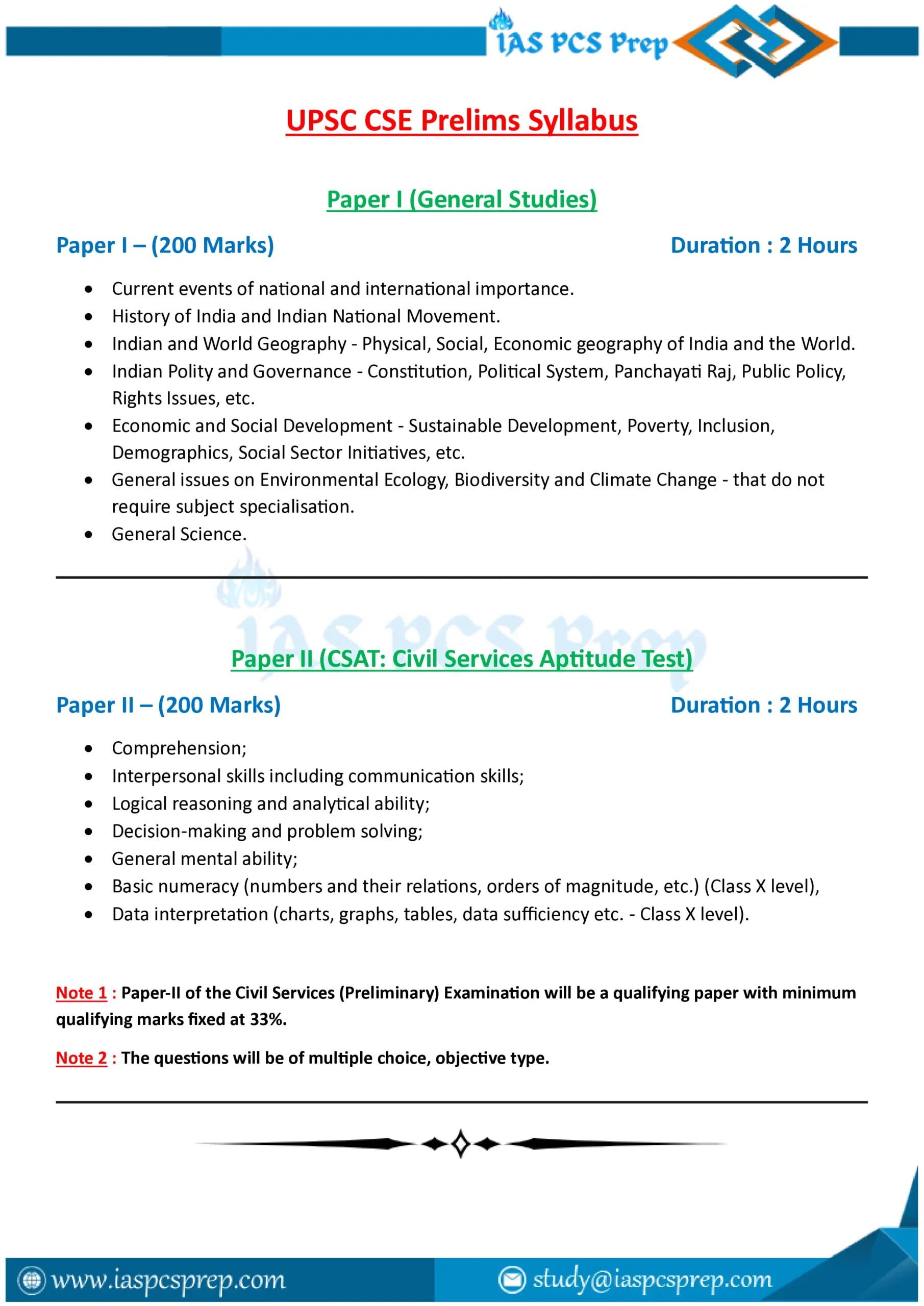
UPSC CSE Prelims Official Syllabus Overview - Paper I GS and Paper II CSAT
Figure: Official Structure and Core Syllabus of UPSC Civil Services Preliminary Examination

2. Paper-I: General Studies (GS) Complete Syllabus

  • Maximum Marks: 200 | Total Questions: 100 | Duration: 2 Hours
  • Negative Penalty: -0.66 marks deducted for each incorrect attempt.
  • Cutoff Benchmark: Your score in Paper-I alone determines whether you clear the cutoff to write the Mains Examination, provided Paper-II is qualified.

Official Syllabus Breakdown with Micro-Topics:

  • 1. Current Events of National and International Importance:
    • Major geopolitical summits (G20, BRICS, SCO, COP climate conferences).
    • Landmark governmental policies, socio-economic welfare schemes, and legislative acts.
    • Bilateral treaties, maritime initiatives, strategic global defense pacts, and international organizations.
    • Significant awards, indices, and national rankings released by NITI Aayog and global bodies.
  • 2. History of India and Indian National Movement:
    • Ancient India: Indus Valley Civilization settlements, Vedic literature, rise of Mahajanapadas, Buddhism & Jainism, Mauryan administrative architecture, and the Gupta Empire.
    • Medieval India: Early regional dynasties (Cholas, Pallavas), Delhi Sultanate governance, Vijayanagara Empire, Mughal administrative systems (Mansabdari), and Bhakti-Sufi traditions.
    • Modern India & National Movement: British expansion, 1857 revolt, tribal and peasant uprisings, socio-religious reform movements, early congress phase, Swadeshi movement, Gandhian mass movements, revolutionary activities, and Indian Independence Act 1947.
  • 3. Indian and World Geography – Physical, Social, Economic:
    • Physical Geography: Geomorphology (earthquakes, volcanoes, plate tectonics), Climatology (monsoons, cyclones, atmospheric pressure belts), and Oceanography (ocean currents, salinity, coral reefs).
    • Indian Geography: River drainage basins, mountain passes, climate zones, natural vegetation, and soil classification.
    • Economic & Human Geography: Mineral resources distribution, industrial corridors, energy reserves, migration patterns, and agricultural crop belts.
  • 4. Indian Polity and Governance – Constitution, Political System, Panchayati Raj:
    • Preamble, Fundamental Rights (Part III), Directive Principles (Part IV), and Fundamental Duties.
    • Union and State Executive (President, Governor, Prime Minister, Chief Minister).
    • Parliament and State Legislatures (legislative procedures, bills, committees, parliamentary privileges).
    • Indian Judiciary (Supreme Court, High Courts, Judicial Review, Public Interest Litigation).
    • Local Self-Government (73rd and 74th Constitutional Amendment Acts, PESA Act).
    • Constitutional and Non-Constitutional Bodies (ECI, UPSC, CAG, Finance Commission, NITI Aayog).
  • 5. Economic and Social Development:
    • National Income Accounting (GDP, GNP, NNP, inflation indices – CPI, WPI).
    • Fiscal and Monetary Policy (RBI instruments, Repo, SDF, budget classifications, tax reforms).
    • Banking Sector & Capital Markets (NPAs, IBC, SEBI regulations, stock and bond markets).
    • Inclusive growth, poverty alleviation, demographic dividend, and Sustainable Development Goals (SDGs).
  • 6. Environmental Ecology, Biodiversity, and Climate Change:
    • Ecosystem functioning, food chains, trophic levels, and ecological succession.
    • Biodiversity conservation: National Parks, Wildlife Sanctuaries, Biosphere Reserves, Ramsar Wetlands.
    • IUCN Red List status of endangered and critically endangered species.
    • International environmental conventions: UNFCCC, CBD, CITES, Ramsar, Vienna Convention.
  • 7. General Science & Emerging Technologies:
    • Core scientific principles in Biology, Physics, and Chemistry (everyday applications).
    • Frontier technologies: Artificial Intelligence, Quantum Computing, Blockchain, Biotechnology, Gene Editing (CRISPR-Cas9), Space missions (ISRO/NASA), and defense systems.
WhatsApp Channel
Follow Now

3. Paper-II: Civil Services Aptitude Test (CSAT) Syllabus

  • Maximum Marks: 200 | Total Questions: 80 | Duration: 2 Hours
  • Negative Penalty: -0.83 marks deducted for each incorrect attempt.
  • Mandatory Qualifying Nature: Candidates must score a minimum of 33% (66 marks out of 200) to qualify. Marks scored in CSAT are not included in the cutoff determination, but failing CSAT results in immediate disqualification regardless of your score in Paper-I.

Official CSAT Syllabus Curriculum:

  • Comprehension: Short and long unseen reading passages evaluating logical inference, analytical deductions, central themes, and contextual implications.
  • Interpersonal Skills including Communication Skills: Understanding verbal context and scenario-based communication.
  • Logical Reasoning and Analytical Ability: Syllogisms, coding-decoding, blood relations, seating arrangements, directional puzzles, statement-assumption, and critical reasoning.
  • Decision-Making and Problem-Solving: Practical administrative dilemmas requiring balanced ethical choices.
  • General Mental Ability: Series completion, clocks, calendars, cubes and dice, spatial and Venn diagrammatic reasoning.
  • Basic Numeracy (Class X Level): Number systems, divisibility rules, remainders, LCM & HCF, percentages, profit & loss, simple & compound interest, ratio & proportion, averages, time & work, permutations & combinations, and probability.
  • Data Interpretation (Class X Level): Charts, bar graphs, tables, pie charts, and data sufficiency analysis.
Mandatory Examination Attendance Rule: Candidates must physically appear in both papers (Paper-I and Paper-II) of the Preliminary Examination. If a candidate appears in Paper-I in the morning session but remains absent in Paper-II in the afternoon session, they will be summarily disqualified, and their Paper-I will not be evaluated.

4. Official Rules Governing Attempts & Evaluation

  • What Officially Constitutes an “Attempt”?
    • An attempt is officially counted if a candidate appears in at least one paper of the Preliminary Examination.
    • Simply filling out and submitting the online application form does not count as an attempt if the candidate remains absent on exam day.
    • If a candidate writes Paper-I, marks attendance, and leaves without writing Paper-II, the attempt is officially recorded.
    • Even if a candidate’s candidature is subsequently cancelled or disqualified during the exam, the appearance still counts as an attempt.
  • Negative Marking Protocol:
    • Every question features four answer alternatives. Marking an incorrect option results in a deduction of one-third (1/3rd) of the marks assigned to that question.
    • If a candidate selects more than one bubble on the OMR sheet for a single question, it is treated as an incorrect answer—even if one of the choices happens to be correct—and the penalty applies.
    • Unanswered questions left completely blank incur zero penalty.

Frequently Asked Questions (FAQs)

Q1. What is the official website to verify the UPSC CSE Prelims Syllabus?
Ans. The authentic official portal for checking and downloading the UPSC Civil Services Preliminary examination syllabus is upsc.gov.in.
Q2. What is the overall structure of the Civil Services Examination?
Ans. The Civil Services Examination consists of two sequential stages:
  1. Stage 1: Civil Services (Preliminary) Examination (Objective type screening test comprising GS Paper-I and CSAT Paper-II).
  2. Stage 2: Civil Services (Main) Examination, which includes the Written Descriptive Examination (9 papers totaling 1750 marks) followed by the Personality Test / Interview (275 marks).
Q3. If I fill out the Prelims application form but do not appear on exam day, is my attempt counted?
Ans. No. Merely submitting the application form does not consume an attempt. Your attempt is counted only if you physically attend the exam center and appear for at least one paper in the Preliminary examination.
Q4. What are the minimum qualifying marks for CSAT (Paper-II)?
Ans. Under current UPSC examination rules, CSAT (General Studies Paper-II) requires a fixed qualifying benchmark of 33%, which translates to a minimum of 66 marks out of 200 (net of negative marking).
Q5. Are Prelims marks added to determine the final rank and service allotment?
Ans. No. The Preliminary examination functions purely as a screening filter. Marks scored in Prelims are completely excluded from the final merit order. Final selection, ranking, and service allocations (IAS, IPS, IFS, etc.) depend entirely on the combined marks scored in the written Mains examination (1750 marks) and the Personality Test (275 marks), totaling 2025 marks.
Q6. How does the negative marking mechanism operate in Prelims?
Ans. One-third (1/3rd) of the marks allocated to a question is deducted as penalty for every wrong attempt (-0.66 marks in Paper-I and -0.83 marks in Paper-II). If you select multiple options for a single question, it is evaluated as a wrong answer and penalized. Questions left unattempted carry zero deduction.
Q7. Where can I find more authentic information and official notifications about UPSC CSE?
Ans. Aspirants can access comprehensive exam notifications, previous years’ official question papers, and authentic commission updates directly from the official portal at upsc.gov.in and its dedicated FAQ repository at upsc.gov.in/faqs.

Master the UPSC Prelims Syllabus!

Know what to study. Success starts with a clear understanding of the GS and CSAT topics.

Download the simplified PDF to track your progress.

📥 Download PDF Now