


UPSC Civil Services Exam: A Beginner’s Complete Guide to Eligibility, Syllabus, and Exam Pattern
Serving the nation as an IAS, IPS, or IFS officer is one of the most prestigious career goals in India. This journey begins by tackling the UPSC Civil Services Examination (CSE)—widely considered one of the most comprehensive and rewarding competitive exams in the world.
For a beginner, the massive volume of information can seem intimidating. This complete guide breaks down every step: constitutional background, exact eligibility conditions, stage-wise paper patterns, syllabus mapping, scoring rules, and a practical beginner roadmap.
For a beginner, the massive volume of information can seem intimidating. This complete guide breaks down every step: constitutional background, exact eligibility conditions, stage-wise paper patterns, syllabus mapping, scoring rules, and a practical beginner roadmap.
UPSC CSE at a Glance
| Particular | Official Details |
|---|---|
| Exam Name | Civil Services Examination (CSE) |
| Conducting Body | Union Public Service Commission (UPSC) |
| Exam Frequency | Once a Year (Annual Cycle) |
| Exam Level | National (All India Competitive Examination) |
| Selection Architecture |
|
| Educational Qualification | Graduation in any discipline from a recognized University |
| Age Limit (General) | 21 to 32 Years (As on 1st August of the exam year) |
| Attempts Allowed |
|
| Final Merit Marks | 2025 Marks (Written Mains: 1750 + Personality Test: 275) |
| Official Website | upsc.gov.in |
1. What is UPSC and Which Services Are Offered?
- Constitutional Status: The Union Public Service Commission (UPSC) is an independent constitutional authority mandated under Articles 315 to 323 (Part XIV) of the Constitution of India to handle recruitment for All India Services and Central Civil Services.
- Administrative Significance: CSE does not just assess memorization. It evaluates analytical perspective, decision-making under stress, conceptual depth, and administrative leadership required to govern a diverse nation.
-
Major Services Categorization:
- All India Services (AIS): Indian Administrative Service (IAS), Indian Police Service (IPS), and Indian Forest Service (IFS – Prelims common, Mains held separately). Shared between the Union and the States.
- Central Services (Group A): Indian Foreign Service (IFS), Indian Revenue Service (IRS – Income Tax & Customs), Indian Audit & Accounts Service (IA&AS), Indian Postal Service (IPoS), Indian Railway Management Service (IRMS), and Indian Defence Accounts Service (IDAS).
- Central Services (Group B): Armed Forces Headquarters Civil Service, Delhi, Andaman & Nicobar Islands Civil Service (DANICS), DANIPS, and Pondicherry Civil Service.
2. Essential Eligibility Criteria (Who Can Apply?)
-
A. Nationality:
- For the IAS, IPS, and IFS, the candidate must be a Citizen of India.
- For other services, candidates may be citizens of India, subjects of Nepal or Bhutan, or Tibetan refugees who arrived in India before 1st January 1962 with the intention of permanently settling.
-
B. Educational Qualification:
- The candidate must hold a degree from any recognized Central, State, or Deemed University, or possess an equivalent qualification approved by the Government of India.
- No Minimum Percentage: UPSC does not demand any first-class division or minimum cutoff marks in college. Simple pass marks in graduation are 100% valid.
- Final Year Students: Candidates appearing in their final semester/year degree examinations can apply and sit for the Prelims, provided they submit proof of passing their degree during the Mains Detailed Application Form (DAF-I) submission.
Category-Wise Age Limit & Permissible Attempts (Cut-off Date: August 1st)
| Category | Minimum Age | Upper Age Limit | Number of Attempts |
|---|---|---|---|
| General / EWS | 21 Years | 32 Years | 6 Attempts |
| OBC (Non-Creamy Layer) | 21 Years | 35 Years | 9 Attempts |
| SC / ST | 21 Years | 37 Years | Unlimited (Up to 37 years) |
| PwBD (General / OBC) | 21 Years | 42 Years | 9 Attempts |
| PwBD (SC / ST) | 21 Years | 42 Years | Unlimited (Up to 42 years) |
3. The Three-Stage Selection Process & Detailed Syllabus
The Civil Services Examination is an intense, year-long journey structured into three sequential screening rounds:
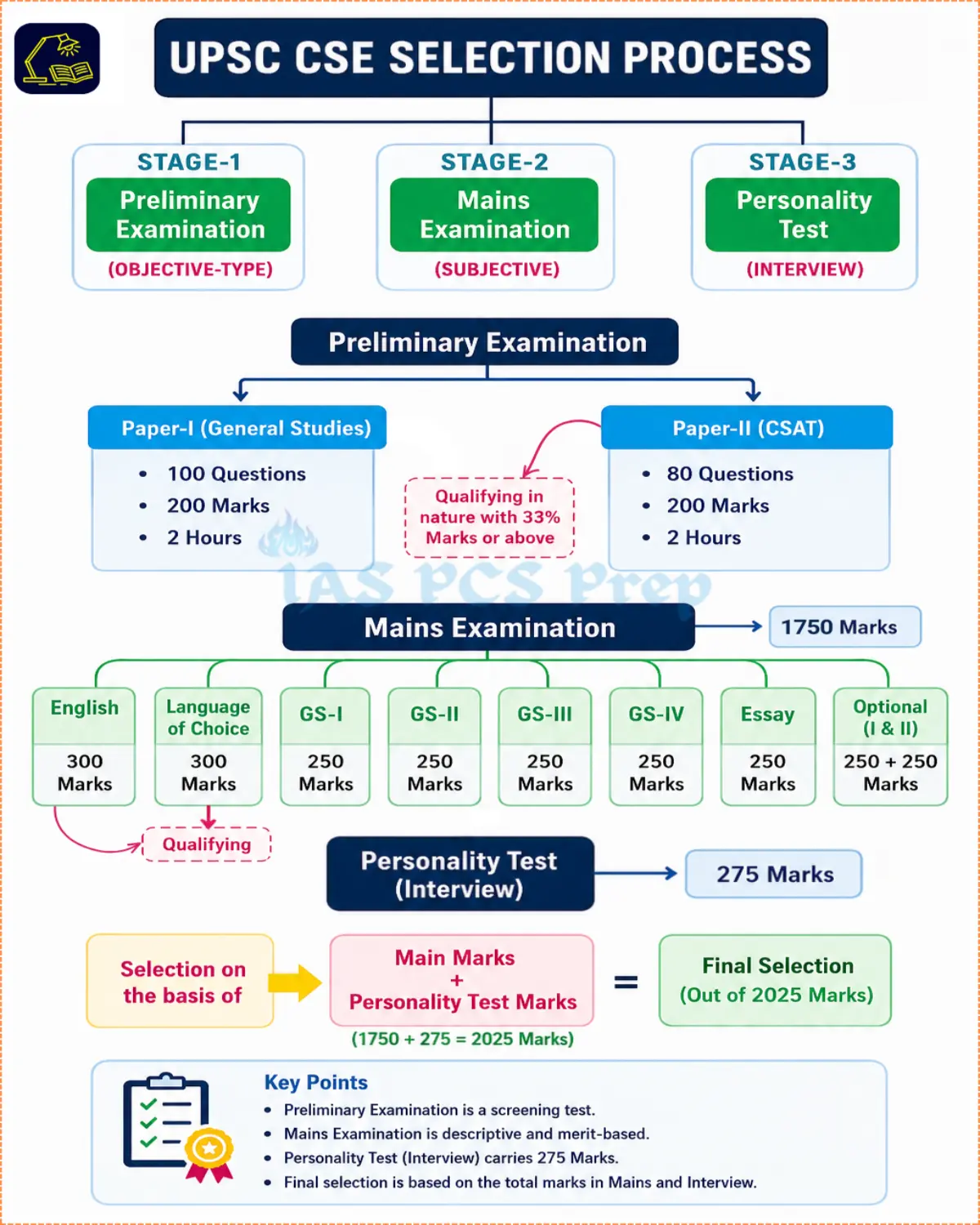
Figure: Complete Architecture of UPSC CSE Selection Process (Prelims, Mains, and Interview)
Stage 1: Preliminary Examination (The Objective Filter)
- Nature & Purpose: An objective elimination test designed to shortlist candidates for the Mains examination. Marks scored in Prelims are not counted in the final merit rank list.
- Format: Two compulsory papers conducted on the same day in offline Pen-and-Paper mode (OMR sheets).
- Negative Marking: One-third (33.33%) of the total marks allocated to a question is deducted for every incorrect attempt. Unattempted questions carry zero penalty.
Paper I: General Studies (GS-1)
- Marks: 200 | Questions: 100 | Duration: 2 Hours | Negative Marking: -0.66 per error
- Significance: Only the score in this paper determines whether you qualify for the Prelims cutoff to write Mains.
-
Syllabus Scope:
- Current events of national and international importance.
- History of India and Indian National Movement (Ancient, Medieval, Modern & Freedom Struggle).
- Indian and World Geography: Physical, Social, and Economic Geography of India and the World.
- Indian Polity and Governance: Constitution, Political System, Panchayati Raj, Public Policy, Rights Issues.
- Economic and Social Development: Sustainable Development, Poverty, Inclusion, Demographics, Fiscal Policies.
- General issues on Environmental Ecology, Biodiversity, and Climate Change (no subject specialization required).
- General Science & Emerging Technologies (Space, Biotechnology, AI, Defense).
Paper II: Civil Services Aptitude Test (CSAT)
- Marks: 200 | Questions: 80 | Duration: 2 Hours | Negative Marking: -0.83 per error
- Significance: A purely qualifying paper. Every candidate must score a minimum of 33% (66 marks out of 200) to pass. If an aspirant scores below 66 marks in CSAT, their GS Paper-I will not even be evaluated.
-
Syllabus Scope:
- Reading Comprehension and Analytical Inference.
- Interpersonal skills including communication skills.
- Logical reasoning and analytical ability.
- Decision-making and problem-solving scenarios.
- General mental ability.
- Basic numeracy (numbers and their relations, orders of magnitude – Class X level).
- Data Interpretation (charts, graphs, tables, data sufficiency – Class X level).
Stage 2: Main Examination (The Written Academic Core)
- Nature & Scale: A conventional descriptive written exam consisting of 9 papers conducted across two weekends (5–6 days).
- Merit Marks: 1750 Marks (Only Papers I to VII are evaluated for ranking).
A. Qualifying Papers (Marks Do Not Count for Rank)
- Paper A: Modern Indian Language (300 Marks): Candidate chooses any one language included in the 8th Schedule of the Constitution. Passing cutoff: 25% (75 Marks).
- Paper B: English Language (300 Marks): Reading comprehension, precis writing, vocabulary, and basic composition. Passing cutoff: 25% (75 Marks).
Crucial Rule: If an aspirant fails to achieve 25% marks in either of these qualifying language papers, UPSC does not check their remaining 7 General Studies, Essay, or Optional papers.
B. Merit Ranking Papers (7 Papers • 250 Marks Each)
| Paper Code | Paper Name | Subject Coverage | Marks |
|---|---|---|---|
| Paper I | Essay | Two essays written on philosophical, socio-economic, or governance themes | 250 Marks |
| Paper II | GS-I | Indian Heritage, Art & Culture, World History, Indian Society & Physical/Human Geography | 250 Marks |
| Paper III | GS-II | Constitution, Polity, Governance, Social Justice & International Relations | 250 Marks |
| Paper IV | GS-III | Indian Economy, Agriculture, Science & Technology, Biodiversity, Disaster Management & Internal Security | 250 Marks |
| Paper V | GS-IV | Ethics, Integrity, Aptitude, Philosophical Thinkers & Practical Administrative Case Studies | 250 Marks |
| Paper VI | Optional-1 | Optional Subject: Paper 1 (Theoretical concepts and discipline foundations) | 250 Marks |
| Paper VII | Optional-2 | Optional Subject: Paper 2 (Applied aspects and Indian context) | 250 Marks |
Stage 3: Personality Test (The Interview)
- Marks: 275 Marks | Venue: UPSC Headquarters, Dholpur House, New Delhi
- Core Objective: The interview assesses administrative suitability. A panel of experienced bureaucrats and subject experts evaluates personal integrity, mental alertness, balance of judgment, clear and logical exposition, and social awareness.
-
Final Merit Calculation:
Written Mains Score (1750) + Interview Score (275) = Final Merit Score (2025 Marks)
WhatsApp Channel
Follow Now
4. Strategic Framework: How to Choose Your Optional Subject?
The optional subject carries 500 marks—roughly 25% of your total written evaluation. Selecting the right subject can be the single biggest difference between getting selected or missing the rank list. Evaluate these parameters:
- Syllabus Overlap with General Studies: Subjects such as Political Science & International Relations (PSIR), Public Administration, History, Geography, and Sociology have significant overlap with GS Papers I, II, and IV.
- Academic Background: If you performed well in your graduation subject (Engineering, Economics, Literature, Law), continuing with it reduces foundational learning time.
- Syllabus Conciseness & Predictability: Some subjects (like Philosophy, Anthropology, or Sociology) have comparatively concise, well-defined boundaries and relatively predictable question patterns.
- Resource Availability: Ensure quality textbooks, standard toppers’ test copies, and reliable mock evaluation are accessible before locking your decision.
5. Beginner’s Practical Roadmap: Step-by-Step Preparation
-
Step 1: Master the Syllabus & Past Year Questions (PYQs):
- Print the official UPSC syllabus and keep it on your desk. Every topic you read must align directly with a syllabus keyword.
- Review at least 10 years of Prelims and Mains PYQs to understand the nature, depth, and angle of UPSC questioning.
-
Step 2: Build Conceptual Clarity with NCERTs (Months 1–4):
- Study NCERT textbooks from Class 6th to 12th for History, Geography, Polity, Economics, and Science. They present complex governance, historical, and scientific concepts in simple language.
-
Step 3: Advance to Standard Reference Texts (Months 4–8):
- Indian Polity: Indian Polity by M. Laxmikanth
- Ancient Indian History: Old NCERT Class 11th by R.S. Sharma (or India’s Ancient Past)
- Medieval Indian History: Old NCERT Class 11th by Satish Chandra (History of Medieval India)
- Modern Indian History: A Brief History of Modern India (Spectrum) by Rajiv Ahir
- Art & Culture: NCERT Class 11th An Introduction to Indian Art + selected chapters of Nitin Singhania
- Geography: NCERT Class 11th & 12th (Physical & Human) + Certificate Physical and Human Geography by G.C. Leong + Oxford Student Atlas
- Indian Economy: Class 11th NCERT (Indian Economic Development) + standard economy notes + annual Union Budget & Economic Survey summary
- General Science & Technology: NCERT Science books (Class 6th to 10th for basics) + The Hindu’s Sunday S&T section + Monthly compilations for Space, Biotech, Defense, and AI
- Environment & Ecology: NCERT Biology (Class 12th, last 4 ecology chapters) + standard ecology notes + annual climate summit conventions
-
Step 4: Cultivate Daily Current Affairs Discipline:
- Read one national daily newspaper—either The Hindu or The Indian Express (focus on the Editorial and Explained pages). Focus on policy impact rather than political controversies.
-
Step 5: Test Series & Answer Writing Practice (Months 8–12):
- Start practicing 1–2 Mains answers daily once you finish a core subject.
- Enroll in standard mock test series for Prelims and simulate real exam conditions to master time and negative marking management.
Frequently Asked Questions (FAQs)
Q1. Is coaching mandatory to clear the UPSC Civil Services Examination?
Ans. No, coaching is not mandatory. Many toppers clear this examination every year through disciplined self-study, standard textbooks, and quality online study materials. Consistency, structured syllabus completion, and rigorous test series practice matter far more than coaching classrooms.
Q2. What counts as an official “Attempt” in UPSC?
Ans. Simply filling out and submitting the online application form does not count as an attempt. An attempt is counted only if you physically appear for at least one paper in the Preliminary examination. If you miss both papers on exam day, your attempt remains intact.
Q3. Can working professionals prepare for and clear UPSC?
Ans. Yes, numerous working candidates secure top ranks every year. It requires structured time management: dedicating 4 to 5 focused hours on weekdays, 8 to 10 hours on weekends, making concise digital notes, and maintaining consistent weekend revisions.
Q4. When is the ideal time to start Mains answer writing practice?
Ans. Never start answer writing on day one. Spend the first 3 to 4 months completing basic NCERTs and building a foundational vocabulary. Once you understand the concepts of a subject, start writing answers to previous year questions (PYQs).
Q5. Is any minimum percentage required in graduation to apply for UPSC?
Ans. No. There is no minimum percentage requirement in graduation. A candidate only needs a recognized pass degree from an accredited university to be fully eligible.
Your UPSC Exam Blueprint!
This guide covers all you need to know: eligibility, the 3-stage exam pattern, and the complete syllabus.
Download the free, print-friendly PDF to keep this guide handy for your offline study sessions.